
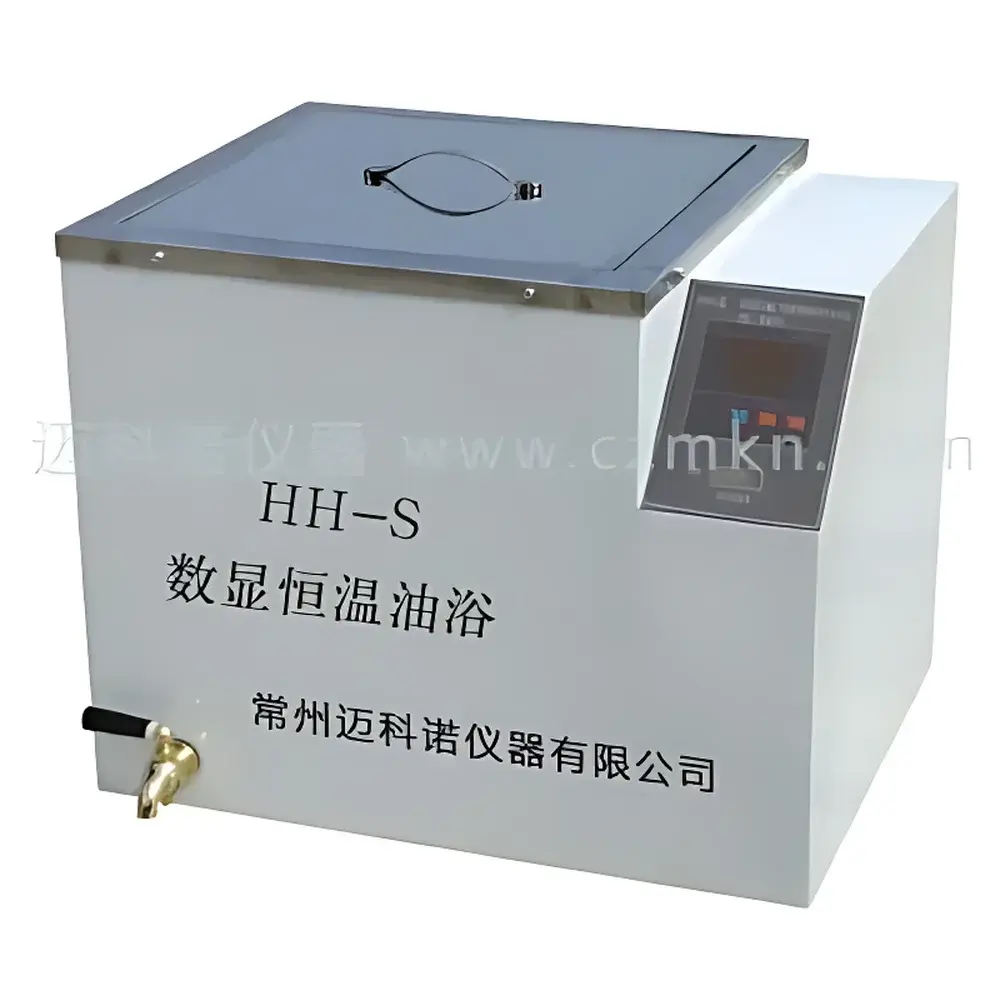
MKN HH-S Digital Constant-Temperature Oil Bath
| Brand | MKN |
|---|---|
| Model | HH-S |
| Power Supply | 220 V, 50 Hz |
| Heating Power | 2000 W |
| Temperature Range | Ambient to 300 °C |
| Temperature Stability | ≤ ±1 °C |
| Oil Temperature Fluctuation | ≤ 2 °C |
| Chamber Dimensions | 28 × 28 × 30 cm (L × W × H) |
| Construction | Imported Stainless Steel |
| Control System | Dual-integration High-Accuracy A/D Converter with Operational Amplifier Circuitry |
| Heating Method | Far-Infrared Heating |
| Display | LED Digital Readout |
| Application Class | General Laboratory Thermal Processing |
Overview
The MKN HH-S Digital Constant-Temperature Oil Bath is a precision-engineered thermal processing instrument designed for laboratory-scale heating, soaking, distillation, and concentration applications requiring stable elevated temperatures beyond the operational limits of water baths. Unlike aqueous systems constrained by boiling point, this oil bath utilizes thermally stable silicone or mineral oils to achieve uniform heat distribution across a continuous range from ambient temperature up to 300 °C. Its core architecture integrates a robust stainless steel oil reservoir, a far-infrared heating module, and a closed-loop analog-digital hybrid temperature control system based on high-stability operational amplifiers and dual-integration A/D conversion. This design ensures rapid thermal equilibration—typically under 15 minutes from ambient to 250 °C—and maintains spatial temperature uniformity within ±1 °C across the working chamber, as verified per ASTM E1112-22 (Standard Practice for Calibration of Liquid-Bath Temperature Controllers). The unit operates without forced convection, relying instead on natural oil convection and optimized tank geometry to minimize thermal gradients.
Key Features
- Stainless steel oil bath chamber fabricated from imported 304-grade stainless steel, offering long-term resistance to oxidation, thermal cycling fatigue, and chemical exposure from common organic solvents and reagents.
- Far-infrared heating elements embedded beneath the bath floor provide contactless, uniform energy transfer—reducing localized hot spots and extending oil service life compared to resistive coil designs.
- Digital LED display with real-time temperature readout (0.1 °C resolution) and intuitive push-button interface for setpoint adjustment, enabling precise manual operation without software dependency.
- Thermal safety architecture includes dual independent overtemperature cutoffs: a mechanical bimetallic limiter (set at 320 °C) and an electronic fail-safe circuit that interrupts power if sensor feedback deviates >5 °C from setpoint for >30 seconds.
- Compact footprint (28 × 28 × 30 cm) optimized for benchtop integration in QC labs, synthetic chemistry workstations, and stability testing environments where space and thermal isolation are critical.
Sample Compatibility & Compliance
The HH-S accommodates standard laboratory glassware—including round-bottom flasks (up to 2 L), condenser assemblies, Soxhlet extractors, and immersion probes—without modification. Its open-bath configuration supports both direct immersion and jacketed vessel setups. The unit complies with IEC 61010-1:2010 for electrical safety in laboratory equipment and meets EN 60529 IP20 ingress protection requirements. While not certified for Class I Division 1 hazardous locations, it is routinely deployed in GLP-compliant environments for non-volatile solvent evaporation, polymer melt conditioning, and pharmaceutical excipient drying—provided local ventilation and oil flash-point protocols (e.g., use of Dow Corning PMX-200 silicone oil, flash point >300 °C) are observed. No USP or ISO/IEC 17025 calibration certificate is supplied ex-factory; users must perform initial verification per internal SOPs using NIST-traceable PT100 probes.
Software & Data Management
The HH-S operates as a standalone analog-digital hybrid controller with no embedded firmware, network interface, or data logging capability. All temperature regulation and display functions are implemented in hardware, eliminating cybersecurity vulnerabilities and ensuring deterministic response times (<500 ms setpoint recovery after 5 °C load disturbance). For regulated environments requiring audit trails, external recording is achieved via 0–5 V analog output (configurable as temperature-proportional signal), compatible with third-party chart recorders, PLCs, or SCADA systems compliant with FDA 21 CFR Part 11 when paired with validated acquisition software. No proprietary drivers or cloud connectivity are involved—supporting air-gapped lab networks and legacy infrastructure.
Applications
- Controlled-rate drying of hygroscopic compounds (e.g., lithium salts, metal-organic frameworks) under inert atmosphere gloveboxes using sealed oil bath adapters.
- Pre-heating and thermal conditioning of viscometry sample cups prior to Brookfield or Anton Paar rotational measurements, minimizing thermal lag artifacts.
- Soxhlet extraction of lipids from biological matrices at 80–120 °C using low-volatility solvents such as petroleum ether or chloroform.
- Accelerated stability testing of topical ointments and transdermal patches per ICH Q1A(R3), maintaining constant temperature profiles during 30- to 90-day studies.
- Calibration reference source for secondary temperature sensors (e.g., thermocouples, RTDs) across the 50–280 °C range, traceable to national metrology institutes via user-supplied reference standards.
FAQ
What types of heat transfer fluids are compatible with the HH-S?
Silicone oils (e.g., DC-200 series), polyalphaolefins (PAOs), and high-flash-point mineral oils (flash point ≥300 °C) are recommended. Avoid glycols, water-based fluids, or low-boiling hydrocarbons due to vapor pressure and degradation risks.
Can the HH-S be used under nitrogen purge?
Yes—its open-top design allows integration with inert gas manifolds. Ensure gas flow rate is laminar and does not induce surface turbulence that compromises temperature uniformity.
Is the temperature sensor replaceable by the end user?
The integrated Pt100 sensor is factory-calibrated and sealed within the bath wall; replacement requires return to authorized service centers to maintain measurement integrity.
Does the unit support ramp-and-soak programming?
No—this is a single-setpoint analog controller. Multi-step thermal profiles require external programmable timers or PLC coordination via the analog output signal.
What maintenance intervals are recommended for extended operation above 200 °C?
Oil level and clarity should be inspected weekly; full oil replacement is advised every 6 months under continuous use at >250 °C to prevent carbonization and sensor drift.
Related Products



