
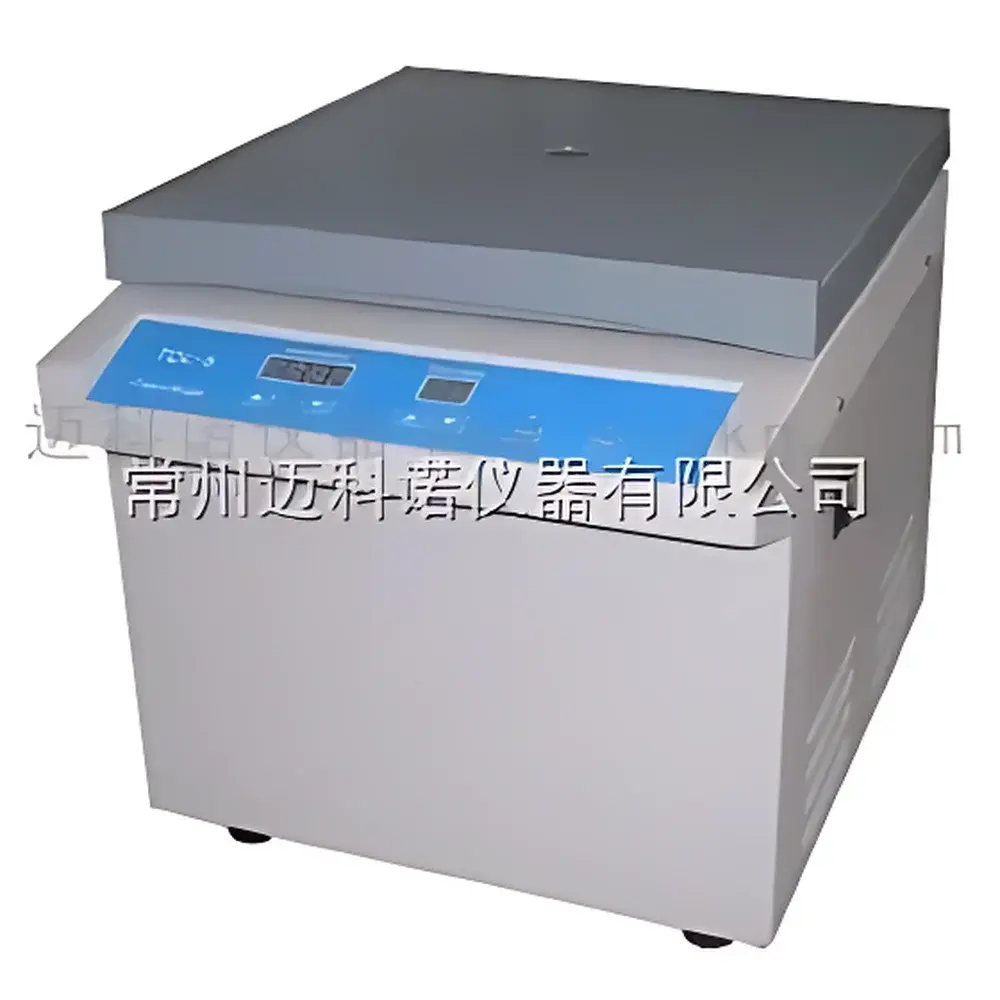
TDL-5 Desktop Low-Speed High-Capacity Centrifuge
| Origin | Zhejiang, China |
|---|---|
| Manufacturer Type | Authorized Distributor |
| Origin Category | Domestic (PRC) |
| Centrifuge Class | Low-Speed |
| Max Speed | 0–4000 rpm |
| Max RCF | 2770 × g |
| Capacity | 100 mL × 4 / 50 mL × 8 / 15 mL × 16 |
| Timer Range | 0–30 min |
| Power | 250 W |
| Noise Level | ≤60 dB(A) |
| Input | AC 220 V, 50 Hz, 3 A |
| Rotor Material | Stainless Steel |
| Control Interface | Touch Panel with Digital Display (RPM, Time, RCF) |
| Safety Features | Electronic Lid Lock, Dual Thermal Fuses, Imbalance Detection & Auto Shutdown |
| Rotor Type | Horizontal Swing-Out |
Overview
The TDL-5 Desktop Low-Speed High-Capacity Centrifuge is an engineered solution for routine sedimentation and phase separation tasks in life science and clinical laboratories. Designed around horizontal swing-out rotor architecture, it operates on the principle of sedimentation centrifugation—utilizing gravitational force augmentation (RCF) to separate particles based on density, size, and shape within heterogeneous liquid suspensions. Its operational range (0–4000 rpm, up to 2770 × g) positions it optimally for low-shear applications including whole blood fractionation, cell pellet recovery, serum/plasma preparation, and coarse particulate clarification—where preservation of structural integrity and biological activity is critical. Unlike high-speed or ultracentrifuge systems, the TDL-5 prioritizes volumetric throughput and operational robustness over extreme g-forces, making it a foundational instrument in QC labs, hospital core facilities, and academic teaching environments.
Key Features
- Horizontal swing-out rotor design with mechanical balance protection—automatically halts operation upon detection of mass asymmetry exceeding ±5% between opposing buckets.
- Digital touch interface with real-time display of rotational speed (rpm), elapsed time, and calculated relative centrifugal force (×g), enabling precise method replication and audit-ready parameter logging.
- Integrated electronic lid interlock system compliant with IEC 61010-1 safety standards; rotor chamber remains physically locked until rotational speed decays below 50 rpm.
- Dual redundant thermal fusing circuitry protects motor windings and control electronics under sustained load or ambient temperature excursions.
- Stainless steel rotor construction (AISI 304) ensures corrosion resistance against common aqueous buffers, saline solutions, and mild organic solvents encountered in biomedical workflows.
- Acoustically damped housing—engineered with vibration-absorbing polymer mounts and balanced drive assembly—to maintain noise output at ≤60 dB(A) during continuous operation.
Sample Compatibility & Compliance
The TDL-5 accommodates standard laboratory centrifuge tubes across three configurations: four 100 mL conical tubes, eight 50 mL round-bottom tubes, or sixteen 15 mL capped tubes—supporting both sealed and vented formats. It is validated for use with anticoagulated whole blood (EDTA, heparin, citrate), cell culture supernatants, crude tissue homogenates, food emulsions, and environmental water samples. The instrument meets electromagnetic compatibility requirements per EN 61326-1 and electrical safety standards per EN 61010-1. While not certified for ISO 13485 or FDA 21 CFR Part 11 out-of-the-box, its digital parameter recording capability supports GLP-compliant documentation when integrated into lab-wide electronic lab notebook (ELN) systems with user-access controls and audit trail functionality.
Software & Data Management
The TDL-5 operates as a standalone instrument with embedded microcontroller firmware—no external PC connection or proprietary software required. All run parameters (speed setpoint, timer duration, acceleration/deceleration profiles) are stored in non-volatile memory and recalled via preset buttons. For traceability, each cycle logs timestamp, final speed, actual runtime, and fault codes (e.g., “E01: Lid Open,” “E03: Imbalance”) to internal memory (retains last 99 cycles). Optional RS-232 serial output enables integration with centralized lab equipment monitoring platforms for preventive maintenance scheduling and usage analytics.
Applications
- Blood banking: Separation of packed red blood cells, platelet-rich plasma (PRP), and platelet-poor plasma (PPP) from whole blood units.
- Pharmaceutical QA: Clarification of suspension-based drug formulations prior to filter sterilization or HPLC analysis.
- Food microbiology: Pelleting of bacterial cultures from milk, juice, or broth media for subsequent colony isolation or DNA extraction.
- Environmental testing: Concentration of suspended solids and microorganisms from wastewater or surface water samples per EPA Method 1603.
- Academic instruction: Demonstrating sedimentation kinetics, Stoke’s law validation, and centrifugal force–velocity relationships in undergraduate biophysics curricula.
FAQ
What rotor types are compatible with the TDL-5?
Only the factory-supplied horizontal swing-out rotor (part no. TDL-5-HR) is certified for use. Adapters for 15/50/100 mL tubes are included; custom rotors or third-party accessories void safety certification.
Is the TDL-5 suitable for centrifuging infectious samples?
Yes—when used with sealed, biocontainment-certified tubes (e.g., OSHA-compliant screw-cap polypropylene) and operated inside a certified biosafety cabinet (BSC) for open-lid procedures. The rotor chamber is not hermetically sealed.
Does the instrument support variable acceleration/deceleration rates?
No—the TDL-5 uses fixed ramp profiles: 30 s to reach set speed and 60 s to coast to stop. This minimizes shear-induced aggregation in sensitive biological suspensions.
Can runtime be extended beyond 30 minutes?
No—maximum timer duration is hardware-limited to 30 minutes. For longer protocols, manual restart or external programmable timers are required.
What maintenance is recommended for long-term reliability?
Biannual inspection of rotor threads, lid seal integrity, and fuse continuity; annual calibration of speed and timer accuracy using NIST-traceable tachometer and stopwatch per ISO/IEC 17025 guidelines.



