
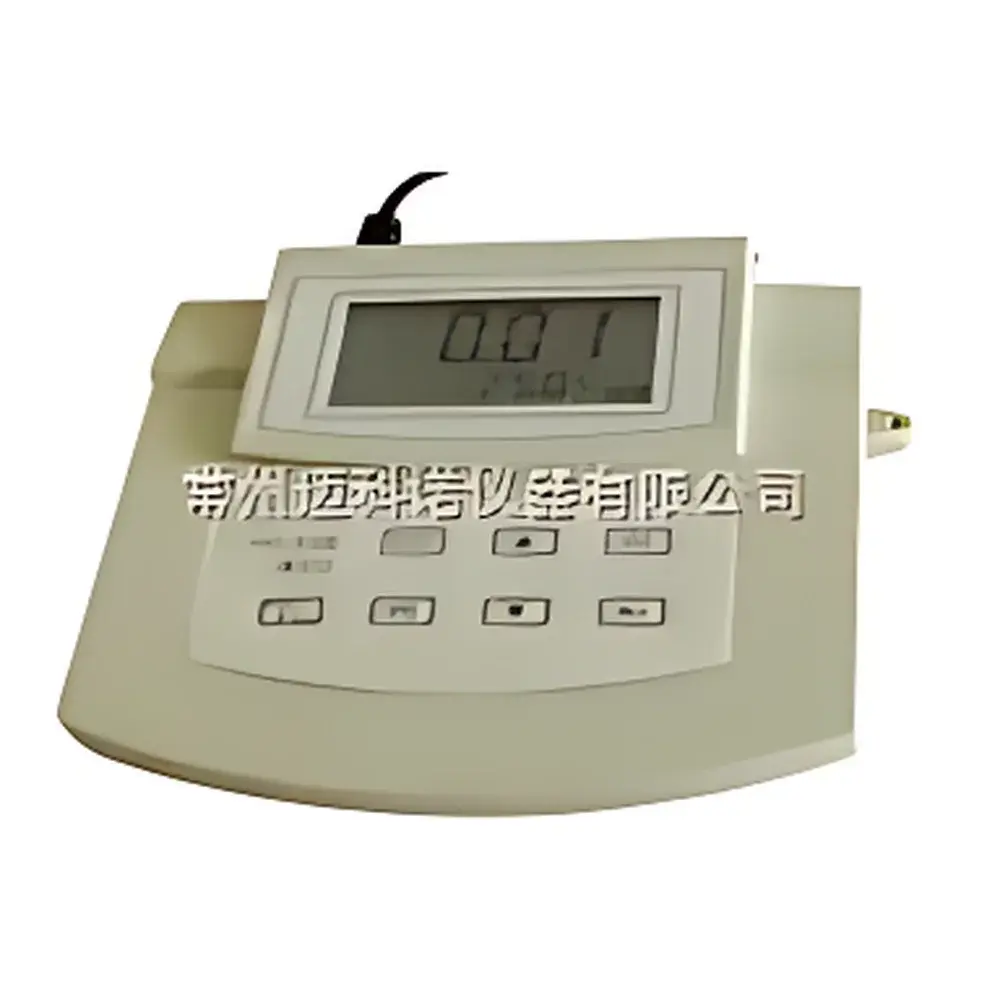
PXS-215 Ion Meter
| Origin | Zhejiang, China |
|---|---|
| Manufacturer Type | Distributor |
| Origin Category | Domestic (China) |
| Model | PXS-215 |
| Quotation | Upon Request |
| Sample Introduction Method | Manual Immersion Electrode |
| Sensitivity | Not Specified |
| Spectral Library | Not Applicable |
Overview
The PXS-215 Ion Meter is a benchtop electrochemical analyzer engineered for precise potentiometric measurement of ionic activity in aqueous solutions. It operates on the Nernst equation principle, utilizing ion-selective electrodes (ISEs) or combination electrodes to convert ionic concentration into a measurable millivolt signal, which is then converted and displayed as pX (negative logarithm of ion activity) or direct mV output. Designed for routine laboratory use in academic, environmental, industrial, and quality control settings, the instrument delivers stable, repeatable readings under standard ambient conditions. Its dual-line LCD display with blue backlight enables simultaneous visualization of pX/mV values and real-time temperature compensation—critical for accurate thermally corrected ion activity calculations per IUPAC guidelines.
Key Features
- High-resolution dual-parameter display: 0.01 pX and 1 mV resolution ensures fine-grained differentiation across low- and high-concentration regimes.
- Integrated temperature compensation: Automatic or manual adjustment over 0–60 °C range supports compliance with ASTM D1129 and ISO 7870-2 for standardized ion activity reporting.
- Robust electronic architecture: Basic error of ±0.01 pX ±1 digit (pX mode) and ±0.1% FS ±1 digit (mV mode) meets typical requirements for teaching labs and field-deployable QC applications.
- Stability performance: Drift ≤0.01 pX per 3 hours under continuous operation—validated per GLP-aligned instrument verification protocols.
- Compact ergonomic design: Dimensions of 200 × 210 × 70 mm (L × W × H) and mass of 1 kg facilitate integration into limited-space analytical workstations without compromising mechanical stability.
- Wide environmental operating envelope: Functional within 5–50 °C ambient temperature and ≤85% relative humidity, suitable for non-climate-controlled laboratories and mobile environmental testing units.
Sample Compatibility & Compliance
The PXS-215 is compatible with standard glass pH electrodes, calomel reference electrodes, and commercially available monovalent and divalent ion-selective electrodes (e.g., F⁻, Cl⁻, NO₃⁻, Ca²⁺, NH₄⁺), provided electrode impedance and output voltage fall within the instrument’s input specifications. It does not support gas-phase or non-aqueous sample introduction; all measurements require aqueous electrolyte solutions with conductivity >50 µS/cm to ensure stable junction potential. The device conforms to general safety standards for Class II laboratory electrical equipment (IEC 61010-1) and supports traceable calibration using certified reference solutions traceable to NIST SRMs. While not inherently 21 CFR Part 11 compliant due to lack of audit trail or user access controls, it may be operated within validated workflows where manual recordkeeping satisfies local GLP/GMP documentation requirements.
Software & Data Management
The PXS-215 operates as a standalone hardware unit with no embedded data logging, USB connectivity, or proprietary software interface. All measurements are viewed in real time on the front-panel LCD and must be manually recorded. For regulated environments requiring electronic records, external data capture can be achieved via optional analog output modules (not included) interfaced with SCADA systems or validated spreadsheet templates. Calibration history, electrode condition notes, and environmental parameters should be maintained in laboratory notebooks per ISO/IEC 17025 Clause 7.7 requirements.
Applications
- Academic instruction: Quantitative analysis labs for undergraduate chemistry and environmental science curricula focusing on equilibrium electrochemistry and ion activity concepts.
- Environmental monitoring: Field and lab-based determination of fluoride, nitrate, and chloride in surface water, groundwater, and wastewater effluents per EPA Method 300.0 and ISO 10304-1.
- Industrial process control: Routine checks of ion concentrations in boiler feedwater, plating baths, and semiconductor rinse solutions.
- Quality assurance in food and beverage production: Monitoring sodium, potassium, and calcium levels in processed liquids and extracts.
- Research support: Preliminary screening of ion exchange efficiency, membrane selectivity, and sensor response characterization prior to advanced instrumentation deployment.
FAQ
What types of ion-selective electrodes are compatible with the PXS-215?
Standard BNC-input ISEs and combination electrodes with output ranges between −1800 mV and +1800 mV are supported. Electrode compatibility depends on impedance matching and reference junction stability—not on proprietary connectors.
Does the PXS-215 support automatic calibration?
No—it requires manual two-point or single-point calibration using standard buffer or ionic strength adjustment solutions. No built-in calibration curve storage or slope calculation is provided.
Can the instrument measure pH?
Yes—when used with a standard pH electrode, it functions as a conventional pH meter with identical pX scale interpretation (pH = pH⁺). All technical specifications apply equivalently to hydrogen ion measurement.
Is temperature compensation mandatory for accurate results?
Yes—temperature directly affects Nernstian response slope and liquid junction potentials. Manual or automatic compensation must be applied to report thermodynamically consistent pX values per IUPAC recommendations.
What power source does the PXS-215 require?
AC 220 V ±10%, 50 Hz mains supply only. No battery operation or DC adapter option is available.
Related Products




