
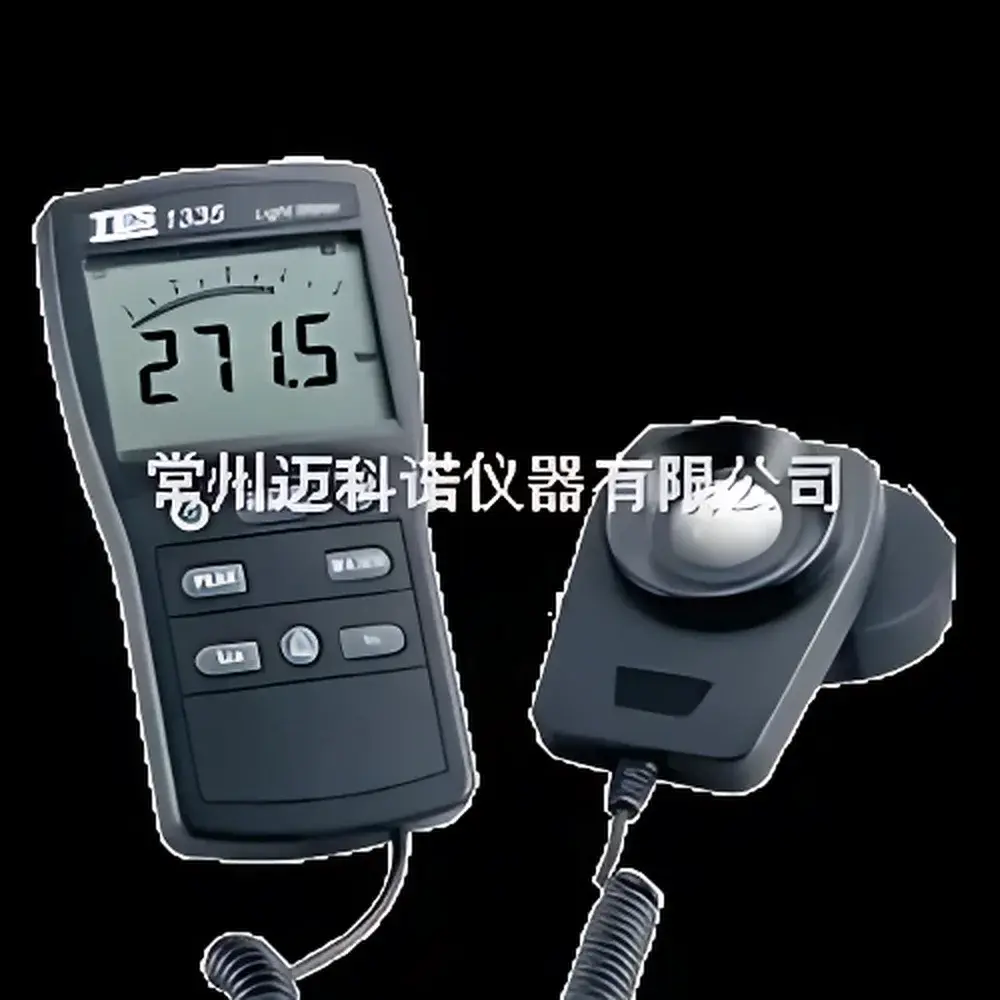
MKN TES-1335 Digital Illuminance Meter
| Brand | MKN |
|---|---|
| Model | TES-1335 |
| Sensor Type | Silicon Photodiode with Diffuser & Cosine-Corrected Filter |
| Measurement Range | 0–40,000 lux (0–40,000 fc) |
| Resolution | 0.01 lux / 0.01 fc |
| Accuracy | ±3% rdg ± 0.5% f.s. (±4% rdg ±10 digits above 10,000 lux, calibrated against 2856 K standard lamp) |
| Spectral Response Compliance | CIE Photopic Luminosity Function (f'₁ < 6%) |
| Cosine Error Compensation | Built-in optical diffuser with cosine angular correction |
| Display | 3¾-digit LCD + analog bar graph |
| Sampling Rate | 1.3 Hz (digital), 13.3 Hz (analog) |
| Auto Power-Off | 30 minutes |
| Operating Temp. | 0–40 °C, ≤80% RH |
| Storage Temp. | −10–50 °C, ≤70% RH |
| Power | 6 × AAA (1.5 V), ~400 h continuous use (Zn-Carbon) |
| Detector Cable Length | 150 cm |
| Detector Dimensions | 92 × 60 × 29 mm |
| Meter Dimensions | 150 × 72 × 35 mm |
| Weight | 320 g |
| Standards Compliance | CNS 5119 Class AA, ISO/CIE photometric traceability |
Overview
The MKN TES-1335 Digital Illuminance Meter is a precision-grade handheld photometric instrument engineered for reliable, repeatable measurement of illuminance in accordance with the CIE (Commission Internationale de l’Éclairage) photopic luminosity function. It employs a silicon photodiode sensor coupled with a high-transmission optical diffuser and rigorously characterized cosine-corrected filter to minimize angular response error—critical for accurate measurements under non-perpendicular illumination conditions. Designed for laboratory validation, facility lighting audits, workplace ergonomics assessments, and architectural daylighting studies, the TES-1335 delivers metrologically sound data traceable to national photometric standards. Its spectral accuracy (f’₁ < 6%) ensures conformity with CNS 5119 Class AA requirements—a benchmark for general-purpose illuminance meters used in industrial hygiene, quality assurance, and regulatory compliance workflows.
Key Features
- True CIE-compliant spectral response validated against 2856 K tungsten standard lamps per ISO/CIE calibration protocols
- Integrated cosine angular correction via molded optical diffuser—reducing measurement deviation at incidence angles up to ±75°
- High-resolution 3¾-digit LCD display with real-time analog bar graph for dynamic light-level visualization
- Multi-range auto-scaling across six lux and six foot-candle sub-ranges (0.01–40,000 lux / fc), eliminating manual range selection errors
- Simultaneous peak hold, min/max capture, and relative-difference mode for comparative analysis across spatial or temporal gradients
- Programmable data hold and automatic power-off (30 min) to preserve battery life without compromising measurement continuity
- Robust mechanical architecture: IP54-rated enclosure (dust-protected, splash-resistant), ergonomic grip, and shock-absorbing rubberized housing
Sample Compatibility & Compliance
The TES-1335 is optimized for measuring steady-state and slowly varying broadband visible light sources—including LED arrays, fluorescent tubes, incandescent fixtures, and natural daylight—within the 380–780 nm photopic sensitivity band. It is not intended for pulsed, UV, or IR radiation. The instrument meets CNS 5119 Class AA performance criteria for illuminance meters, aligning with international best practices outlined in ISO 8995-1 (lighting of work places) and IESNA RP-1 (recommended practice for office lighting). While not FDA 21 CFR Part 11–certified (as it lacks audit-trail software functionality), its hardware-level calibration stability supports GLP/GMP-aligned documentation when paired with external logbooks or validated spreadsheet templates.
Software & Data Management
The TES-1335 operates as a standalone field instrument with no embedded firmware update capability or PC connectivity. All data acquisition, storage, and retrieval occur manually via on-device functions: peak hold, min/max logging, and relative-value referencing. For traceable recordkeeping, users are advised to document readings alongside environmental context (e.g., date, location, light source type, distance from detector) in accordance with ISO/IEC 17025 clause 7.5.2 (recording of measurement results). Calibration certificates—issued by accredited third-party labs—include uncertainty budgets referenced to NIST-traceable photometric standards and are valid for 12 months under normal operating conditions.
Applications
- Workplace lighting verification per OSHA 1910.303 and EN 12464-1 standards for visual task areas
- LED luminaire performance evaluation during R&D and production QA cycles
- Daylight harvesting system commissioning and seasonal performance monitoring
- Educational physics labs demonstrating inverse-square law, Lambert’s cosine law, and spectral weighting principles
- Facility energy audits supporting LEED v4.1 EQ Credit: Interior Lighting and WELL Building Standard L02
- Museum and archival storage environment monitoring to prevent photochemical degradation of sensitive materials
FAQ
What calibration standard is used for factory certification?
Calibration is performed using a NIST-traceable 2856 K tungsten-halogen reference lamp under controlled thermal and geometric conditions, in compliance with CIE S 007/E and ISO/IEC 17025.
Can the TES-1335 measure pulsed or modulated light sources?
No. Due to its 1.3 Hz digital sampling rate and analog bandwidth limitation, it is unsuitable for PWM-driven LEDs, stroboscopic lighting, or flicker analysis; dedicated flicker meters (e.g., IEEE 1789-compliant devices) are required.
Is the cosine correction verified independently?
Yes. Angular response testing follows CIE Publication 171:2006 methodology, with measured f₂(θ) deviation < ±2.5% at ±60° incidence—well within Class AA specification limits.
Does the instrument support external data logging?
Not natively. However, the analog bar graph output can be interfaced with compatible oscilloscopes or DAQ systems for time-series profiling, provided signal isolation and impedance matching are implemented.
How often should recalibration be scheduled?
Annually under routine use; more frequently if subjected to mechanical shock, extreme temperature cycling, or exposure to condensation or corrosive atmospheres.




