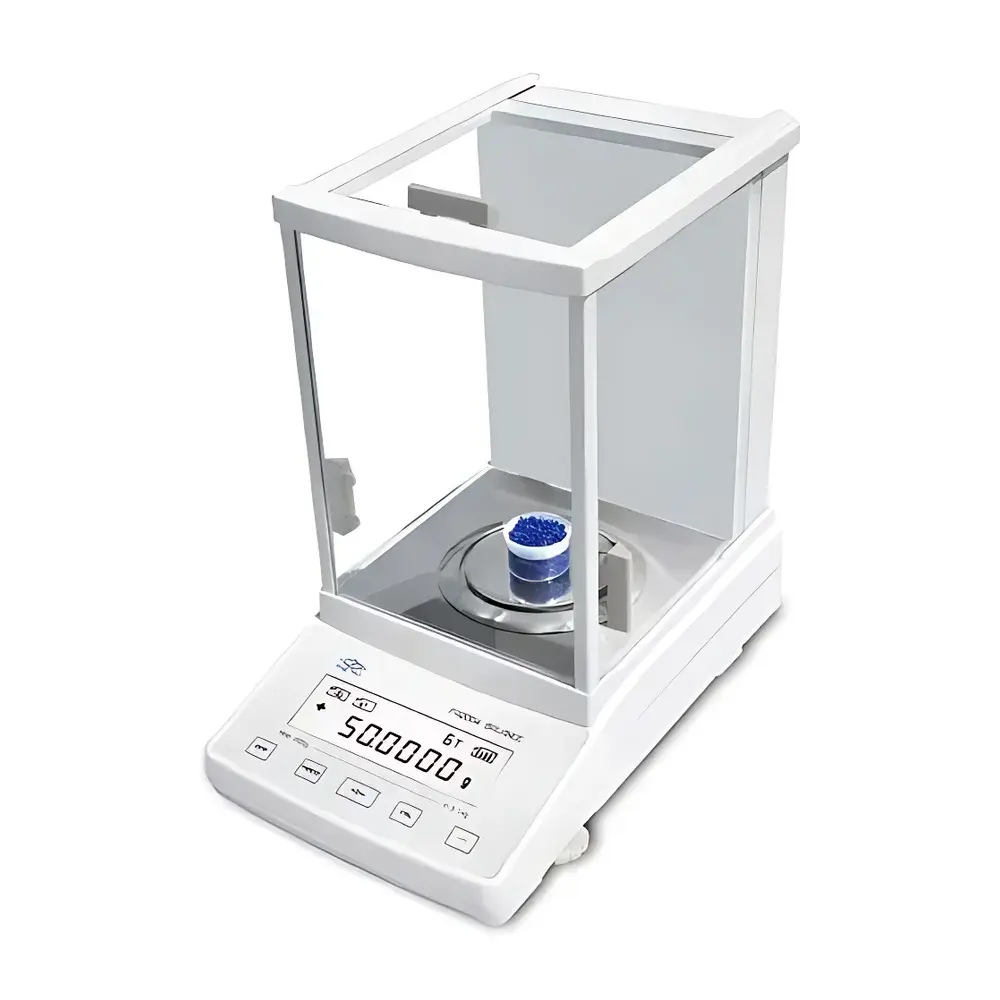
FA Series Analytical Electronic Balance
| Origin | Jiangsu, China |
|---|---|
| Manufacturer Type | Authorized Distributor |
| Origin Category | Domestic (China) |
| Model | FA1004 / FA2004 |
| Capacity & Readability | 100 g / 0.0001 g |
| Sensor Technology | Electromagnetic Force Compensation |
| Pan Diameter | Φ80 mm |
| Minimum Weight | 0.0008 g |
| Linearity Error | ±0.0003 g |
| Stabilization Time | ≤8 s |
| Sensitivity Drift | ±0.0005 g |
| Units | g, oz, ct |
| Operating Temperature | 17.0–25.5 °C |
| Display Refresh Rate | 0.1–0.4 s (adjustable) |
| Tare Range | 0–100 g / 0–200 g |
| External Calibration Mass | 100 g / 200 g |
| Counting Function | Yes |
| Display | Backlit LCD |
| Draft Shield Dimensions | 240 × 190 × 265 mm |
| Overall Dimensions | 340 × 215 × 360 mm |
| Power Supply | AC 220 V ±12 V, 50 Hz, 600 mA |
| Housing Material | Precision Cast Aluminum with Triple-Door Glass Draft Shield |
| Optional Interface | RS232 Serial Port |
| Net Weight | 7.8 kg |
| Gross Weight | 11 kg |
| Packaging | Double-Carton, Inner Box: 415 × 285 × 430 mm, Outer Box: 475 × 315 × 485 mm |
Overview
The FA Series Analytical Electronic Balance is a precision mass measurement instrument engineered for high-reproducibility weighing in regulated laboratory environments—including QC/QA labs, pharmaceutical R&D, academic research, and materials testing facilities. It operates on the principle of electromagnetic force compensation (EMFC), a metrologically traceable method in which the gravitational force acting on a sample is counterbalanced by an electromagnetic force generated within a high-stability coil-magnet system. The resulting current required to maintain equilibrium is linearly proportional to mass and digitally converted with 24-bit ADC resolution. This architecture eliminates mechanical wear, ensures long-term stability, and delivers consistent repeatability at the 0.1 mg readability level—critical for applications requiring compliance with USP , ISO/IEC 17025, and ASTM E898 standards.
Key Features
- Electromagnetic force compensation sensor technology ensures zero hysteresis, minimal drift, and immunity to mechanical fatigue—enabling stable calibration intervals and reduced maintenance overhead.
- Dual-capacity models (FA1004: 100 g / 0.1 mg; FA2004: 200 g / 0.1 mg) share identical metrological performance, allowing lab-wide protocol harmonization across varying sample mass requirements.
- Triple-door glass draft shield (240 × 190 × 265 mm) provides full visual access while maintaining laminar airflow control—optimized for static and dynamic weighing under ISO 9001-compliant environmental conditions (17.0–25.5 °C, ≤60% RH).
- Backlit LCD display with user-selectable refresh rates (0.1–0.4 s) supports real-time monitoring of settling behavior—essential for volatile or hygroscopic samples where rapid stabilization is critical.
- Integrated counting function with automatic average piece weight calculation meets ISO 7870-2 requirements for discrete-part inventory control and tablet/capsule batch verification.
- Cast aluminum housing with reinforced structural geometry minimizes vibration transmission and thermal expansion effects—enhancing robustness in shared lab spaces with adjacent centrifuges or HVAC systems.
Sample Compatibility & Compliance
The FA Series accommodates a broad range of sample types—from powders and granules to small metallic components and pre-weighed reference standards—within its Φ80 mm stainless steel pan. Its minimum weighable amount (MWA) of 0.0008 g satisfies the 2× readability rule per USP and EU GMP Annex 18, ensuring statistical confidence in low-mass measurements. The balance supports external calibration using Class M1 or better weights traceable to NIST or BIPM standards. All firmware operations—including calibration logs, tare events, and unit conversions—are timestamped and non-erasable, facilitating audit readiness for FDA 21 CFR Part 11 and GLP/GMP documentation requirements.
Software & Data Management
Equipped with standard RS232 serial interface, the FA Series enables bidirectional communication with LIMS, ELN, or custom data acquisition software. Output formats include ASCII-compatible weighing data streams with configurable prefixes (e.g., “WGT:”, “TAR:”) and delimiter options (CR/LF, TAB). Internal memory stores up to 100 calibration records and 200 weighing sessions with full metadata (date/time, operator ID if integrated with network authentication, ambient temperature snapshot). No proprietary drivers are required—compatible with Windows, macOS, and Linux via standard terminal emulation or Python-based pySerial integration.
Applications
- Pharmaceutical formulation: Active pharmaceutical ingredient (API) dispensing, excipient ratio verification, and dissolution test sample preparation per USP .
- Chemical synthesis: Stoichiometric reagent weighing, catalyst loading, and yield calculation in reaction optimization workflows.
- Materials science: Density determination via pycnometry, thin-film mass deposition quantification, and nanoparticle dispersion concentration validation.
- Food & beverage QA: Nutrient labeling compliance checks, moisture content gravimetric analysis (AOAC 950.46), and allergen cross-contamination threshold verification.
- Environmental testing: Filter mass gain analysis in PM2.5/PM10 air sampling protocols (EPA Method IO-3.2) and soil organic carbon quantification (ISO 10694).
FAQ
What calibration standards are recommended for routine verification?
Class M1 stainless steel weights certified to ISO 9001 and traceable to national metrology institutes (e.g., NIST SRM 31a) are recommended for daily performance checks. Annual recalibration should be performed by an ISO/IEC 17025-accredited service provider.
Is internal calibration available?
No—the FA Series relies exclusively on external calibration to ensure transparency, auditability, and alignment with ISO/IEC 17025 Clause 6.5.2 requirements for independent verification of measurement uncertainty.
Can the balance operate continuously under controlled room conditions?
Yes—when installed on a vibration-isolated bench within the specified temperature (17.0–25.5 °C) and humidity (≤60% RH) range, the FA Series maintains specification compliance over extended operational cycles without warm-up drift exceeding ±0.0005 g.
How is data integrity ensured during RS232 transmission?
Each transmitted weighing event includes CRC-16 checksum validation, and the device buffers unsent data during temporary host disconnection—resuming transmission upon reconnection without data loss.
Does the balance support multi-language UI or regulatory language packs?
The firmware interface is fixed in English only, consistent with IEC 61000-4-30 and FDA guidance for unambiguous human-machine interaction in regulated environments.