
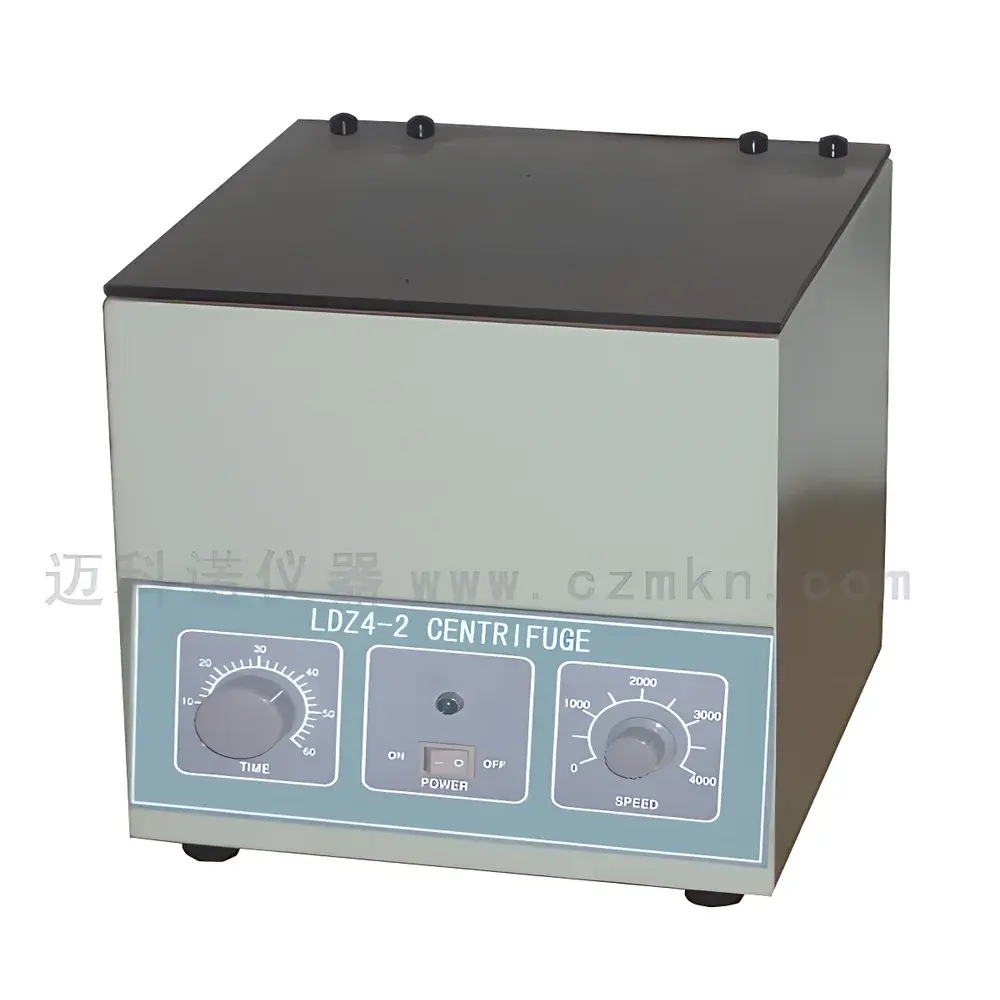
MKN LDZ4-2 Automatic Balancing Centrifuge
| Brand | MKN |
|---|---|
| Model | LDZ4-2 |
| Maximum Speed | 4000 rpm (infinitely variable) |
| Relative Centrifugal Force (RCF) | 2325 × g |
| Capacity | 8 × 20 mL or 8 × 15 mL |
| Timer Range | 0–60 min |
| Noise Level | ≤60 dB(A) |
| Power Supply | AC 220 V, 50 Hz, 2 A |
Overview
The MKN LDZ4-2 Automatic Balancing Centrifuge is a benchtop centrifugal separation instrument engineered for precision, reliability, and operational safety in routine laboratory workflows. It operates on the principle of centrifugal force generation through high-speed rotor rotation, enabling density-based separation of heterogeneous liquid mixtures—including serum, plasma, immune complexes, and biochemical suspensions. Unlike manually balanced centrifuges, the LDZ4-2 integrates an automatic dynamic balancing system that continuously compensates for minor sample mass asymmetries during acceleration and deceleration phases. This eliminates the need for manual tube pairing or counterbalancing, significantly reducing operator error and improving reproducibility across sequential runs. Its compact footprint and low thermal signature—achieved via optimized motor cooling and aluminum alloy rotor construction—support continuous operation in temperature-sensitive environments such as clinical diagnostics labs and teaching facilities.
Key Features
- Infinitely variable speed control (0–4000 rpm) with digital display for precise rotational parameter setting
- Integrated automatic balancing mechanism that detects and corrects imbalances in real time without interrupting operation
- Aluminum alloy rotor assembly designed for mechanical robustness, corrosion resistance, and minimal thermal expansion under repeated thermal cycling
- Programmable timer (0–60 minutes) with audible end-of-run alert and automatic rotor deceleration
- Low-noise operation (≤60 dB[A]) compliant with ISO 15714:2017 acoustic emission standards for laboratory equipment
- Over-speed protection, lid interlock safety switch, and automatic rotor recognition to prevent misuse
Sample Compatibility & Compliance
The LDZ4-2 accommodates standard conical-bottom centrifuge tubes (15 mL and 20 mL), supporting common clinical and research protocols including serum separation (e.g., CLSI GP44-A4), plasma preparation for ELISA or immunoassay workflows, and cell pellet recovery in basic molecular biology applications. The rotor geometry ensures uniform radial distribution of g-force across all positions, minimizing inter-tube variability. While not certified for biosafety level 3 (BSL-3) containment or aerosol-tight operation, the unit complies with IEC 61010-1:2010 (Safety Requirements for Electrical Equipment for Measurement, Control, and Laboratory Use) and meets CE marking requirements for electromagnetic compatibility (EMC) per EN 61326-1:2013. It is suitable for GLP-aligned environments where documented procedural consistency—not full 21 CFR Part 11 compliance—is required.
Software & Data Management
The LDZ4-2 operates as a standalone instrument with no embedded software or data logging capability. All operational parameters are set via front-panel controls and retained only for the duration of the active run. For laboratories requiring audit trails or electronic record retention, integration with external lab information management systems (LIMS) is achievable via optional RS-232 or USB-to-serial adapters (sold separately). Manual protocol documentation—including speed, time, RCF, and tube configuration—must be maintained per institutional SOPs to satisfy ISO/IEC 17025:2017 clause 7.5.2 (Control of Records).
Applications
- Clinical diagnostics: Serum/plasma separation from whole blood samples prior to immunoassay, clinical chemistry, or coagulation testing
- Biochemistry education: Demonstration of sedimentation principles, protein precipitation, and cell fractionation fundamentals
- Quality control labs: Routine particulate removal from reagent solutions and buffer clarification prior to filtration
- Pharmaceutical R&D support: Preliminary phase separation in formulation stability studies (non-GMP use)
- Veterinary and agricultural testing labs: Milk fat separation, plant extract clarification, and pathogen pellet concentration
FAQ
Does the LDZ4-2 support refrigerated operation?
No. This model is a non-refrigerated centrifuge and is intended for ambient-temperature applications only. For temperature-sensitive samples, users should pre-chill specimens and minimize run duration.
Is rotor calibration required before first use?
No factory calibration is needed—the rotor is dynamically balanced at the point of manufacture and verified per ISO 1941:2018 (Centrifuge Rotors – Balance Tolerance). However, users must ensure symmetrical tube loading per the capacity specification (e.g., always load 8 tubes, never 7).
Can this centrifuge be used for viral or bacterial pelleting?
It is not recommended for high-biosafety applications. The maximum RCF (2325 × g) is insufficient for complete pelleting of most viruses or small bacteria; ultracentrifugation (>100,000 × g) is required for such applications.
What maintenance intervals are recommended?
Inspect rotor threads and bucket latches monthly; clean rotor chamber with 70% ethanol after each use; perform full visual inspection of drive shaft and bearing integrity every 6 months or after 500 operating hours—whichever occurs first.



