
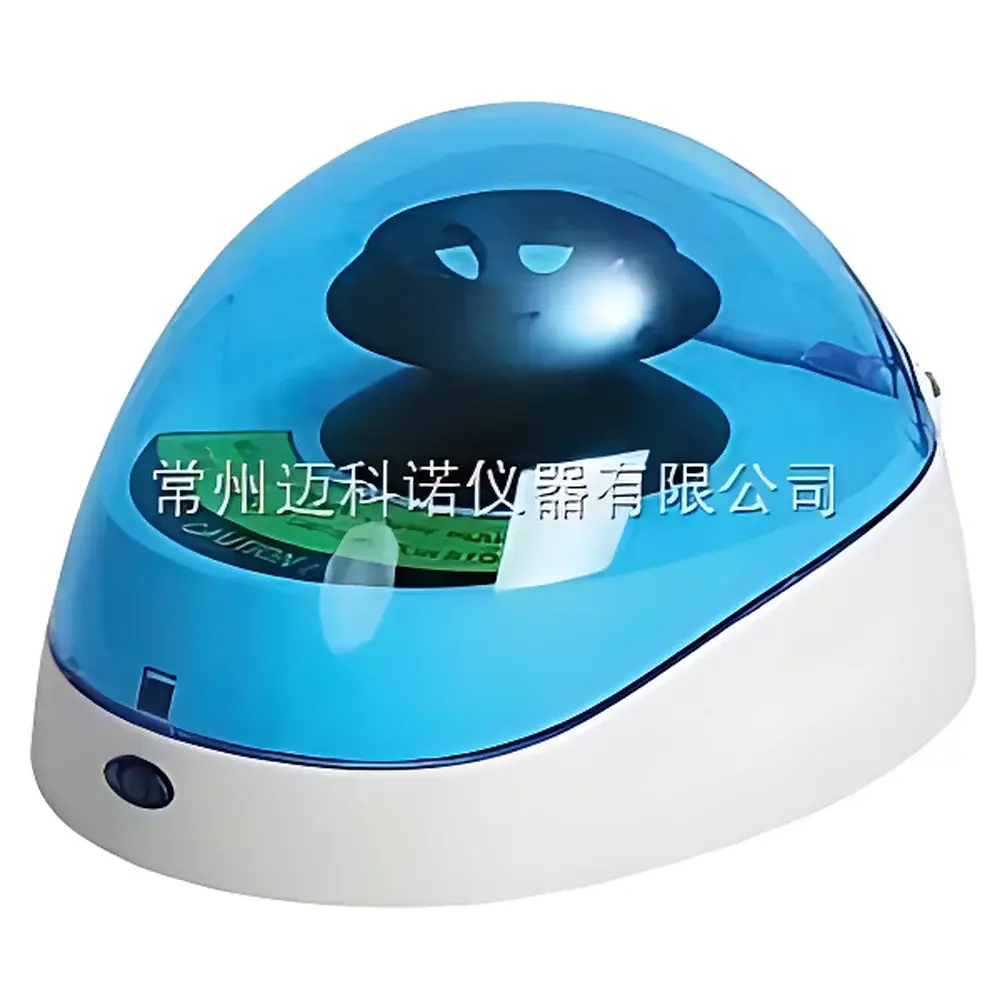
MKN Mini-7K Compact Benchtop Centrifuge
| Brand | MKN |
|---|---|
| Model | Mini-7K |
| Max Speed | 7200 rpm |
| RCF | 2350 × g |
| Capacity | 6 × 1.5/2.0 mL tubes + dual 8-position 0.2 mL strip rotors |
| Noise Level | <52 dB(A) |
| Motor | Brushless DC motor with carbon-fiber rotor assembly |
| Dimensions | Compact benchtop footprint (typical: 145 × 155 × 120 mm) |
| Compliance | CE, RoHS, ISO 13485–aligned manufacturing |
Overview
The MKN Mini-7K Compact Benchtop Centrifuge is an engineered solution for rapid, low-volume sample sedimentation in resource-constrained or space-limited laboratory environments—including molecular biology workstations, point-of-care testing stations, field-deployable diagnostic units, and teaching laboratories. It operates on the principle of centrifugal force generation via high-efficiency brushless DC motor rotation, delivering precise and repeatable relative centrifugal force (RCF) up to 2350 × g. Unlike floor-standing or refrigerated centrifuges, the Mini-7K is optimized for microscale applications requiring fast spin-down of PCR tubes, capillary blood collection devices, microcentrifuge tubes, and thin-film sample carriers—without compromising mechanical stability or thermal management. Its compact architecture integrates passive heat dissipation and vibration-damping structural design to ensure consistent rotor dynamics across extended duty cycles.
Key Features
- Brushless DC motor with integrated carbon-fiber rotor assembly—ensures extended service life, minimal maintenance, and resistance to corrosion from common reagents (e.g., ethanol, chloroform, diluted acids)
- Dual-configuration rotor compatibility: standard 6-position 1.5/2.0 mL tube carrier and interchangeable dual 8-position 0.2 mL strip rotors for high-throughput qPCR preparation
- Patented acoustic dampening housing reduces operational noise to <52 dB(A) at 1 m distance—enabling use in open-plan labs, cleanrooms, and shared instrumentation spaces without acoustic interference
- Intuitive push-button interface with LED status indicators for speed, time, and rotor identification—no software installation or external controller required
- Automatic rotor recognition logic prevents overspeed operation; built-in imbalance detection halts rotation if mass asymmetry exceeds ±0.5 g per position
- UL/CE-certified power supply with overvoltage and thermal cutoff protection—compliant with IEC 61010-1 safety standards for Class II laboratory equipment
Sample Compatibility & Compliance
The Mini-7K accommodates standard microcentrifuge formats including Eppendorf-style 1.5 mL and 2.0 mL conical tubes, 0.2 mL PCR strips (8-tube configuration), glass or polymer microscope slides (via optional slide adapter), and 0.2–0.5 mL microvolume adapters. All rotor inserts are autoclavable at 121°C for 20 minutes, supporting GLP-compliant workflows where traceability and sterility assurance are critical. The device meets RoHS Directive 2011/65/EU for hazardous substance restriction and conforms to electromagnetic compatibility requirements per EN 61326-1. While not a medical device per FDA 21 CFR Part 820, its manufacturing quality system aligns with ISO 13485 principles for production consistency and documentation control.
Software & Data Management
The Mini-7K operates as a standalone instrument with no embedded firmware logging or network connectivity. All operational parameters—including run time, set speed, and elapsed cycles—are retained in non-volatile memory for audit trail purposes. For laboratories implementing electronic lab notebooks (ELNs) or LIMS integration, optional USB data export modules (sold separately) support CSV-formatted runtime logs compliant with ALCOA+ data integrity principles. Audit trails include timestamped start/stop events, rotor ID, and error codes—fully traceable for internal QA reviews or regulatory inspections under ISO/IEC 17025 or CAP accreditation frameworks.
Applications
- Rapid pelleting of nucleic acids during column-based DNA/RNA extraction protocols
- Spin-down of enzymatic reaction mixtures prior to electrophoresis or spectrophotometric analysis
- Clarification of cell lysates in small-scale protein expression screening
- Centrifugation of capillary blood samples for hematocrit estimation in decentralized diagnostics
- Preparation of microvolume samples for MALDI-TOF target spotting or microfluidic chip loading
- Teaching laboratory demonstrations of sedimentation kinetics and RCF calculations
FAQ
What is the maximum recommended run time per cycle?
Continuous operation is rated for up to 30 minutes at full speed (7200 rpm); extended runs beyond this require ≥5-minute cooldown intervals to maintain motor longevity.
Can the Mini-7K be used with lithium battery-powered portable systems?
Yes—the unit accepts 100–240 V AC input but also supports 12 V DC operation via optional regulated adapter, enabling integration into mobile diagnostic carts or solar-powered field labs.
Is rotor calibration required before first use?
No factory calibration is needed; however, users must verify rotor balance using supplied test weights prior to initial deployment per ISO 20957-4 guidelines.
Does the device support programmable multi-step protocols?
No—this model implements fixed-speed, timer-based operation only. Programmable ramp/hold sequences require the MKN CentriPro series.
How often should the carbon-fiber rotor be inspected for microcracks?
Visual inspection is recommended every 500 operating hours or annually, whichever occurs first, using 10× magnification and oblique lighting per ASTM E1444-22 practice for surface discontinuity assessment.



