
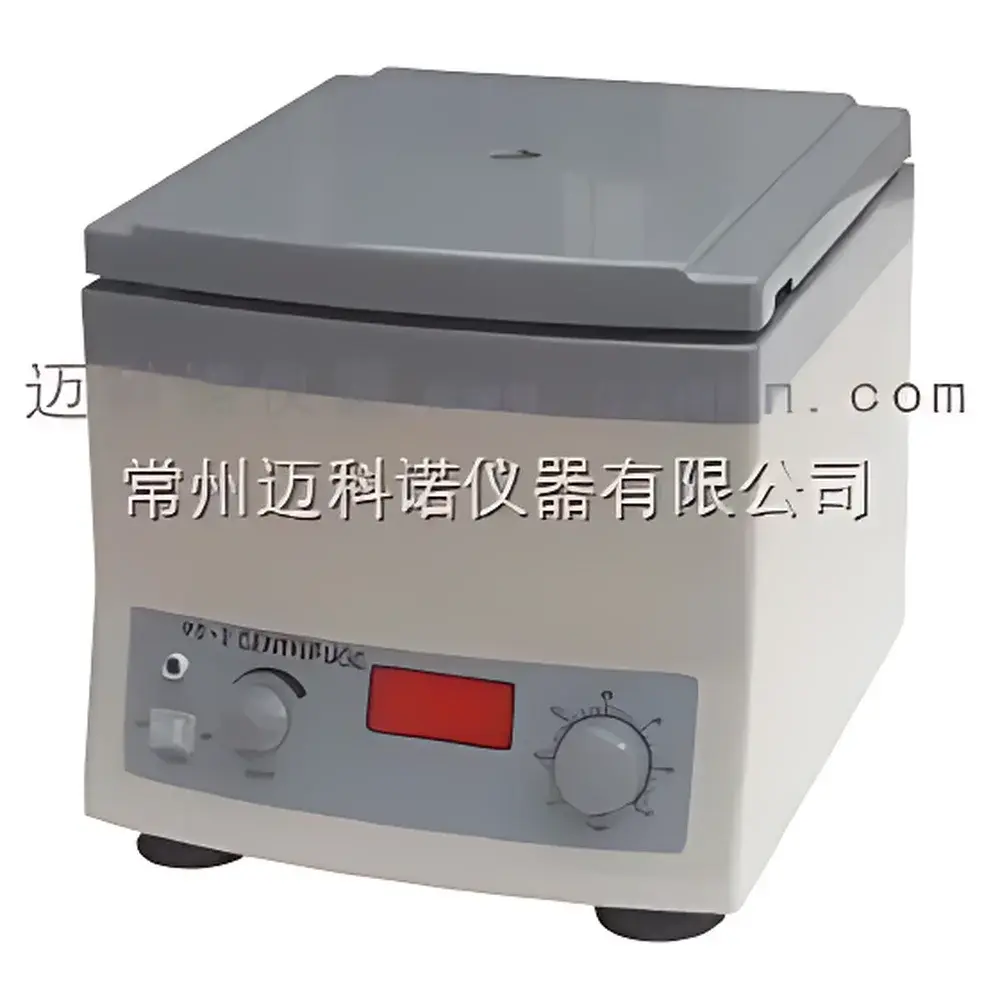
Jinhe 90-2 Digital Display Electric Centrifuge
| Origin | Zhejiang, China |
|---|---|
| Manufacturer Type | Distributor |
| Model | 90-2 |
| Max Speed | 0–4000 rpm (digital display) |
| Relative Centrifugal Force (RCF) | 2325 × g |
| Capacity | 12 × 20 mL (or 12 × 15 mL) |
| Timer Range | 0–60 min |
| Power | 135 W |
| Noise Level | ≤60 dB(A) |
| Supply Voltage | AC 220 V, 50 Hz, 2 A |
| Rotor Material | Anodized Aluminum |
| Drive Motor | Dedicated Brushless DC Centrifuge Motor |
| Safety Features | Mechanical lid interlock switch, dual fuses, imbalance protection circuit |
Overview
The Jinhe 90-2 Digital Display Electric Centrifuge is a compact, benchtop centrifugation system engineered for routine separation tasks in academic laboratories, clinical diagnostics, pharmaceutical quality control, and food safety testing environments. It operates on the principle of sedimentation under controlled centrifugal force—generating radial acceleration to separate components of heterogeneous liquid mixtures based on differences in density, particle size, and molecular weight. With a maximum rotational speed of 4000 rpm and an achievable RCF of 2325 × g, the unit delivers sufficient force for pelleting cells, precipitating macromolecules, clarifying suspensions, and isolating plasma from whole blood samples. Its brushless DC motor ensures consistent torque delivery across the full speed range, while the mechanical timer and digital RPM readout provide precise operational repeatability—critical for method standardization in GLP-compliant workflows.
Key Features
- Integrated digital RPM display with real-time speed monitoring—enabling accurate parameter verification during operation.
- Mechanical timer with 1–60 minute adjustable range, offering deterministic run duration without software dependency.
- Robust anodized aluminum rotor designed for long-term corrosion resistance and thermal stability during repeated heating/cooling cycles.
- Dual-layer safety architecture: electromechanical lid interlock prevents operation when the lid is open; redundant fuse protection safeguards against overcurrent events.
- Imbalance detection circuit automatically halts rotation if mass asymmetry exceeds tolerance—reducing risk of mechanical failure and sample loss.
- Low-noise design (<60 dB[A]) achieved through precision-balanced rotor assembly and vibration-damping housing—suitable for shared lab spaces and quiet-zone facilities.
- Compact footprint (ideal for limited bench space) and lightweight construction (≤12 kg) facilitate repositioning and integration into modular laboratory layouts.
Sample Compatibility & Compliance
The 90-2 accommodates standard conical-bottom tubes up to 20 mL capacity (12-position configuration), supporting common formats including polypropylene and polycarbonate centrifuge tubes used in hematology, microbiology, and environmental analysis. It complies with IEC 61010-1:2010 for electrical safety in laboratory equipment and meets EN 61326-1:2013 requirements for electromagnetic compatibility (EMC). While not certified for biosafety level (BSL) containment or refrigerated operation, its design aligns with general-purpose centrifuge usage guidelines referenced in ISO 15190:2020 (Clinical laboratory safety) and CLSI EP25-A2 (Evaluation of centrifuge performance). Routine calibration and preventive maintenance—per manufacturer-recommended intervals—are advised to sustain traceable performance in regulated settings.
Software & Data Management
This model operates as a standalone instrument with no embedded microprocessor-based data logging or network connectivity. All operational parameters—including set speed, elapsed time, and real-time RPM—are visible via front-panel LED indicators only. No proprietary software, USB interface, or audit trail functionality is included. As such, it fulfills basic documentation needs through manual logbook entries and is compatible with paper-based SOPs compliant with FDA 21 CFR Part 11 Annex A (for non-electronic records) and ISO/IEC 17025:2017 Clause 7.5.2 (control of recorded information). For labs requiring electronic record retention, external time-stamped video recording or integrated lab information management systems (LIMS) may be employed alongside this device.
Applications
- Plasma and serum separation from whole blood specimens in clinical chemistry and point-of-care testing.
- Pelleting bacterial cultures and yeast cells prior to DNA/RNA extraction or protein purification protocols.
- Clarification of cell lysates, enzyme reaction mixtures, and colloidal suspensions in biochemistry research.
- Sedimentation of suspended solids in water and wastewater samples for environmental monitoring (e.g., turbidity reduction prior to spectrophotometric analysis).
- Preparative isolation of precipitated proteins or nucleic acids following ammonium sulfate or ethanol precipitation steps.
- Quality assurance testing of emulsions, suspensions, and dispersions in food science and cosmetic formulation laboratories.
FAQ
Is the 90-2 centrifuge suitable for use with infectious or hazardous biological materials?
No—it lacks sealed rotor containment, aerosol-tight lid design, or biosafety certification. Use only with low-risk, non-pathogenic samples in accordance with institutional biosafety level (BSL-1) practices.
Can the rotor be autoclaved?
The anodized aluminum rotor is not autoclavable. Cleaning is recommended using 70% ethanol or mild detergent solutions followed by air drying.
Does the unit support variable acceleration/deceleration rates?
No—this is a fixed-ramp device with preset acceleration and coast-down profiles optimized for mechanical reliability and tube integrity.
What is the expected service life under normal usage conditions?
With scheduled maintenance (e.g., bearing inspection every 12 months, fuse replacement as needed), typical operational lifespan exceeds 8 years at ≤4 hrs/day average duty cycle.
Is calibration documentation provided with the instrument?
Factory calibration certificates are not included by default but can be requested separately for traceable RPM and timer verification per ISO/IEC 17025-accredited third-party providers.



