
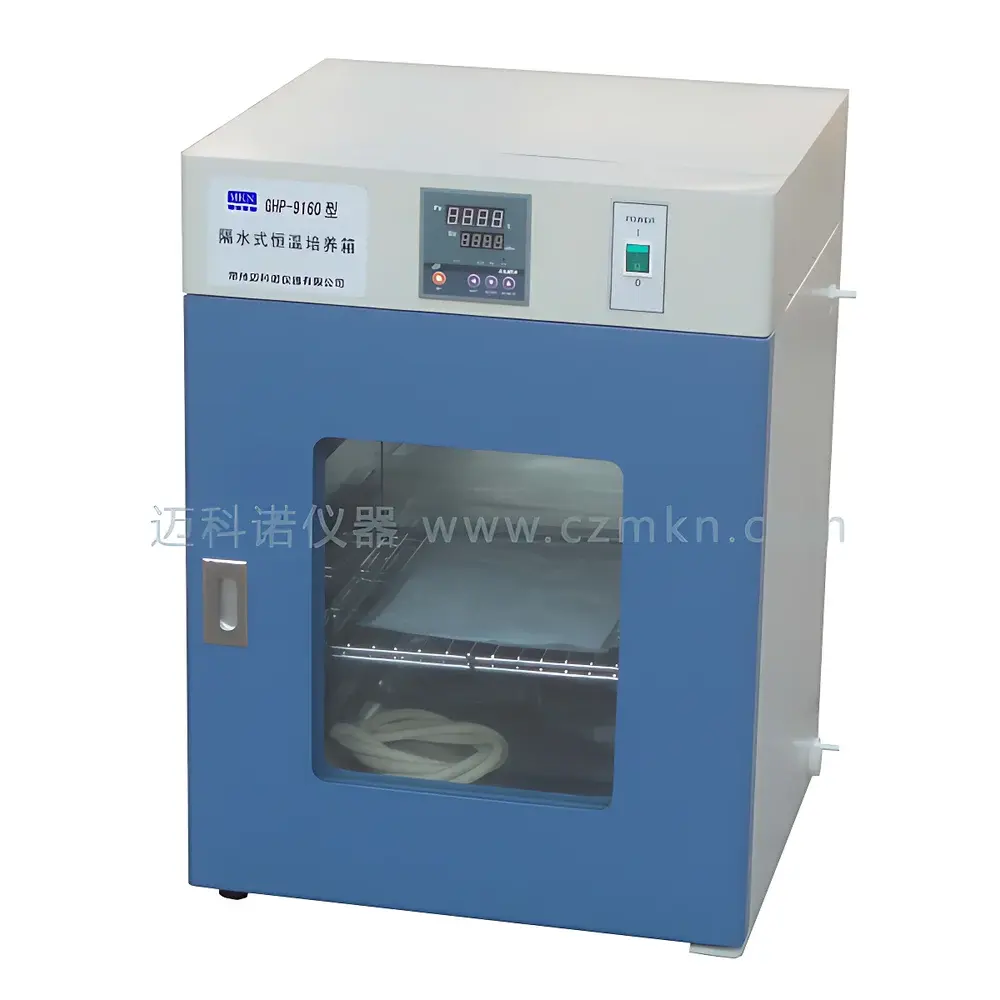
Macono GHP-160 Water-Jacketed Temperature-Controlled Incubator
| Origin | Zhejiang, China |
|---|---|
| Manufacturer Type | Authorized Distributor |
| Capacity | 160 L |
| Temperature Range (with Humidification) | Not Specified |
| Temperature Uniformity | Not Specified |
| Humidity Range | Not Specified |
| Construction | Stainless Steel Water Jacket, Double-Glazed Observation Door, Silicone Rubber Sealing |
Overview
The Macono GHP-160 Water-Jacketed Temperature-Controlled Incubator is engineered for stable, low-drift thermal environments essential in microbiological culture, cell propagation, enzyme activity studies, and long-term biological storage. Unlike forced-air incubators, this unit employs a water-jacketed thermal mass design—where heated water circulates uniformly around the inner chamber—to deliver exceptional temperature stability (< ±0.3 °C typical drift over 24 h) and minimal thermal overshoot during setpoint transitions. This architecture inherently dampens external ambient fluctuations and eliminates fan-induced desiccation, making it especially suitable for sensitive primary cultures, hybridoma work, and applications requiring uninterrupted thermal continuity over extended periods (e.g., 72–168 h assays). The chamber is constructed from electropolished stainless steel (AISI 304), and the water jacket is fabricated via argon-shielded TIG welding to ensure structural integrity and corrosion resistance under continuous humid operation.
Key Features
- Microprocessor-based digital temperature controller with PID algorithm and real-time display (0.1 °C resolution), enabling precise setpoint management and programmable ramp-hold profiles.
- Double-glazed, tempered glass observation door with silicone rubber gasket seal—minimizes heat loss and moisture escape while maintaining optical clarity for non-invasive monitoring.
- Externally mounted heating elements isolate thermal generation from the chamber interior, preventing radiant hotspots and eliminating risk of sample overheating or thermal shock.
- Integrated dual-level safety system: audible/visual alarm triggers upon chamber temperature deviation exceeding ±2 °C from setpoint or water jacket level falling outside operational range.
- Water jacket fill port with calibrated sight gauge and overflow drain—facilitates maintenance without disassembly and supports routine water quality control (e.g., deionized water replenishment per GLP guidelines).
Sample Compatibility & Compliance
The GHP-160 accommodates standard laboratory vessels including Petri dishes (up to 150 mm), multi-well plates (6–96-well), culture flasks (T25–T225), and test tubes (13–25 mm diameter), with adjustable stainless-steel shelving (3 positions, load capacity ≥15 kg/shelf). Chamber dimensions (W×D×H) are 500 × 450 × 720 mm, optimized for ergonomic loading and uniform air/water convection. While humidity control is not integrated in this base model, the sealed chamber design permits optional external humidification via sterile water reservoirs or integration with regulated lab-grade humidified gas lines. The unit complies with IEC 61010-1:2010 for electrical safety in laboratory equipment and meets structural requirements outlined in ISO 13408-1 (aseptic processing) for cleanroom-adjacent use. It supports audit-ready documentation when operated under GLP or GMP-aligned SOPs—including manual logbook entries for temperature verification and water level checks.
Software & Data Management
This analog-digital hybrid incubator does not include embedded data logging or network connectivity. However, its RS-232 interface (optional accessory) enables connection to external chart recorders or PC-based acquisition systems using Modbus RTU protocol. Users may integrate the unit into centralized environmental monitoring platforms (e.g., Vaisala viewLinc, DicksonOne) via third-party analog signal converters (4–20 mA output for temperature). All operational parameters—including setpoint, actual chamber temperature, and alarm status—are displayed locally on the front-panel LED screen. For regulatory traceability, laboratories are advised to perform daily manual verification using NIST-traceable thermistors (e.g., Fluke 1523) and document results in controlled logbooks compliant with FDA 21 CFR Part 11 Annex 11 principles (where handwritten records are retained with dated, signed entries).
Applications
The GHP-160 serves core functions across academic, clinical, and industrial life science workflows: bacterial and fungal strain preservation (ATCC-recommended storage at 4–8 °C or 25–37 °C); mammalian cell line expansion under CO2-free conditions; seed germination studies in plant physiology; enzymatic reaction kinetics at defined thermal setpoints; and stability testing of biologics intermediates per ICH Q1A(R2). Its thermal inertia makes it preferred for BSL-2-compatible procedures where airflow interruption must be avoided (e.g., during biosafety cabinet transfers), and its passive humidity retention supports short-duration tissue explant culture without supplemental humidification.
FAQ
Is humidity control available as a factory option?
No—the GHP-160 is configured exclusively as a temperature-stabilized water-jacketed incubator. Humidity regulation requires external humidification sources and is not supported by internal sensors or feedback loops.
What maintenance is required for the water jacket?
Deionized or distilled water must be refilled monthly; annual inspection of weld seams and gasket integrity is recommended. Chlorinated tap water is prohibited to prevent scaling and galvanic corrosion.
Can this unit be validated per IQ/OQ protocols?
Yes—its mechanical simplicity and stable thermal response support full installation and operational qualification using standard thermocouple mapping (ASTM E2875) and dwell-time stability testing.
Does the unit meet electromagnetic compatibility (EMC) standards for shared lab environments?
It complies with EN 61326-1:2013 Class B emission limits for laboratory equipment, ensuring co-location with sensitive analytical instruments such as PCR cyclers and microplate readers.
Is calibration certificate included with shipment?
A factory-issued calibration report (traceable to national standards) is provided; users must perform field verification prior to first use and at intervals defined by internal quality policy (typically every 6 months).



