
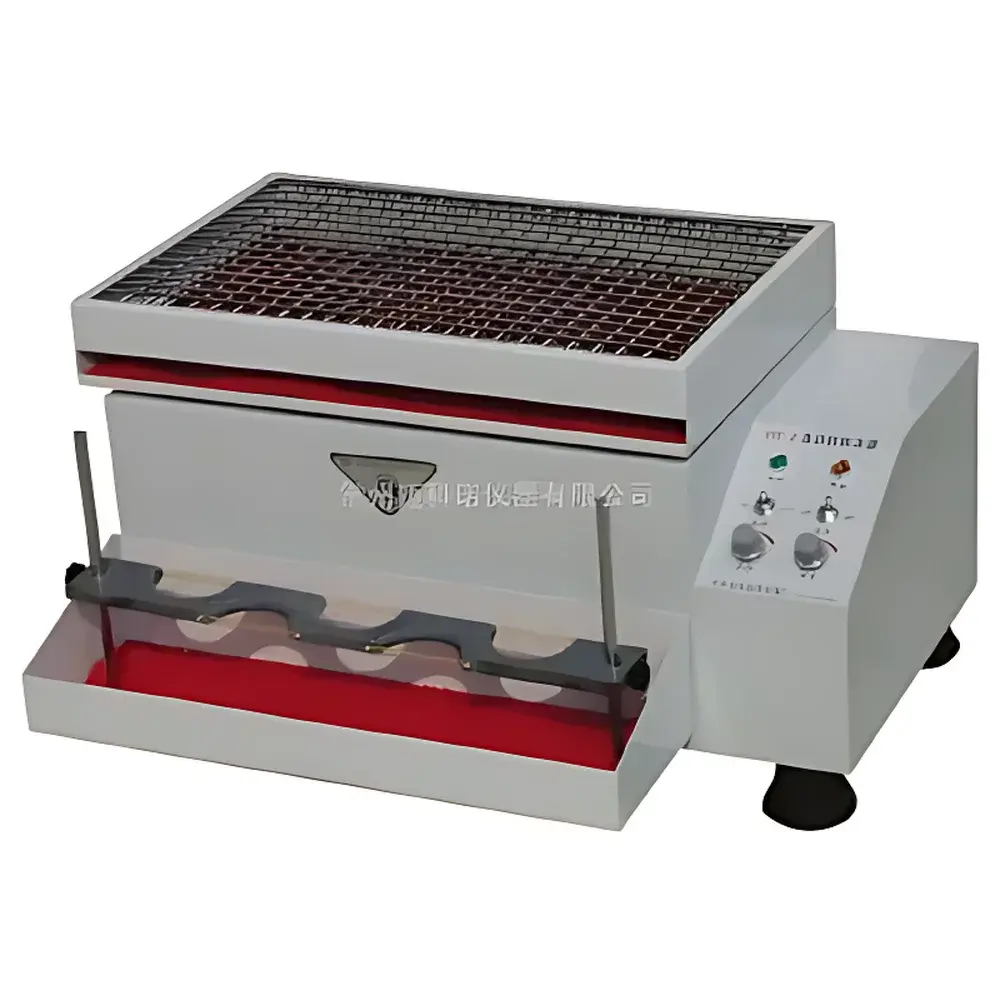
MKN HY-3 Dual-Mode Orbital and Vertical Shaker
| Brand | MKN |
|---|---|
| Model | HY-3 |
| Type | Benchtop Dual-Axis Shaker |
| Power Supply | AC 220 V, 50 Hz |
| Horizontal Amplitude | ≥40 mm |
| Vertical Amplitude | ≥20 mm |
| Horizontal Frequency Range | 0–300 rpm (infinitely variable) |
| Vertical Frequency Range | 0–280 rpm (infinitely variable) |
| Max Load Capacity | ≥20 kg |
| Oscillation Modes | Horizontal only / Vertical only / Simultaneous dual-axis |
| Timer Range | 0–120 min |
| Motor Type | Permanent Magnet DC Motor |
| Safety Compliance | Grounded chassis, CE-marked electrical design (IEC 61010-1) |
Overview
The MKN HY-3 Dual-Mode Orbital and Vertical Shaker is an engineered benchtop platform designed for precise, reproducible agitation of biological, chemical, and microbiological samples under controlled mechanical stimulation. Unlike conventional single-axis shakers, the HY-3 integrates two independent oscillation systems—horizontal orbital and vertical reciprocating—within a single compact chassis. This dual-axis architecture enables users to select mode-specific excitation (orbital mixing for suspension homogenization or cell culture aeration; vertical shaking for precipitation resuspension or solid-liquid extraction) or apply synchronized biaxial motion to enhance mass transfer kinetics in viscous or heterogeneous media. The device operates on the principle of controlled mechanical displacement via permanent magnet DC motor actuation, coupled with analog electronic speed regulation to ensure low-noise, vibration-damped operation across its full frequency range. Its rigid frame and anti-slip base eliminate lateral drift during high-load operation—a known limitation in legacy shaker designs—making it suitable for extended unattended runs in regulated laboratory environments.
Key Features
- Dual independent drive systems: Separate horizontal orbital and vertical reciprocating mechanisms, each with dedicated speed control and status indicators
- Infinitely variable speed control: 0–300 rpm (horizontal), 0–280 rpm (vertical), calibrated via front-panel potentiometer with real-time visual feedback
- High-load stability: Rated for ≥20 kg payload with minimal amplitude deviation across operational range; reinforced aluminum alloy platform with non-slip silicone mat surface
- Precision timing function: Digital timer (0–120 minutes) with automatic shutdown and audible end-of-cycle alert
- Low-noise engineering: Optimized gearless DC motor drive and balanced counterweight system reduce acoustic emission to <55 dB(A) at 1 m distance
- Safety-integrated design: Earth-grounded chassis, overcurrent protection circuitry, and fail-safe power cutoff upon abnormal thermal rise
Sample Compatibility & Compliance
The HY-3 accommodates standard laboratory vessels including Erlenmeyer flasks (up to 2 L), centrifuge tubes (15–50 mL), multi-well plates (6–96-well), and custom containers secured via universal clamping fixtures. Its amplitude and frequency profiles comply with common protocol requirements for microbial growth (e.g., ASTM D2578 for bacterial suspension homogenization), enzymatic reaction mixing (ISO 17994:2021), and reagent resuspension per USP compounding guidelines. While not certified for GMP manufacturing environments, the unit meets IEC 61010-1 safety standards for laboratory electrical equipment and supports GLP-compliant documentation when used with external logging devices. No built-in audit trail or 21 CFR Part 11 functionality is provided; however, manual log entries—including date/time, speed, duration, and operator ID—are recommended for traceability in quality-controlled workflows.
Software & Data Management
The HY-3 operates as a standalone hardware instrument without embedded firmware, network interface, or proprietary software. All parameter settings are manually configured via physical controls, ensuring deterministic behavior and eliminating cybersecurity vulnerabilities associated with connected lab instruments. For laboratories requiring electronic recordkeeping, integration with third-party data acquisition systems (e.g., LabVIEW, MATLAB Data Acquisition Toolbox) is achievable using optional analog output modules (0–5 V signal proportional to set speed). Raw operational logs must be maintained externally in accordance with institutional SOPs. Firmware updates, remote diagnostics, or cloud-based monitoring are not supported.
Applications
- Microbial culture propagation: Aerobic growth of E. coli, Bacillus subtilis, and yeast strains in liquid media
- Cellular dissociation and suspension maintenance: Uniform dispersion of adherent mammalian cells post-trypsinization
- Immunoassay plate agitation: Enhanced antigen-antibody binding kinetics in ELISA and lateral flow assay development
- Environmental sample processing: Homogenization of soil extracts, wastewater sludge, or biofilm suspensions
- Pharmaceutical formulation studies: Solubility testing, dissolution rate profiling, and excipient compatibility screening
- Academic teaching labs: Demonstrating kinetic effects of agitation intensity on reaction equilibria and mass transfer coefficients
FAQ
What safety certifications does the HY-3 carry?
The unit complies with IEC 61010-1:2010 for electrical safety in laboratory equipment and features grounded metal housing, thermal cut-off protection, and short-circuit isolation.
Can the HY-3 operate continuously beyond 120 minutes?
Yes—by setting the timer to “∞” (infinite mode), the shaker will run until manually powered off; the 120-minute limit applies only to timed operation.
Is vertical-only mode suitable for precipitate resuspension?
Yes—its ≥20 mm stroke and adjustable frequency (0–280 rpm) provide sufficient mechanical energy to fully redisperse settled particulates without foaming or splashing.
Does the shaker support ISO/IEC 17025 accredited calibration?
While the HY-3 lacks built-in calibration ports, third-party metrology labs can verify amplitude and frequency accuracy per ISO/IEC 17025 using laser vibrometry and optical tachometry.
What maintenance is required for long-term reliability?
Routine cleaning of the platform surface and inspection of motor mounting bolts every 6 months; no lubrication or internal servicing is needed due to brushless DC motor construction.





