
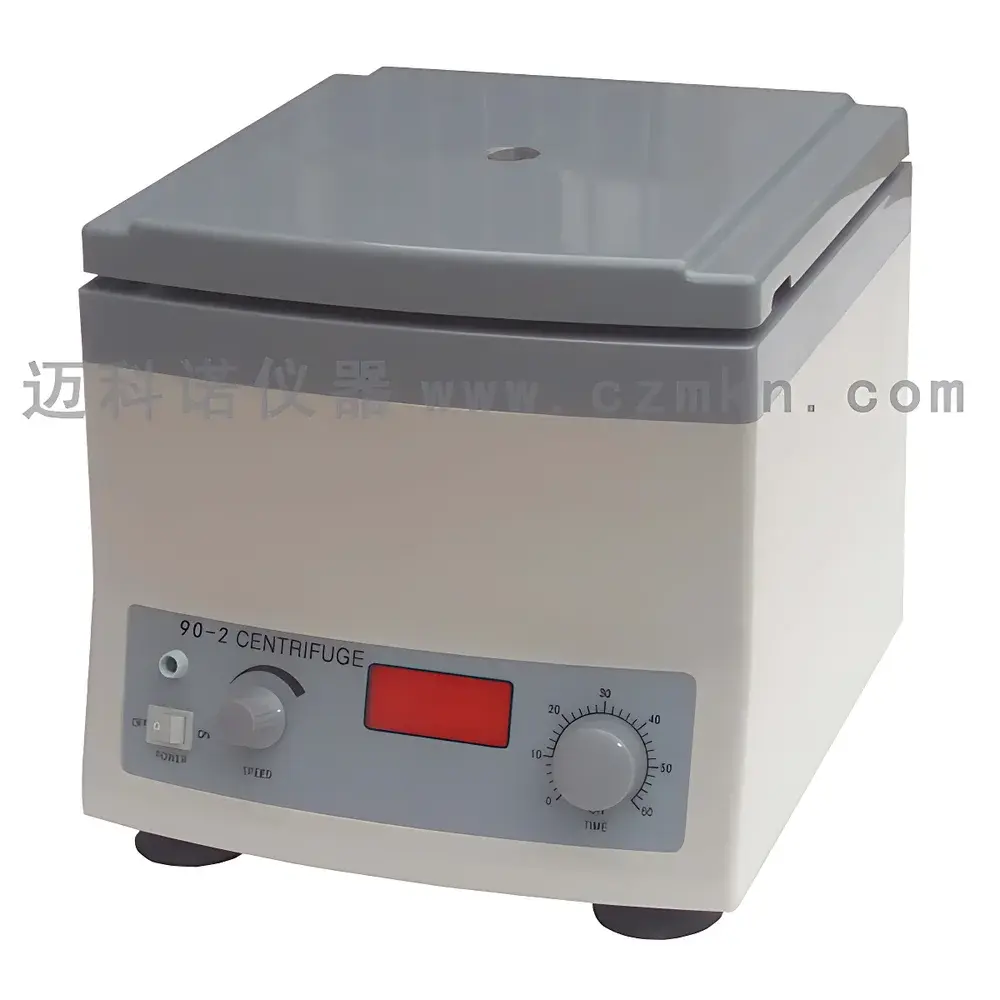
MKN 90-2 Digital Display Electric Centrifuge
| Brand | MKN |
|---|---|
| Model | 90-2 |
| Max Speed | 0–4000 rpm |
| Relative Centrifugal Force (RCF) | 2325 × g |
| Capacity | 12 × 20 mL (or 12 × 15 mL) |
| Timer Range | 0–60 min |
| Power | 135 W |
| Noise Level | ≤60 dB(A) |
| Supply Voltage | AC 220 V, 50 Hz, 2 A |
| Rotor Material | Aluminum Alloy |
| Drive System | Dedicated Centrifuge Motor |
| Control Type | Stepless Speed Adjustment + Mechanical Timer |
| Display | Digital RPM + Analog Time Scale |
| Safety Features | Balance Protection, Dual Fuse System, Safety Interlock Switch |
| Compliance | Designed for GLP-compliant laboratories |
Overview
The MKN 90-2 Digital Display Electric Centrifuge is a compact, benchtop centrifugation system engineered for routine separation tasks in life science, clinical, pharmaceutical, and environmental laboratories. It operates on the principle of sedimentation under centrifugal force—accelerating particle settling based on differences in density, size, and shape within a liquid suspension. With a maximum rotational speed of 4000 rpm and an RCF of 2325 × g, the unit delivers sufficient force for efficient pelleting of cells, precipitates, and particulates from biological fluids such as whole blood, serum, plasma, and cell culture supernatants. Its lightweight aluminum rotor—balanced for stability at operational speeds—and low-noise (<60 dB[A]) design support continuous use in shared lab environments without compromising operator comfort or acoustic integrity.
Key Features
- Stepless speed control with digital RPM readout ensures precise, repeatable rotational settings across the full 0–4000 rpm range.
- Mechanical timer (0–60 minutes) with analog scale provides intuitive, non-electronic timing—eliminating software dependency and enhancing long-term reliability.
- Dual safety architecture: integrated safety interlock switch prevents operation when the lid is open, while dual fuse protection guards against overcurrent events.
- Balance-sensing protection mechanism halts rotation automatically if rotor imbalance exceeds safe thresholds—minimizing mechanical stress and preventing potential failure.
- High-strength polymer housing offers corrosion resistance and impact resilience, while maintaining low mass for easy repositioning on benchtops.
- Aluminum alloy rotor is chemically inert to common aqueous and buffered solutions, supporting compatibility with standard centrifuge tubes (15 mL and 20 mL conical formats).
Sample Compatibility & Compliance
The 90-2 accommodates up to twelve 15 mL or 20 mL conical centrifuge tubes per run, enabling parallel processing of clinical or research samples without requiring tube adapters. It is suitable for applications involving whole blood fractionation, bacterial pellet collection, enzyme assay preparation, and environmental water sample clarification. The device conforms to IEC 61010-1:2010 (Safety Requirements for Electrical Equipment for Measurement, Control, and Laboratory Use), including provisions for dielectric strength, creepage distance, and protective earthing. While not certified to ISO 13485 or FDA 21 CFR Part 11, its mechanical timer and analog/digital hybrid interface support audit-ready documentation practices in GLP environments where electronic data integrity is not mandated.
Software & Data Management
This model operates without embedded firmware or network connectivity—intentionally designed for simplicity, durability, and regulatory transparency. All operational parameters (speed, time) are set manually and displayed physically: RPM via LED digits, time via calibrated dial. No data logging, USB export, or PC interface is included, eliminating validation overhead associated with electronic records. This architecture aligns with laboratories prioritizing traceability through handwritten logbooks or LIMS-integrated manual entry—particularly in QC/QA workflows governed by USP <1058>, ISO/IEC 17025, or internal SOPs requiring minimal software qualification.
Applications
- Blood banking: Separation of plasma, buffy coat, and erythrocytes from anticoagulated whole blood.
- Microbiology: Harvesting bacterial or yeast cultures prior to DNA extraction or protein analysis.
- Pharmaceutical QA: Clarification of dissolution media or filtration aids during tablet formulation studies.
- Food safety testing: Concentration of pathogens (e.g., Salmonella, E. coli) from enrichment broths.
- Environmental monitoring: Isolation of suspended solids or algal biomass from surface water samples.
- Academic teaching labs: Demonstrating sedimentation kinetics, density gradient principles, and rotor dynamics fundamentals.
FAQ
What is the maximum relative centrifugal force (RCF) achievable with this centrifuge?
The MKN 90-2 generates up to 2325 × g at its rated maximum speed of 4000 rpm with the standard aluminum rotor loaded at full capacity.
Is the rotor autoclavable?
No—the aluminum rotor is not designed for autoclaving. Cleaning is recommended using 70% ethanol or mild detergent followed by air drying.
Does the unit include rotor identification or speed calibration certification?
No factory-provided calibration certificate is supplied; however, users may perform in-house speed verification using a certified tachometer per ISO 8573-1 or ASTM E29-22 guidelines.
Can this centrifuge be used for hazardous or infectious samples?
Only when operated inside a certified biosafety cabinet or with sealed, leak-proof tubes rated for centrifugation—no aerosol-tight lid or biocontainment features are built into the base unit.
What maintenance is required for long-term reliability?
Routine inspection of the safety interlock switch, visual check of rotor integrity (cracks, pitting), and periodic cleaning of the chamber cavity are recommended every 6 months or after 500 runs.



