
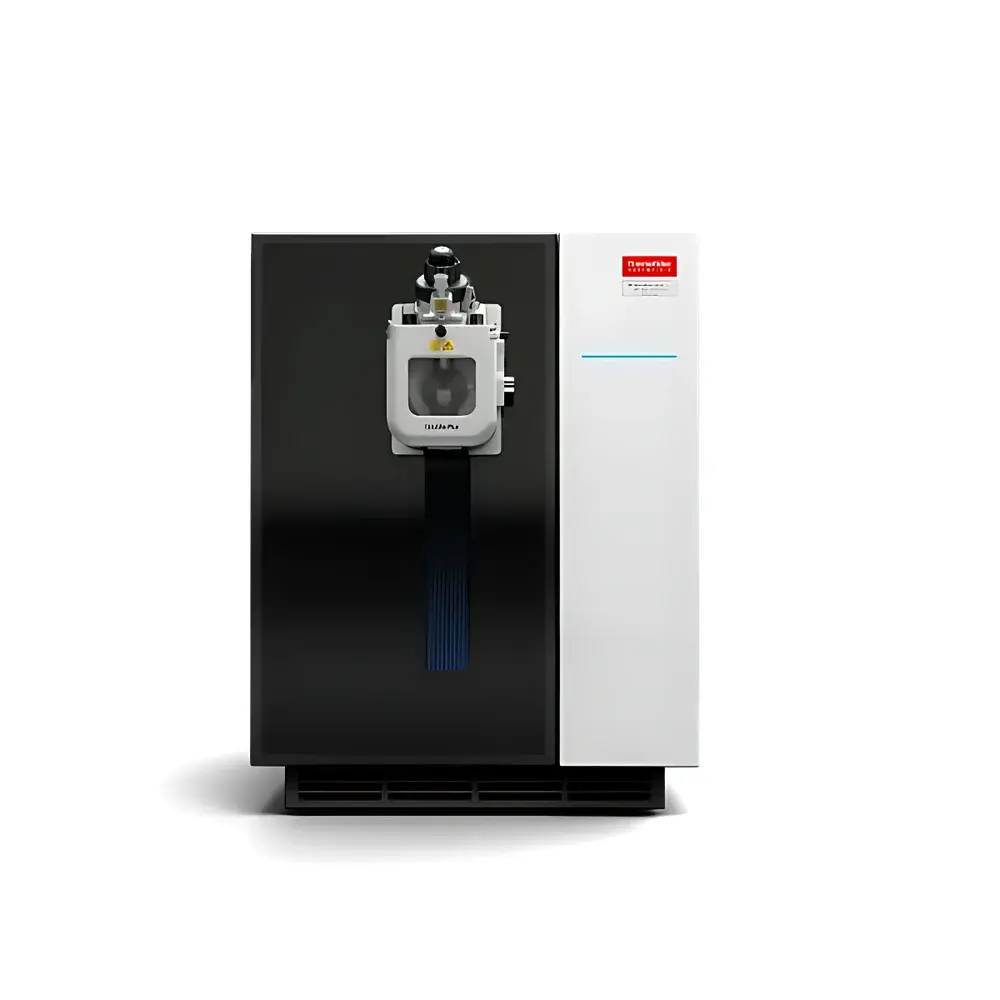
Thermo Fisher Orbitrap Excedion Pro Mass Spectrometer
| Brand | Thermo Fisher |
|---|---|
| Origin | Germany |
| Manufacturer Type | Original Equipment Manufacturer (OEM) |
| Product Origin | Imported |
| Model | Orbitrap Excedion Pro Mass Spectrometer |
| Instrument Type | Orbitrap-Based Hybrid Mass Spectrometer |
| Application Scope | Universal |
| Mass Range | m/z 40–6,000 |
| Resolution | 480,000 at m/z 200 |
| Mass Accuracy | <1 ppm RMS |
Overview
The Thermo Fisher Orbitrap Excedion Pro Mass Spectrometer is a next-generation hybrid high-resolution mass spectrometry platform engineered for demanding applications in biopharmaceutical characterization, proteomics, metabolomics, structural biology, and multi-omics integration. Built upon the proven Orbitrap mass analyzer architecture, it combines electrostatic trapping with Fourier-transform detection to deliver exceptional mass accuracy, resolution, and dynamic range in a single instrument. Unlike conventional quadrupole-Orbitrap systems, the Excedion Pro integrates advanced ion optics, dual fragmentation capabilities (HCD and ETD), and proprietary eDR (enhanced Dynamic Range) scanning—enabling simultaneous high-fidelity detection of both low- and high-abundance species across complex biological matrices. Its design adheres to rigorous engineering standards for long-term stability under continuous operation in regulated environments, including GLP-compliant laboratories and GMP-aligned analytical development workflows.
Key Features
- Enhanced Orbitrap technology featuring improved ion transmission efficiency and reduced space-charge effects, enabling sustained high resolution (>480,000 at m/z 200) without compromising scan speed.
- Dual fragmentation modes: High-energy Collision-induced Dissociation (HCD) and Electron-transfer Dissociation (ETD), with optional EThcD (Electron-transfer/higher-energy Collision Dissociation) for comprehensive peptide backbone cleavage and PTM localization.
- Extended mass range support up to m/z 12,000 under native conditions—validated for intact protein analysis, antibody-drug conjugate (ADC) characterization, and oligonucleotide sequencing.
- Electric-field ion funnel with optimized RF/DC gradients minimizes in-source fragmentation of labile metabolites and lipids, preserving molecular integrity during transfer into the mass analyzer.
- eDR scanning mode delivers five-decade dynamic range in a single MS1 scan, significantly improving detection sensitivity for low-abundance PTMs and post-translational variants within heterogeneous samples.
- Full compatibility with TMTpro™ 32-plex isobaric labeling, supporting deep quantitative proteome profiling with minimized ratio compression and enhanced reproducibility across large cohort studies.
Sample Compatibility & Compliance
The Orbitrap Excedion Pro supports direct infusion, nanoLC, microLC, and UHPLC-coupled workflows across aqueous, organic, and mixed-solvent mobile phases. It accommodates diverse sample types—including denatured and native proteins, monoclonal antibodies, ADCs, synthetic oligonucleotides, polar and nonpolar metabolites, glycolipids, and phospholipids—without hardware modification. The system complies with ISO/IEC 17025 requirements for testing laboratories and supports audit-ready data acquisition under FDA 21 CFR Part 11 when deployed with Thermo Scientific Chromeleon CDS v7.3 or later. Instrument qualification documentation aligns with ICH Q5, Q5A(R2), and USP guidelines for analytical instrument lifecycle management.
Software & Data Management
Controlled via Thermo Scientific Tune and Xcalibur software platforms, the Excedion Pro enables method-driven acquisition, real-time spectral quality monitoring, and automated calibration routines traceable to NIST SRM 1950 reference materials. Raw data files (.raw) are natively compatible with Proteome Discoverer 2.5+, Compound Discoverer 3.3+, and LipidSearch 5.0 for targeted and untargeted workflows. All processing steps—including peak picking, deconvolution, database searching (via Sequest HT, Mascot, Byonic), and statistical validation—are fully scriptable and support integration into enterprise LIMS environments. Audit trails, electronic signatures, and user-access controls meet GLP/GMP data integrity requirements per ALCOA+ principles.
Applications
- Biopharmaceutical Development: Comprehensive characterization of mAbs, bispecifics, Fc-fusion proteins, and ADCs—including DAR distribution, payload heterogeneity, aggregation state, and higher-order structure assessment under native MS conditions.
- Proteomics: Deep coverage phosphoproteomics, ubiquitinomics, and glycoproteomics; conformational dynamics studies via hydrogen-deuterium exchange (HDX-MS); and cross-linking MS (XL-MS) for protein-protein interaction mapping.
- Metabolomics & Lipidomics: Untargeted profiling of polar metabolites (e.g., amino acids, TCA cycle intermediates) and complex lipid classes (e.g., cardiolipins, sulfatides) with sub-picomolar LODs in plasma, tissue, and cell lysate extracts.
- Multi-omics Integration: Cross-platform alignment of proteomic, phosphoproteomic, and metabolomic datasets using standardized metadata schemas compliant with HUPO-PSI and MetaboLights submission standards.
FAQ
What is the maximum mass range achievable for intact protein analysis?
The system supports reliable detection up to m/z 12,000 under native electrospray conditions, validated for proteins such as IgG1 (~150 kDa) and larger multimeric complexes.
Does the Excedion Pro support real-time data-dependent acquisition (DDA) and data-independent acquisition (DIA)?
Yes—it natively supports both DDA and DIA (including t-SWATH and HR-MSE) with customizable isolation windows, variable cycle times, and intelligent precursor selection algorithms.
Is the instrument compatible with third-party chromatography systems?
Yes—standardized API interfaces and vendor-neutral LC control protocols enable seamless integration with Agilent, Waters, and Shimadzu UHPLC systems via digital I/O or Ethernet-based communication.
How is mass calibration maintained over extended run times?
Automatic internal calibration is performed every 12 hours using lock-mass correction from a dedicated reference compound infused continuously through a divert valve, ensuring long-term mass stability within ±0.2 ppm RMS.
Can raw data files be reprocessed with updated search algorithms or parameters?
Yes—all .raw files retain full centroided and profile-mode intensity data, allowing retrospective reprocessing with newer versions of search engines or customized false discovery rate (FDR) thresholds without reacquisition.



