
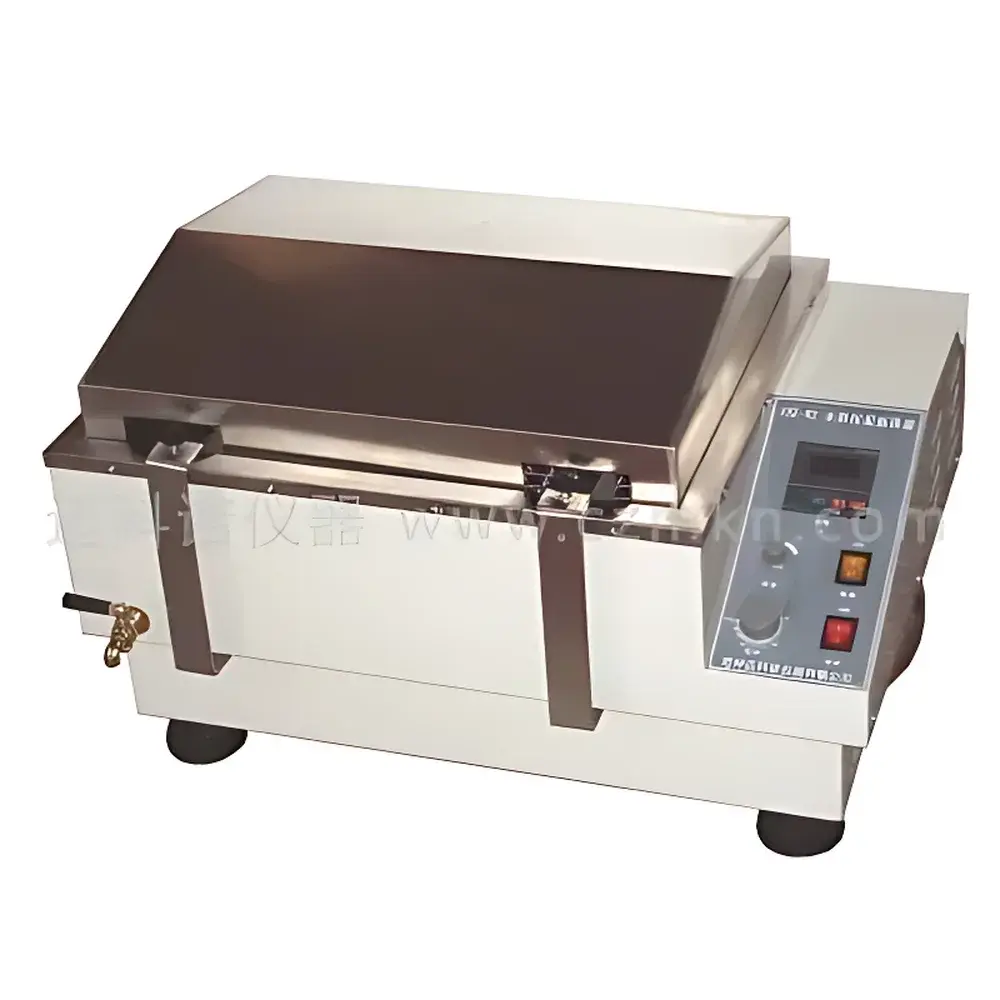
MKN SHZ-82 Water Bath Orbital Shaker
| Brand | MKN |
|---|---|
| Origin | Jiangsu, China |
| Model | SHZ-82 |
| Power Supply | 220 V, 50 Hz |
| Temperature Control Range | Ambient to 100 °C (±1 °C accuracy, LED digital display) |
| Speed Range | 0–300 rpm |
| Timer | 0–120 min |
| Oscillation Amplitude | 20 mm |
| Chamber Dimensions (W×D×H) | ≥490 × 390 × 170 mm |
| External Dimensions (W×D×H) | 720 × 480 × 520 mm |
| Heating Power | 2000 W |
| Oscillation Mode | Reciprocating |
| Construction | Stainless steel chamber and frame |
| Clamp Type | Universal stainless steel spring clamp |
| Compliance | Meets GB/T standard requirements for laboratory shakers |
Overview
The MKN SHZ-82 Water Bath Orbital Shaker is a precision-engineered benchtop instrument designed for temperature-controlled agitation of liquid samples in glass or plastic vessels. It operates on the principle of reciprocating oscillation within a thermostatically regulated water bath, enabling uniform heat transfer and consistent mixing across biological, biochemical, and environmental sample matrices. Unlike air-jacketed incubator shakers, the water bath configuration ensures superior thermal stability and minimal temperature gradient—critical for sensitive applications such as bacterial culture expansion, enzyme kinetics assays, and solubility studies where ±1 °C control fidelity directly impacts reproducibility. The unit integrates a high-capacity 2000 W heating system with PID-based digital temperature regulation, delivering stable setpoint maintenance across its full 0–100 °C range. Its robust stainless steel construction—including both chamber and structural frame—ensures corrosion resistance, mechanical durability, and compliance with routine cleaning protocols required in GLP-compliant laboratories.
Key Features
- High-fidelity temperature control: Digital PID controller with ±1 °C accuracy over ambient to 100 °C range, visualized via 4-digit LED display
- Adjustable reciprocating oscillation: Speed continuously variable from 0 to 300 rpm, optimized for gentle suspension of microbial cultures or vigorous homogenization of viscous media
- Programmable timer: 0–120 minute countdown function with auto-shutdown, supporting unattended operation during overnight incubations
- Universal clamping system: Stainless steel spring-loaded universal clamps accommodate tubes (10–50 mL), flasks (up to 1000 mL), and multi-well plates without tooling
- Large working chamber: Internal volume ≥32.5 L (490 × 390 × 170 mm), accommodating up to twelve 250 mL Erlenmeyer flasks simultaneously
- Thermal safety architecture: Dual-stage overtemperature protection with independent mechanical cutoff prevents dry-run damage and ensures operator safety
Sample Compatibility & Compliance
The SHZ-82 supports a broad spectrum of container types—including borosilicate glass culture flasks, polypropylene conical tubes, PCR strip holders, and shallow-depth microplates—without requiring accessory adapters. Its water bath design eliminates convective air currents that may desiccate sample surfaces, making it especially suitable for long-duration aerobic cultivations and low-volume aqueous reactions. The device conforms to GB/T 29868–2013 (General Technical Requirements for Laboratory Shakers) and incorporates electrical safety features aligned with IEC 61010-1:2010 for laboratory equipment. While not inherently 21 CFR Part 11 compliant, its analog timer and non-networked control interface allow straightforward integration into audit-trail workflows when paired with external electronic lab notebook (ELN) documentation systems per GLP/GMP Annex 11 expectations.
Software & Data Management
The SHZ-82 operates via standalone hardware controls—no embedded firmware, no USB connectivity, and no proprietary software stack. This architecture intentionally prioritizes operational simplicity, electromagnetic compatibility (EMC), and long-term serviceability over digital feature creep. All parameters (temperature setpoint, speed, timer duration) are manually configured and retained only during active operation; no data logging, remote monitoring, or calibration history storage is performed internally. For laboratories requiring traceable parameter records, integration with external data acquisition systems (e.g., RS-232-enabled temperature loggers or PLC-scanned analog outputs) is feasible via optional signal taps—though such configurations fall outside standard factory specifications.
Applications
- Microbial cultivation: Escherichia coli, Bacillus subtilis, and yeast propagation under controlled thermal and agitation conditions
- Biochemical assay preparation: Uniform dissolution of lyophilized reagents, buffer equilibration, and antigen-antibody incubation steps
- Environmental testing: BOD5 analysis, soil extract agitation, and heavy metal leaching studies per EPA Method 1311
- Pharmaceutical QC: Stability-indicating dissolution profiling of solid dosage forms in USP Apparatus I/II-compatible vessels
- Agricultural research: Seed germination stimulation, plant tissue culture medium aeration, and pesticide degradation kinetics
- Food safety validation: Pathogen enrichment broths (e.g., BPW, TSB) per ISO 6579 and AOAC guidelines
FAQ
What is the maximum load capacity for flask agitation?
The unit supports up to 8 kg total payload distributed evenly across the platform; recommended loading limits assume use of standard 250 mL Erlenmeyer flasks filled to 70% capacity.
Can the water bath be operated without oscillation?
Yes—the agitation motor and heating system operate independently; temperature-only mode is fully functional for static incubation applications.
Is deionized water required for the bath medium?
Distilled or deionized water is strongly recommended to prevent mineral scaling on the heater element and prolong service intervals between descaling cycles.
Does the unit include a water level sensor?
No—operators must manually verify minimum fill level (≥30 mm above heater element) prior to startup to avoid thermal cutoff activation.
What maintenance schedule is advised for long-term reliability?
Biannual inspection of silicone gasket integrity, quarterly descaling using 5% citric acid solution, and annual verification of temperature probe calibration against NIST-traceable reference standards.





