
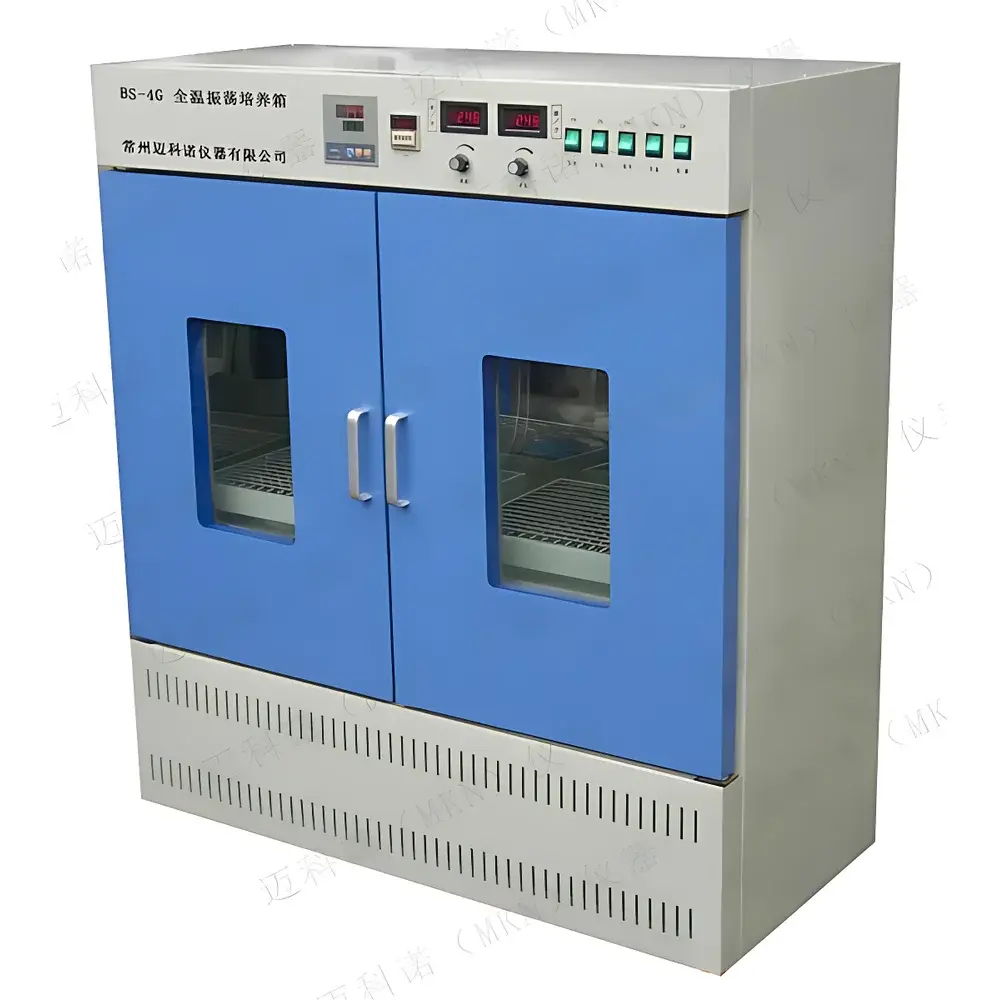
MKN BS-4G Dual-Door Quadruple-Shelf Temperature-Controlled Incubator with Orbital Shaking
| Brand | MKN |
|---|---|
| Model | BS-4G |
| Type | Temperature-Controlled Incubator with Integrated Orbital Shaking System |
| Capacity | 480 L (Quadruple Independent Shaking Decks) |
| Temperature Range | 5–50 °C |
| Temperature Uniformity | ±1 °C |
| Shaking Speed | 0–300 rpm (Infinitely Variable) |
| Orbit Diameter | 20 mm |
| Platform Amplitude | 20 mm (Orbital) |
| Heating Power | 800 W |
| Compressor Power | 180 W |
| Input Voltage | AC 220 V, 50 Hz |
| External Dimensions | 1440 × 770 × 1700 mm (W × D × H) |
| Chamber Material | Stainless Steel (AISI 304) |
| Insulation | In-situ Polyurethane Foam (≥80 mm Thickness) |
| Airflow Design | Forced-Air Circulation with Optimized Ducted Wind Path |
Overview
The MKN BS-4G Dual-Door Quadruple-Shelf Temperature-Controlled Incubator with Orbital Shaking is an integrated life science platform engineered for simultaneous precise thermal regulation and controlled mechanical agitation. It operates on a dual-mode thermoelectric system—combining resistive heating and vapor-compression refrigeration—to maintain stable setpoint temperatures across the full operational range of 5–50 °C, independent of ambient conditions (functional at ambient −5 °C to +32 °C). Unlike single-function incubators or standalone shakers, the BS-4G integrates four independently accessible orbital shaking decks within a single insulated chamber, each supporting concurrent yet isolated culture protocols. Its core measurement and control architecture employs PID-regulated feedback loops with high-stability platinum resistance temperature sensors (PT100), ensuring long-term thermal reproducibility required for microbial growth kinetics, cell line expansion, enzyme activity assays, and fermentation process development.
Key Features
- Four-tier modular shaking platform with independent access via dual front doors—enabling parallel experiments without cross-contamination or thermal disturbance.
- Forced-air convection system with engineered ducted airflow ensures ≤±1 °C temperature uniformity throughout the 480 L chamber volume, validated per ISO 15265:2022 guidelines for incubator performance verification.
- Chamber constructed entirely from electropolished AISI 304 stainless steel; corners fully radiused to prevent microbial retention and support compliant cleaning validation (e.g., ATP bioluminescence or swab-based residue testing).
- Structural insulation comprises ≥80 mm thick in-situ polyurethane foam with closed-cell density >35 kg/m³, providing thermal resistance (R-value) exceeding 2.8 m²·K/W—critical for energy stability during extended overnight runs.
- Infinitely variable orbital shaking (0–300 rpm) with fixed 20 mm orbit diameter; motor-driven eccentric drive mechanism delivers low-vibration, maintenance-free operation with <0.5 mm peak-to-peak displacement tolerance.
- LED digital display with dual-parameter interface: real-time chamber temperature and selected shaking speed; setpoint entry via tactile membrane keypad with password-protected calibration lockout.
Sample Compatibility & Compliance
The BS-4G accommodates standard laboratory vessels including 16 mm × 200 mm test tubes (up to 80 per shelf), 100 mL Erlenmeyer flasks (15 per shelf), and 200 mL baffled flasks (9 per shelf), all secured via universal spring-loaded clamps designed for rapid reconfiguration. Its design conforms to IEC 61010-1:2010 safety requirements for laboratory equipment and incorporates overtemperature cut-off, compressor overload protection, and door-open alarm circuitry. While not certified for sterile applications (e.g., ISO 5 cleanroom use), its surface finish and seamless chamber geometry align with GLP-compliant documentation practices for non-aseptic culture workflows in academic, industrial QC, and environmental monitoring labs.
Software & Data Management
The BS-4G operates as a stand-alone instrument with embedded firmware—no proprietary software or PC dependency required for routine operation. All critical parameters (setpoint, actual temperature, rpm, runtime) are logged internally with timestamping and retained for ≥30 days. Optional RS-485 Modbus RTU interface enables integration into centralized building management systems (BMS) or LIMS platforms for automated audit trail generation—supporting FDA 21 CFR Part 11 compliance when paired with validated third-party data acquisition software and electronic signature modules.
Applications
- Microbial growth profiling under defined thermal and agitation conditions (e.g., E. coli batch culture optimization, yeast biomass production).
- Environmental microbiology studies requiring replicate incubation across temperature gradients (e.g., soil respiration assays, biodegradation kinetics).
- Pharmaceutical stability testing of liquid formulations under agitated, temperature-controlled conditions per ICH Q1A(R3).
- Biotechnology education labs performing comparative fermentation experiments using multiple strains or media compositions.
- Food safety laboratories conducting enrichment cultures for pathogen detection (e.g., Salmonella, Listeria) per ISO 6579-1 and AOAC protocols.
FAQ
Does the BS-4G support humidity control?
No—this model is configured exclusively for temperature and orbital shaking control. Humidity regulation is not implemented; users requiring RH control must select MKN’s dedicated humidity-incorporated incubator series (e.g., BH-4G variants).
Can individual shelves be operated at different temperatures or speeds?
No—the entire chamber maintains a single uniform temperature setpoint; shaking speed is synchronized across all four decks. Independent parameter control per shelf is not supported.
What electrical infrastructure is required for installation?
A dedicated 220 V AC, 50 Hz circuit with minimum 16 A breaker and grounded outlet is mandatory. Ambient ventilation clearance of ≥100 mm at rear and top is required for compressor heat dissipation.
Is calibration documentation provided with shipment?
Yes—a factory-issued calibration certificate traceable to NIM (National Institute of Metrology, China) is included, covering temperature sensor accuracy (±0.5 °C at 37 °C) and speed verification (±2 rpm at 150 rpm).
What maintenance intervals are recommended?
Compressor oil and refrigerant integrity should be verified annually by authorized service personnel; fan filters require cleaning every 90 days in standard lab environments. No routine lubrication of shaking mechanisms is necessary due to sealed-bearing construction.
Related Products



