
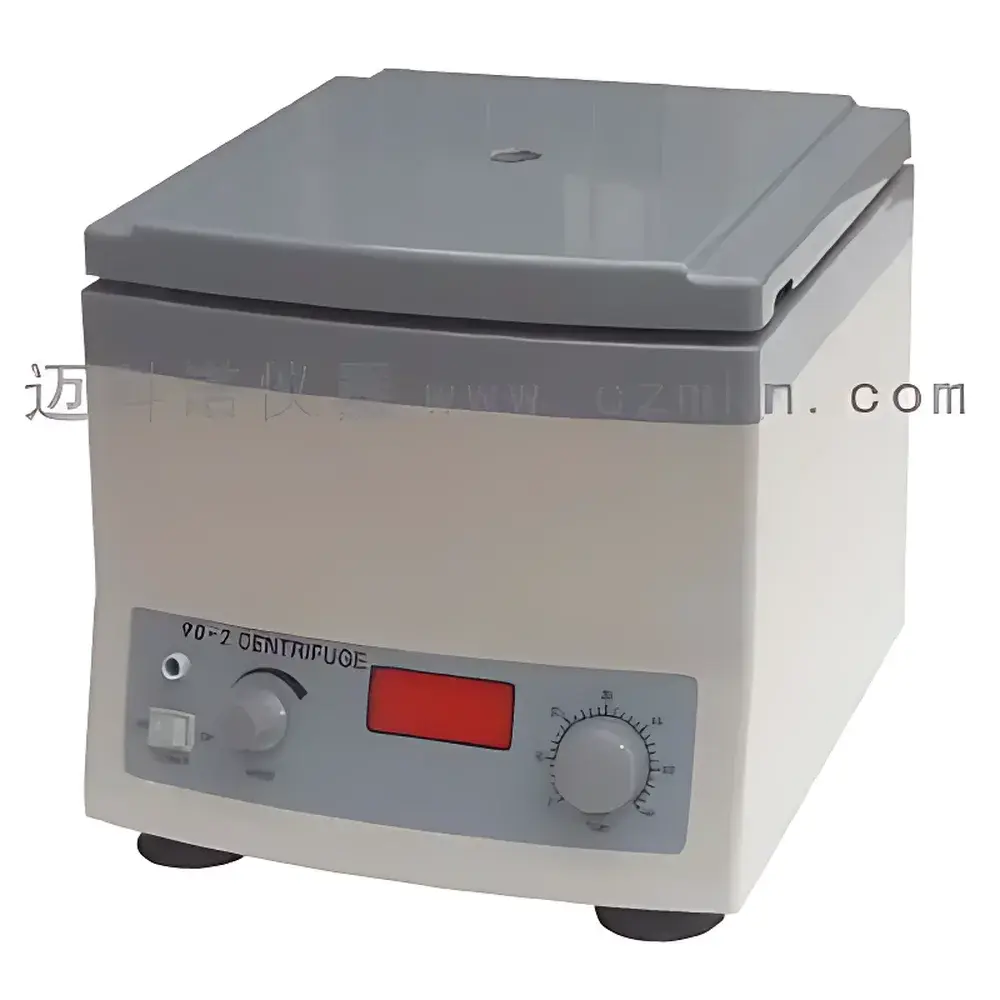
MKN 90-2 Digital Display Benchtop Centrifuge
| Brand | MKN |
|---|---|
| Model | 90-2 |
| Speed Range | 0–4000 rpm (digital display) |
| Relative Centrifugal Force (RCF) | 2325 × g |
| Capacity | 12 × 20 mL (or 12 × 15 mL) tubes |
| Timer Range | 0–60 min (mechanical) |
| Power | 135 W |
| Noise Level | ≤60 dB(A) |
| Supply Voltage | AC 220 V, 50 Hz, 2 A |
| Rotor Material | Anodized Aluminum |
| Safety Features | Dual fuse protection, lid interlock switch, imbalance detection and auto-shutdown |
| Drive System | Dedicated brushless centrifuge motor |
| Construction | High-strength engineering plastic housing |
Overview
The MKN 90-2 Digital Display Benchtop Centrifuge is a compact, high-reliability laboratory instrument engineered for routine separation tasks in life science, clinical diagnostics, pharmaceutical quality control, and environmental testing laboratories. It operates on the principle of sedimentation under controlled centrifugal force—utilizing rotational acceleration to separate components of heterogeneous liquid mixtures based on differences in density, size, and shape. With a maximum speed of 4000 rpm and an RCF of 2325 × g, the 90-2 delivers sufficient force for pelleting cells, precipitating macromolecules, clarifying suspensions, and preparing plasma or serum from whole blood samples. Its benchtop footprint (W × D × H ≈ 260 × 320 × 280 mm) and lightweight construction (<12 kg) make it ideal for shared lab spaces, teaching labs, and mobile field units where space and portability are constrained.
Key Features
- Digital speed display with real-time rpm readout ensures precise parameter verification during operation—critical for method reproducibility and SOP compliance.
- Mechanical timer (0–60 min) provides intuitive, tactile control without software dependency; eliminates risk of electronic failure or calibration drift associated with digital timers.
- Integrated safety architecture includes a lid interlock switch that prevents rotor rotation unless the lid is fully closed and latched, dual thermal fuses to guard against motor overcurrent, and automatic imbalance detection that halts operation within milliseconds if rotor load asymmetry exceeds tolerance limits.
- Anodized aluminum rotor offers superior corrosion resistance, dimensional stability across repeated thermal cycles, and compatibility with common aqueous and mild organic solvents used in sample preparation workflows.
- Brushless DC motor delivers consistent torque output across the full speed range, low maintenance requirements, and extended service life—reducing total cost of ownership compared to brushed alternatives.
- Acoustically optimized housing and vibration-damping feet reduce operational noise to ≤60 dB(A), meeting ISO 15712-1 guidelines for laboratory ambient noise levels and supporting quiet working environments.
Sample Compatibility & Compliance
The 90-2 accommodates standard conical-bottom polypropylene or glass tubes (15 mL and 20 mL), including common brands such as Eppendorf, Corning, and Thermo Fisher. Its rotor geometry supports balanced loading of up to 12 tubes—enabling parallel processing of clinical or QC samples while maintaining mechanical equilibrium. The instrument complies with IEC 61010-1:2010 (Safety Requirements for Electrical Equipment for Measurement, Control, and Laboratory Use) and meets EMC immunity standards per IEC 61326-1. While not certified for Class II biosafety applications, its sealed rotor chamber and smooth internal surfaces facilitate decontamination using 70% ethanol or 0.5% sodium hypochlorite—supporting GLP-aligned cleaning validation protocols.
Software & Data Management
As a standalone electromechanical device, the 90-2 does not incorporate embedded firmware, network connectivity, or data logging capabilities. This design philosophy prioritizes operational robustness, regulatory simplicity, and audit readiness: all user-set parameters (speed, time) are directly observable via analog/digital interface with no hidden software layers—eliminating need for FDA 21 CFR Part 11-compliant electronic records or system validation. For labs requiring traceable operation logs, external documentation (e.g., lab notebook entries, LIMS-integrated run sheets) remains the recommended practice in alignment with ISO/IEC 17025:2017 clause 7.5.2.
Applications
- Routine plasma and serum separation from anticoagulated whole blood (e.g., EDTA, heparin, citrate tubes) in clinical chemistry and point-of-care settings.
- Pelleting mammalian or microbial cells prior to lysis or nucleic acid extraction in molecular biology workflows.
- Clarification of cell culture supernatants, fermentation broths, or food extract suspensions prior to HPLC or spectrophotometric analysis.
- Preparative isolation of particulates—including soil colloids, airborne dust fractions, or wastewater solids—for subsequent elemental or morphological characterization.
- QC testing of reagent stability, emulsion integrity, or suspension homogeneity in pharmaceutical and cosmetic manufacturing environments.
FAQ
What is the maximum relative centrifugal force (RCF) achievable with the 90-2 centrifuge?
The 90-2 generates a maximum RCF of 2325 × g at 4000 rpm with the standard 12-place rotor loaded at full capacity.
Is the rotor autoclavable?
No—the anodized aluminum rotor is not designed for autoclaving. Sterilization should be performed using validated chemical methods compatible with aluminum surfaces (e.g., 70% isopropanol followed by air drying).
Can this centrifuge be used for radioactive or biohazardous samples?
It may be used with appropriate secondary containment (e.g., sealed buckets or sealed tube adapters) and institutional biosafety approval; however, it lacks HEPA filtration or negative-pressure enclosures required for BSL-2+ applications.
Does the 90-2 support variable acceleration/deceleration profiles?
No—it operates with fixed ramp-up and coast-down kinetics. For applications requiring controlled braking (e.g., avoiding resuspension of delicate pellets), users should allow natural deceleration or manually intervene post-run.
What maintenance is required for long-term reliability?
Routine cleaning of the chamber and rotor after each use; biannual inspection of fuse integrity and lid switch functionality; annual verification of speed accuracy using a calibrated tachometer per ISO 8573-1 Annex C recommendations.



