
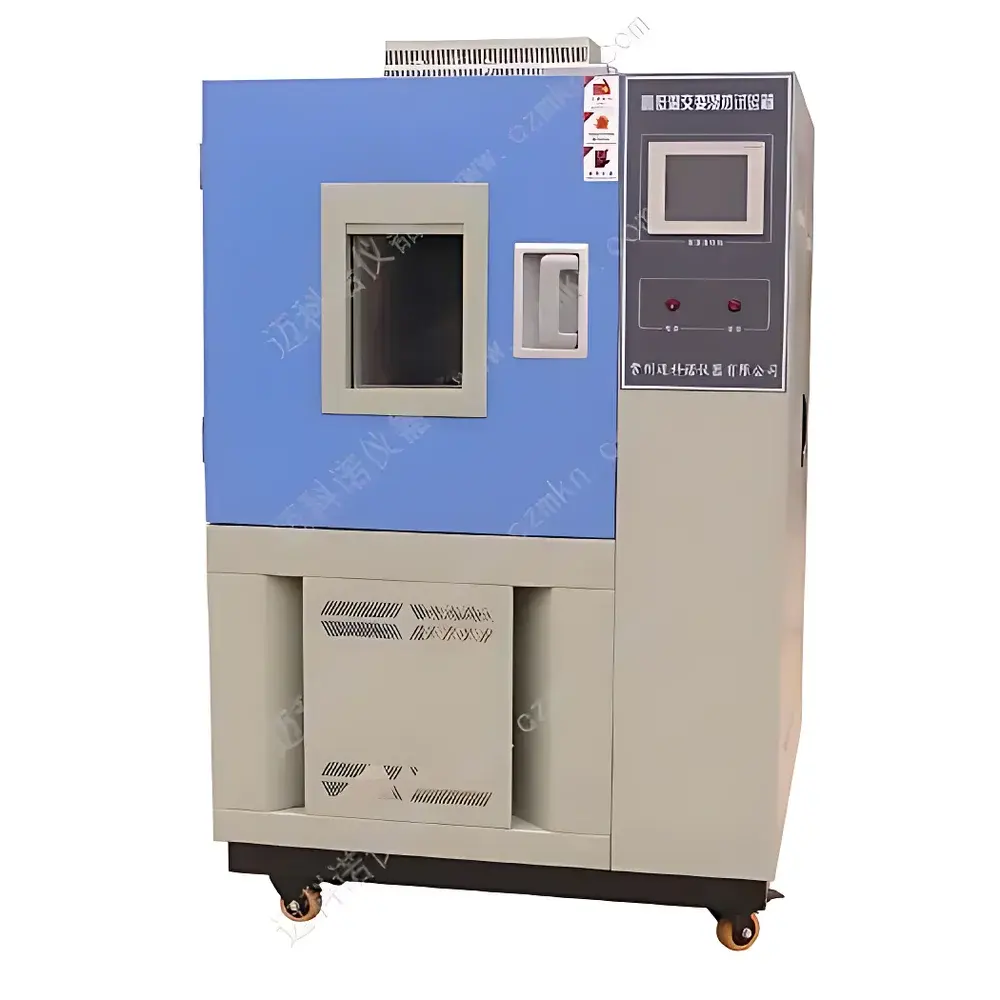
MKN GDWJ Series High-Low Temperature Alternating Test Chamber
| Brand | MKN |
|---|---|
| Model | GDWJ Series |
| Temperature Range | −20/−40/−60 to 100 °C |
| Temperature Uniformity | ≤ ±2 °C |
| Temperature Fluctuation | ≤ ±0.5 °C |
| Heating Rate | ≥ 2–3 °C/min |
| Cooling Rate | ≤ 1 °C/min |
| Internal Dimensions (L×W×H) | 400×500×500 mm to 1000×1000×1000 mm |
| Refrigeration System | Single-stage or Cascade (Air/Water-Cooled) |
| Compressor | France Tecumseh Hermetic Compressor |
| Controller | Fuji Electric or Honeywell Programmable PID Controller |
| Sensor | PT100 Platinum Resistance Thermometer |
| Insulation | Ultra-fine Glass Fiber + Rigid Polyurethane Foam |
| Safety Protections | Over-temperature, Leakage Current, Compressor High-Pressure, Fast-Blow Fuse |
Overview
The MKN GDWJ Series High-Low Temperature Alternating Test Chamber is an engineered environmental simulation system designed for rigorous thermal cycling validation of industrial components and materials under controlled, repeatable conditions. It operates on the principle of forced-air convection with precision-balanced heating and refrigeration circuits—enabling stable, programmable transitions between extreme temperature extremes. This chamber supports standardized thermal stress testing protocols required in product development, quality assurance, and regulatory compliance workflows across electronics, automotive, aerospace, defense, and academic research sectors. Its architecture adheres to fundamental thermodynamic control principles, including BTC (Balance Temperature Control) methodology, which dynamically modulates heater output and refrigerant flow to maintain setpoint stability without overshoot or oscillation—critical for evaluating long-term material fatigue, solder joint integrity, seal performance, and electronic component drift.
Key Features
- Stainless steel inner chamber (SUS304) and corrosion-resistant outer housing (SUS304 brushed finish or powder-coated Q235 steel), ensuring durability and cleanroom compatibility.
- BTC-based dual-loop temperature regulation system that automatically selects optimal refrigeration circuit configuration (single-stage or cascade) based on target setpoint—minimizing thermal inertia and improving response fidelity.
- High-efficiency insulation using layered ultra-fine glass fiber and rigid polyurethane foam (≥100 mm thickness), achieving low heat leakage and energy-conserving operation.
- Forced-air circulation via low-noise, extended-shaft stainless steel centrifugal fan with adjustable airflow distribution—ensuring uniform thermal exposure across full working volume per ISO 16750-4 and IEC 60068-2-14 requirements.
- Integrated safety architecture: independent over-temperature cut-off, compressor high-pressure switch, ground-fault circuit interrupter (GFCI), and fast-blow fuse protection—fully compliant with EN 61000-6-2/6-4 EMC standards.
- Standard viewing window (250 × 300 mm, double-glazed, heated anti-condensation), Ø25 mm test port, two adjustable stainless steel sample shelves, and LED interior lighting for real-time visual monitoring.
Sample Compatibility & Compliance
The GDWJ Series accommodates a broad spectrum of physical samples—from PCB assemblies and battery modules to polymer housings, optical sensors, and mechanical subassemblies—within configurable internal volumes ranging from 100 L to 1000 L. Its thermal performance meets or exceeds the technical specifications outlined in GB/T 10589–2008 (Low-Temperature Test Chambers), GB/T 10586–2006 (Humidity Test Chambers), and GB/T 2423.1–2023 (Cold Testing) and GB/T 2423.2–2023 (Dry Heat Testing). It is also validated against military and international standards including MIL-STD-810H Method 502.7 (Temperature Shock), GJB 150.3A–2009 (Low Temperature), GJB 150.4A–2009 (High Temperature), IEC 60068-2-1, IEC 60068-2-2, and ISO 16750-4. All units undergo factory calibration traceable to national metrology institutes and include as-built verification reports aligned with ISO/IEC 17025 documentation practices.
Software & Data Management
Equipped with Fuji Electric PXR series or Honeywell UDC3500 programmable controllers, the system supports up to 99 programmable segments per cycle—including ramp-hold-soak profiles with variable rate control. Data logging is performed at user-selectable intervals (1 s to 60 min) and stored internally for ≥30 days. Optional Ethernet or RS485 interface enables integration into centralized laboratory information management systems (LIMS) or SCADA platforms. Audit trail functionality—including operator ID, parameter changes, alarm events, and calibration history—is available upon request to satisfy FDA 21 CFR Part 11 and GLP/GMP data integrity requirements. Export formats include CSV and PDF for traceable reporting.
Applications
- Thermal cycling reliability assessment of printed circuit boards (PCBs), connectors, and semiconductor packages per JEDEC JESD22-A104.
- Validation of automotive ECU thermal endurance under ISO 16750-4 and SAE J2380 environmental stress screening protocols.
- Material coefficient of thermal expansion (CTE) evaluation for composites, adhesives, and encapsulants.
- Pre-conditioning of lithium-ion batteries prior to electrochemical testing (e.g., cycle life, impedance spectroscopy).
- Accelerated aging studies for medical device housings, sterilization packaging, and implantable electronics per ISO 11607-1.
- Environmental qualification of avionics hardware per RTCA DO-160 Section 4 (Temperature Variation).
FAQ
What temperature ranges are available for the GDWJ Series?
The GDWJ Series offers three standard low-temperature endpoints: −20 °C (GDWJ-A), −40 °C (GDWJ-B), and −60 °C (GDWJ-C), all with an upper limit of +100 °C.
Is cascade refrigeration mandatory for −60 °C operation?
Yes—achieving and sustaining −60 °C requires a two-stage cascade refrigeration system; single-stage configurations are limited to −40 °C maximum.
Can the chamber be integrated into an existing lab automation network?
Yes—RS485 Modbus RTU and optional Ethernet TCP/IP interfaces support bidirectional communication with PLCs, MES, and LIMS platforms.
Does the system comply with FDA 21 CFR Part 11 for electronic records?
Out-of-the-box controller firmware does not include Part 11 features; however, validated software upgrades with electronic signatures, audit trails, and role-based access control are available as a certified option.
What is the standard warranty coverage?
MKN provides a 12-month parts-and-labor warranty from shipment date, covering defects in materials and workmanship under normal use and maintenance conditions per ISO 9001:2015 quality management framework.



