
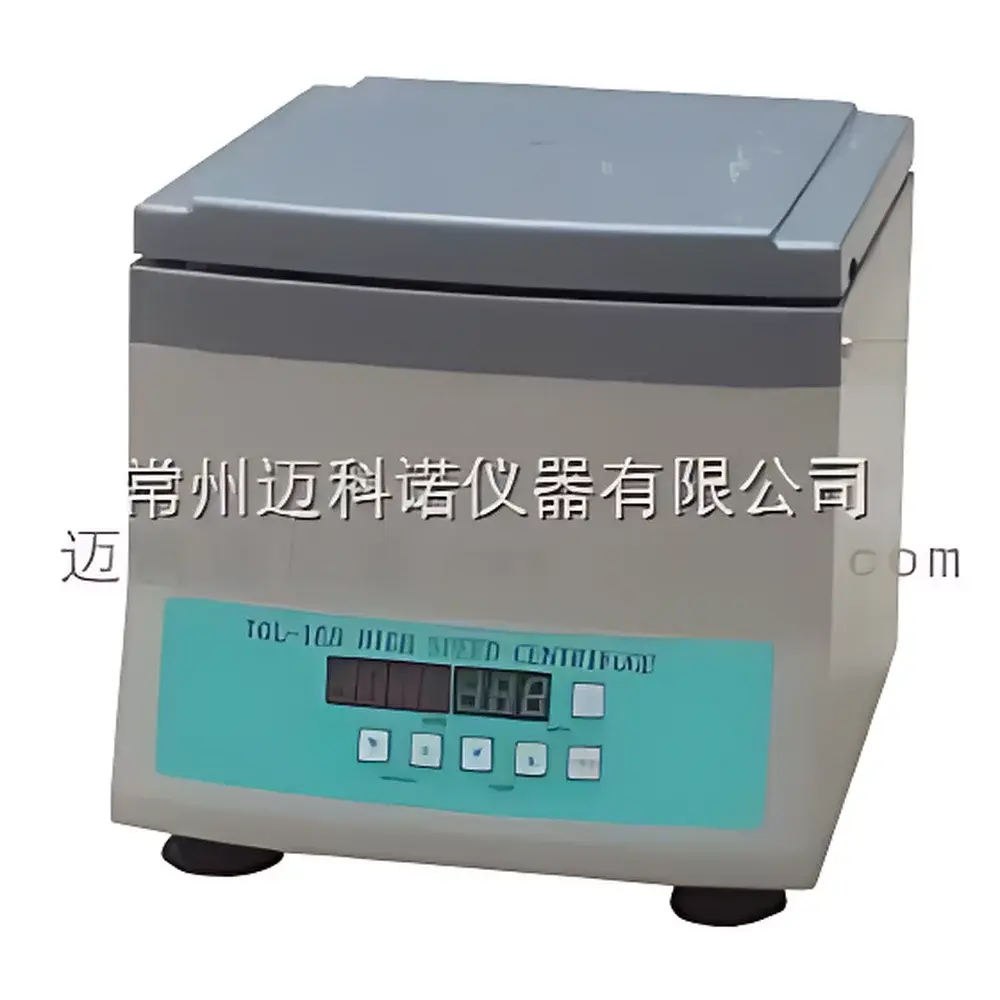
MKN TGL-16B Benchtop High-Speed Centrifuge
| Brand | MKN |
|---|---|
| Model | TGL-16B |
| Max Speed | 16,000 rpm |
| RCF | 17,000 × g |
| Capacity | 12 × 1.5 mL / 12 × 0.5 mL / 8 × 5 mL |
| Timer Range | 0–30 min |
| Noise Level | ≤60 dB(A) |
| Power Supply | AC 220 V, 50 Hz, 5 A |
| Display | Digital Touchscreen with Real-Time RPM/RCF Readout |
| Rotor Material | Anodized Aluminum Alloy |
| Balance System | Automatic Rotor Imbalance Compensation |
| Operating Temperature Rise | <12 °C after 30-min continuous run |
Overview
The MKN TGL-16B Benchtop High-Speed Centrifuge is an engineered solution for routine and high-precision separation tasks in clinical, biochemical, and molecular biology laboratories. It operates on the principle of centrifugal force generation through rapid rotational motion—accelerating suspended particles at differential sedimentation rates based on mass, density, and hydrodynamic radius. Designed for benchtop deployment, the TGL-16B delivers consistent RCF (Relative Centrifugal Force) up to 17,000 × g at its maximum rated speed of 16,000 rpm, enabling efficient pelleting of cellular organelles, microorganisms, macromolecular complexes, and subcellular fractions. Its compact footprint, low thermal signature (<12 °C temperature rise during sustained 30-minute operation), and silent acoustic profile (≤60 dB[A]) make it suitable for shared lab environments where spatial constraints and ambient noise control are critical operational considerations.
Key Features
- Digital touchscreen interface with real-time display of RPM, RCF, remaining time, and rotor status—enabling precise parameter verification and repeatable protocol execution.
- Stepless speed control across the full 0–16,000 rpm range, allowing fine-tuned optimization for delicate samples such as exosomes, ribonucleoprotein complexes, or antibody-antigen precipitates.
- Integrated automatic imbalance detection and compensation system that halts rotation upon detecting ≥5 g mass asymmetry between opposing tubes—preventing mechanical stress and ensuring long-term bearing integrity.
- High-strength anodized aluminum alloy rotor with precision-machined tube pockets; corrosion-resistant surface enhances longevity and simplifies decontamination between biosafety level 2 (BSL-2) applications.
- Brushless DC motor architecture delivering high torque at low power draw, coupled with optimized airflow ducting for passive thermal management—eliminating need for refrigeration while maintaining sample integrity.
- UL-listed safety interlock system: lid must be fully engaged and locked before initiation; rotor deceleration follows programmable brake profiles to minimize sample resuspension.
Sample Compatibility & Compliance
The TGL-16B accommodates standard microcentrifuge tubes (0.5 mL, 1.5 mL) and conical 5 mL tubes without adapter requirements—supporting common formats used in serum/plasma separation, immunoprecipitation, nucleic acid purification, and ELISA workflow steps. All rotors comply with ISO 15195:2018 (requirements for centrifuge calibration) and meet structural safety criteria per IEC 61010-1:2010 (safety requirements for electrical equipment for measurement, control, and laboratory use). The instrument supports GLP-compliant documentation when paired with external audit-trail-enabled lab information management systems (LIMS); while not inherently 21 CFR Part 11 compliant, its digital log export capability (via USB or RS-232) enables traceable record retention for QC/QA audits under ISO/IEC 17025 and CLIA frameworks.
Software & Data Management
The TGL-16B operates as a standalone instrument with embedded firmware supporting protocol storage for up to 10 user-defined methods—including speed, time, acceleration/deceleration ramp profiles, and auto-brake selection. No proprietary software installation is required; however, optional serial-to-USB data logging modules permit timestamped export of runtime parameters (start/stop times, peak RCF, total run cycles) into CSV format for integration with institutional LIMS or electronic lab notebooks (ELN). All settings are retained after power cycling, and firmware updates are delivered via secure offline binary upload using manufacturer-provided utilities—ensuring continuity in regulated environments.
Applications
- Clinical diagnostics: Rapid separation of serum from whole blood (within 5 min at 12,000 rpm), plasma preparation for coagulation assays, and isolation of peripheral blood mononuclear cells (PBMCs) prior to flow cytometry.
- Molecular biology: Clarification of lysates prior to column-based DNA/RNA extraction; pelleting of PCR reaction components for cleanup; concentration of viral vectors or extracellular vesicles.
- Immunology: Recovery of antigen-antibody immune complexes following incubation; washing steps in indirect ELISA protocols; preparation of purified IgG fractions from ascites fluid.
- Quality control labs: Particle removal from reagent stocks; validation of suspension homogeneity in colloidal formulations; stability testing of protein therapeutics under accelerated centrifugation stress.
FAQ
What rotor configurations are supported by the TGL-16B?
The unit ships with a fixed-angle aluminum rotor accommodating three interchangeable tube layouts: 12 positions for 1.5 mL tubes, 12 positions for 0.5 mL tubes, or 8 positions for 5 mL conical tubes—all without requiring tool-based adapter changes.
Does the centrifuge support refrigerated operation?
No. The TGL-16B is a non-refrigerated model optimized for ambient-temperature separations. For temperature-sensitive samples requiring thermal control, users should pre-chill samples and rotors prior to loading.
Is rotor calibration traceable to national standards?
Yes. Each rotor carries a factory-issued calibration certificate referencing NIST-traceable tachometer standards; recalibration services are available through authorized MKN service centers every 12 months or after 500 operating hours.
Can this centrifuge be integrated into automated liquid handling workflows?
While lacking native robotic interface ports (e.g., TTL or Ethernet), the TGL-16B’s programmable timer and consistent mechanical repeatability allow synchronization with third-party automation platforms via external relay-triggered start/stop signals.
What maintenance intervals are recommended?
Visual inspection of rotor integrity and lid seal condition before each use; full cleaning with 70% ethanol after biohazard runs; annual professional servicing including bearing assessment, motor current profiling, and safety interlock validation.



