
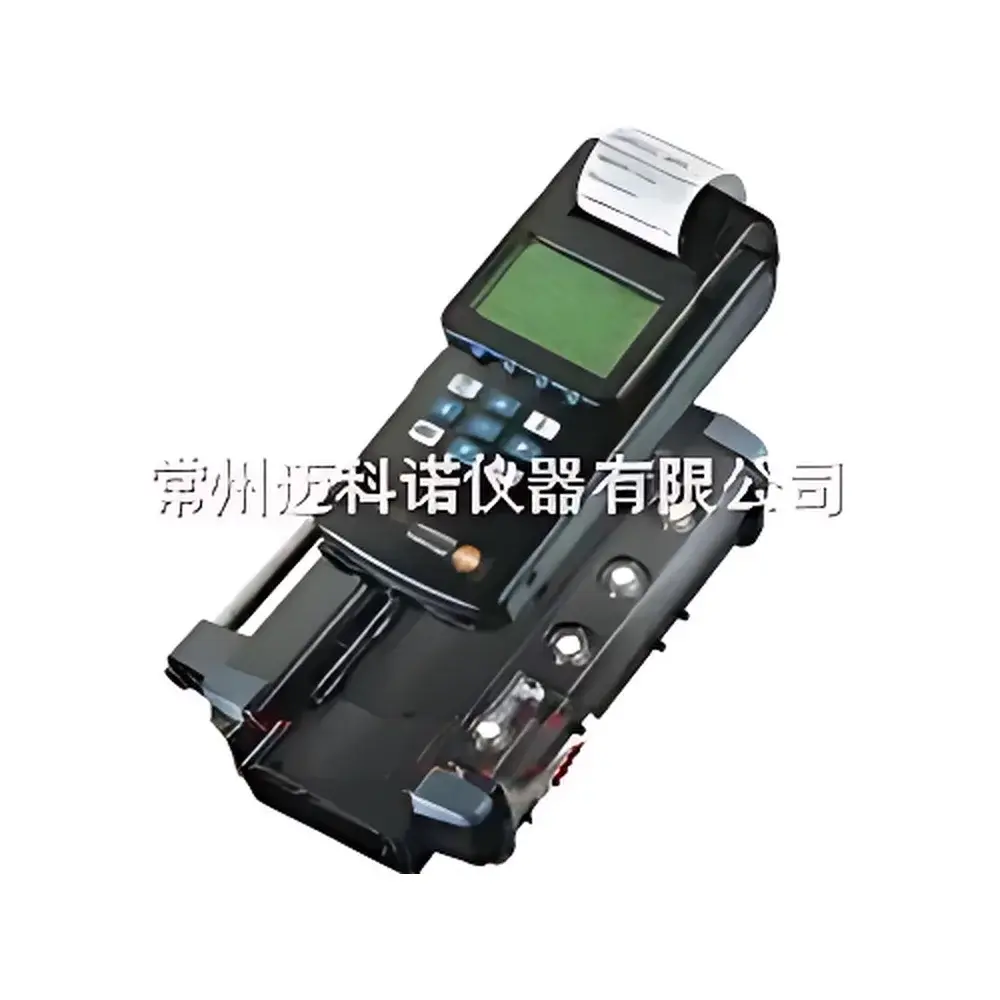
testo 350 XL Portable Flue Gas Analyzer for Environmental Monitoring
| Origin | Zhejiang, China |
|---|---|
| Manufacturer Type | Authorized Distributor |
| Origin Category | Domestic (China) |
| Model | testo 350 XL Portable Flue Gas Analyzer |
| Price Range | USD 1,400 – 7,000 |
| Instrument Type | Portable Flue Gas Analyzer |
| Accuracy | ±0.8% f.s. (O₂), ±5 ppm or ±5% m.v. (NO), ±0.1 hPa (ΔP), ±0.1 °C (K-type), ±0.1 Vol.% (CO₂ calc.) |
| Repeatability | <1% of reading (typical under stable conditions) |
| Response Time | t₉₀ ≤ 40 s (NO₂), t₉₀ ≤ 30 s (NO), t₉₀ ≤ 20 s (O₂), t₉₀ ≤ 40 s (CO) |
| Stability | <1% drift over 8 h (calibrated, 23 °C ambient) |
Overview
The testo 350 XL is a high-precision, field-deployable flue gas analyzer engineered for environmental compliance monitoring, combustion efficiency assessment, and industrial emissions verification. Based on electrochemical sensor technology for gas detection and thermocouple-based (Type K) thermal measurement, the instrument delivers trace-level quantification of regulated combustion byproducts—including O₂, CO, NO, NO₂, SO₂, H₂S, and hydrocarbons—alongside critical physical parameters such as differential pressure, flow velocity, temperature, and humidity. Its integrated Peltier-cooled gas conditioning unit ensures condensate removal and sample stabilization prior to analysis, enabling reliable operation in high-moisture flue streams up to 95% RH. Designed for adherence to international stack testing protocols, the testo 350 XL supports data acquisition in accordance with EN 15267-3, EN 14181 (QAL2/QAL3), ISO 12039, and EPA Method 6C/7E prerequisites for portable emission monitoring systems (PEMS).
Key Features
- Modular sensor architecture: Standard O₂, CO (with auto-shutoff and dilution function), NO, NO₂, and differential pressure measurement; optional SO₂, H₂S, HC, and CO₂ sensors—only compatible with the XL platform
- Integrated gas conditioning system: Peltier cooler + peristaltic pump + fresh-air purge valve for continuous dew point control and sensor protection
- Dual-channel temperature input: Supports two simultaneous K-type probes (–40 °C to +1200 °C) with ±0.5 °C accuracy in low-range and ±0.5% m.v. above 100 °C
- Multi-parameter calculation engine: Real-time derivation of excess air (λ), flue gas loss (qA), dew point, CO₂ concentration (by O₂ balance), and combustion efficiency
- Ruggedized portable design: IP54-rated housing, magnetic rear mount, 3200 g weight, and operational range from –5 °C to +45 °C
- Flexible power options: Rechargeable NiMH battery (2–3 h runtime with active gas conditioning), 110/230 V AC adapter, or direct analysis box supply
- Enhanced human interface: Backlit graphical display, customizable soft keys, optional capacitive touchscreen, and RS232 PC interface for firmware updates and data export
Sample Compatibility & Compliance
The testo 350 XL accommodates heterogeneous sampling environments across stationary combustion sources—including boilers, furnaces, kilns, incinerators, and cogeneration units. Its heated probe variants (up to 650 °C) and corrosion-resistant stainless-steel sampling lines ensure compatibility with acidic, particulate-laden, or high-temperature flue gases. All electrochemical sensors comply with IEC 60741-2 for gas detector performance and undergo factory calibration traceable to NIST-certified reference standards. The device meets electromagnetic compatibility requirements per EN 61326-1 and carries CE marking for use within the European Economic Area. For regulatory reporting, raw sensor outputs and calculated parameters are stored with full metadata (date/time, probe ID, ambient conditions), supporting audit readiness under ISO/IEC 17025 and EPA 40 CFR Part 60 Subpart QA.
Software & Data Management
Data logging is performed internally to a 1 MB non-volatile memory, retaining up to 250,000 measurement values with timestamp, sensor status flags, and user-defined project tags. Export is supported via RS232 to testo’s proprietary software (testo Comsoft Basic/Professional), which enables spectral trend visualization, automated report generation (PDF/CSV), and GLP-compliant electronic signatures. Audit trail functionality records all configuration changes, calibration events, and user logins—meeting FDA 21 CFR Part 11 requirements when deployed in validated environments. Optional cloud synchronization (via USB-to-WiFi bridge) allows remote fleet management and real-time dashboarding for multi-site environmental health & safety (EHS) teams.
Applications
- Stack emission testing per local air quality regulations (e.g., China’s GB 13271, EU’s IED, US EPA NSPS)
- Boiler tuning and energy optimization through λ and qA analysis
- Pre-commissioning verification of SCR/SNCR denitrification systems
- Indoor air quality (IAQ) surveys using CO/CO₂/humidity modules
- Field validation of continuous emission monitoring systems (CEMS)
- Academic and research studies on combustion kinetics and pollutant formation pathways
FAQ
What gas species can the testo 350 XL measure natively, and which require optional sensors?
The base configuration includes O₂, CO (with automatic shut-off and dilution), NO, NO₂, and differential pressure. SO₂, H₂S, total hydrocarbons (HC), and H₂ sensors are exclusive to the XL platform and must be ordered separately.
Is the instrument suitable for high-humidity flue gas applications?
Yes—the integrated Peltier cooler maintains sample dew point below 4 °C, and the condensate trap with peristaltic pump ensures continuous removal of liquid water, preserving sensor integrity and measurement fidelity at up to 95% relative humidity.
How is calibration traceability ensured?
Each sensor module ships with individual calibration certificates referencing NIST-traceable gas standards. Field calibration is supported via zero/span gas ports and testo’s certified calibration kits (e.g., 100 ppm NO in N₂, 10% O₂ in N₂), with full calibration history logged in device memory.
Can the testo 350 XL generate legally admissible test reports?
When used with Comsoft Professional software and configured with electronic signature workflows, reports include digital seals, operator IDs, calibration logs, and time-stamped raw data—fulfilling evidentiary requirements under ISO 17025 and regional environmental agency guidelines.
What is the expected service life of electrochemical sensors under routine use?
Typical operational lifespan is 24–36 months for O₂ and CO sensors, and 18–24 months for NO/NO₂ modules, assuming average exposure to <500 ppm CO and <200 ppm NOx; lifetime is extended significantly by use of the fresh-air purge valve during standby.
Related Products







