
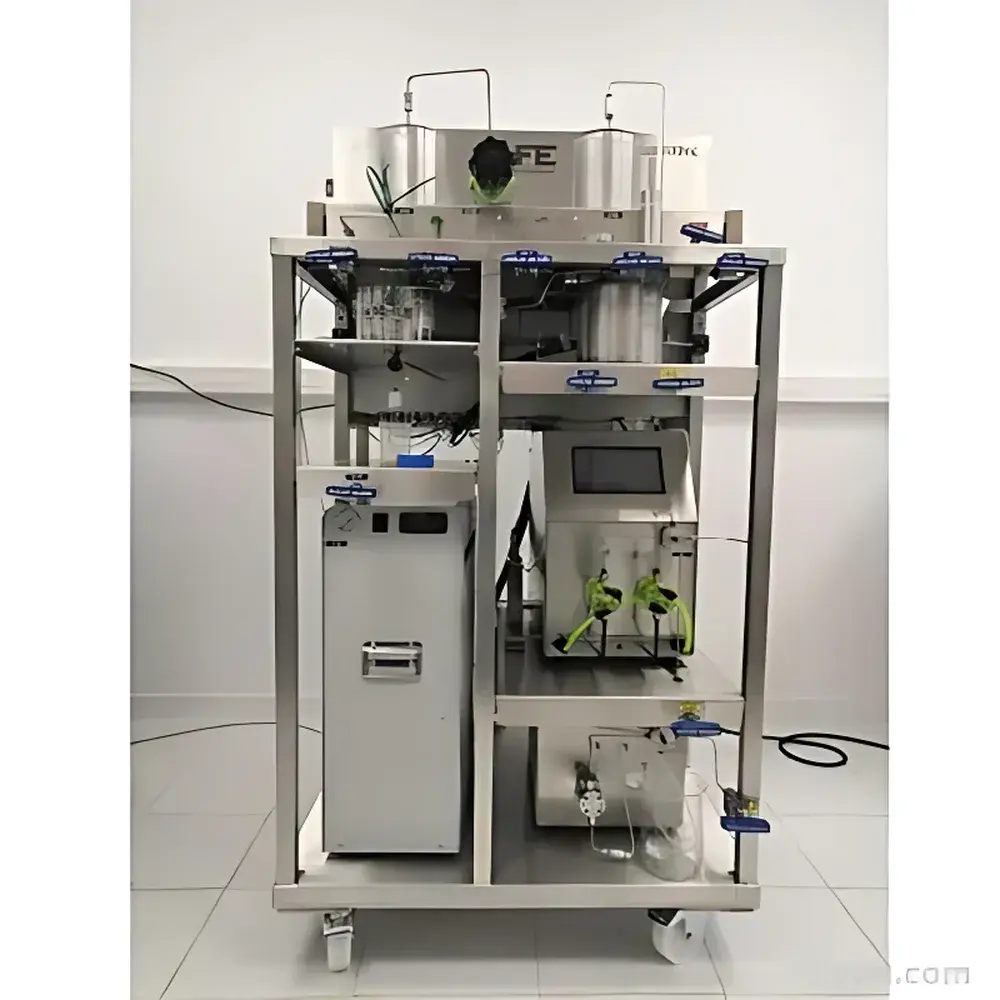
SFE Process SFE LAB100 Supercritical CO₂ Extraction System
| Brand | SFE Process |
|---|---|
| Origin | France |
| Model | SFE LAB100 |
| Maximum Pressure | 1000 bar |
| Maximum Temperature | 150 °C |
| Extraction Vessel Volume | 100 mL |
| CO₂ Mass Flow Rate | 70 g/min |
| Number of Independent Extraction Channels | 2 |
| Co-solvent Pump | Integrated |
| Fractionation Vessels | 2 × 300 mL |
| Cryogenic Trap Capacity | Standard |
| Automatic Valve Switching for Vessel Transfer | Yes |
| Flow Control | Precision Mass Flow Meters |
| Control System | PLC-based, Fully Automated, Recipe-Driven, Unattended Operation |
| Compliance | PED 2014/68/EU (CE Marked), FDA 21 CFR Part 11 Ready, GMP-Compliant Architecture |
| Application Scope | Laboratory R&D, Pharmaceutical Development, Clinical Research, Natural Product Isolation |
Overview
The SFE Process SFE LAB100 Supercritical CO₂ Extraction System is a precision-engineered, dual-channel laboratory-scale platform designed for reproducible, scalable, and regulatory-compliant supercritical fluid extraction (SFE) using carbon dioxide as the primary solvent. Operating at pressures up to 1000 bar and temperatures up to 150 °C, the system enables full thermodynamic control over solvation power, selectivity, and mass transfer kinetics—critical parameters in the isolation of thermolabile, non-polar, or moderately polar bioactive compounds from solid botanical matrices. Its modular architecture integrates high-integrity pressure containment (PED 2014/68/EU certified), real-time mass flow monitoring, cryogenic trapping for volatile fraction recovery, and automated sequential vessel switching—making it suitable for method development aligned with ICH Q5, Q8, and Q9 frameworks. Unlike conventional solvent-based extraction, supercritical CO₂ eliminates residual organic solvent concerns, supports green chemistry principles (EPA Safer Choice compatible), and delivers extracts with inherent microbiological stability and oxidative integrity.
Key Features
- Dual independent 100 mL extraction vessels with simultaneous or staggered operation, enabling comparative studies or parallel process optimization
- Full-range pressure regulation from ambient to 1000 bar via servo-controlled hydraulic intensifier, with redundant pressure relief and burst disc protection
- Precision CO₂ delivery at up to 70 g/min, calibrated via Coriolis-type mass flow meters traceable to NIST standards
- Integrated co-solvent pump supporting ethanol, methanol, or isopropanol addition (0–15% w/w) with programmable gradient profiles
- Two 300 mL fractionation vessels with individually controllable temperature zones (−20 °C to 80 °C) and pressure-regulated phase separation
- Cryogenic trap system with liquid nitrogen or mechanical cooling options for low-boiling volatiles (e.g., monoterpenes, sesquiterpenes)
- PLC-based HMI interface with password-protected user roles, electronic signature support, and audit trail logging compliant with 21 CFR Part 11 requirements
- Preloaded extraction protocols for common matrices (e.g., Cannabis sativa flower, rosemary leaves, green tea, turmeric rhizomes) with adjustable hold times, ramp rates, and depressurization profiles
Sample Compatibility & Compliance
The SFE LAB100 accommodates powdered, granulated, or pelletized solid samples up to 80 g per 100 mL vessel (density-dependent), including dried plant material, microbial biomass, food by-products, and pharmaceutical intermediates. Sample contact surfaces are constructed from electropolished AISI 316L stainless steel with Ra ≤ 0.4 µm finish, meeting ASME BPE-2022 surface hygiene criteria. The system conforms to European Pressure Equipment Directive (PED 2014/68/EU) and carries CE marking for safe operation within EU laboratories. Its software architecture supports ALCOA+ data integrity principles and includes configurable electronic signatures, time-stamped audit trails, and immutable raw data storage—enabling compliance with FDA 21 CFR Part 11, EU Annex 11, and ISO/IEC 17025 accreditation requirements. GMP-ready documentation packages—including DQ/IQ/OQ/PQ templates, calibration records, and material certificates—are provided upon delivery.
Software & Data Management
The embedded control software features a Windows-based engineering interface with dual-mode operation: guided wizard mode for novice users and advanced script mode for custom sequence programming (using IEC 61131-3 Structured Text). All process parameters—including pressure, temperature, flow rate, vessel weight change (via integrated load cells), and trap condensate mass—are sampled at 100 Hz and archived in .CSV and native binary formats. Data export supports direct integration with LIMS platforms via OPC UA or FTPS. Version-controlled recipe management allows secure storage of validated methods with revision history, user attribution, and approval workflows. Raw chromatographic data (when coupled with inline GC or FTIR) can be time-synchronized and cross-referenced with extraction events for multivariate correlation analysis.
Applications
- Pharmaceutical R&D: Isolation of cannabinoids (CBD, CBG, Δ9-THC), alkaloids (vinblastine, paclitaxel precursors), and terpenoid lactones under cGMP-aligned conditions
- Nutraceutical development: Selective decaffeination of green coffee beans, carotenoid enrichment from marigold petals, and tocopherol recovery from soy lecithin
- Clinical biomarker research: Extraction of lipid mediators (resolvins, protectins) from human tissue biopsies without enzymatic degradation
- Flavor & fragrance industry: Solvent-free isolation of delicate headspace volatiles from citrus peels or jasmine flowers
- Academic methodology studies: Kinetic modeling of diffusion-controlled extraction, phase behavior mapping in ternary CO₂–co-solvent–solute systems
- Regulatory reference standard preparation: Production of certified reference materials (CRMs) traceable to NIST SRMs for LC-MS quantitation
FAQ
What safety certifications does the SFE LAB100 hold?
The system complies with PED 2014/68/EU, carries CE marking, and meets EN 13445 design and fabrication standards for unfired pressure vessels. Full certification dossiers—including risk assessments, FMEA reports, and third-party inspection records—are supplied.
Can the system be integrated with downstream analytical instrumentation?
Yes. It features standardized ¼″ VCR ports, analog/digital I/O interfaces, and Modbus TCP connectivity for seamless coupling with GC-MS, HPLC, or real-time FTIR systems.
Is remote monitoring and unattended overnight operation supported?
Absolutely. The PLC controller supports SNMP-based network alerts, email notifications on parameter deviation, and secure VPN-accessible web HMI for real-time supervision across global sites.
How is method transfer from LAB100 to production-scale SFE systems ensured?
SFE Process provides dimensionless scaling protocols based on reduced pressure/temperature, mass flux equivalence, and residence time normalization—validated across its 100 L to 400 L commercial platforms.
Does the system support cleaning validation per pharmaceutical guidelines?
Yes. It includes CIP-compatible wetted path geometry, residue sampling ports, and automated cleaning cycle logging with conductivity and temperature verification points.



