
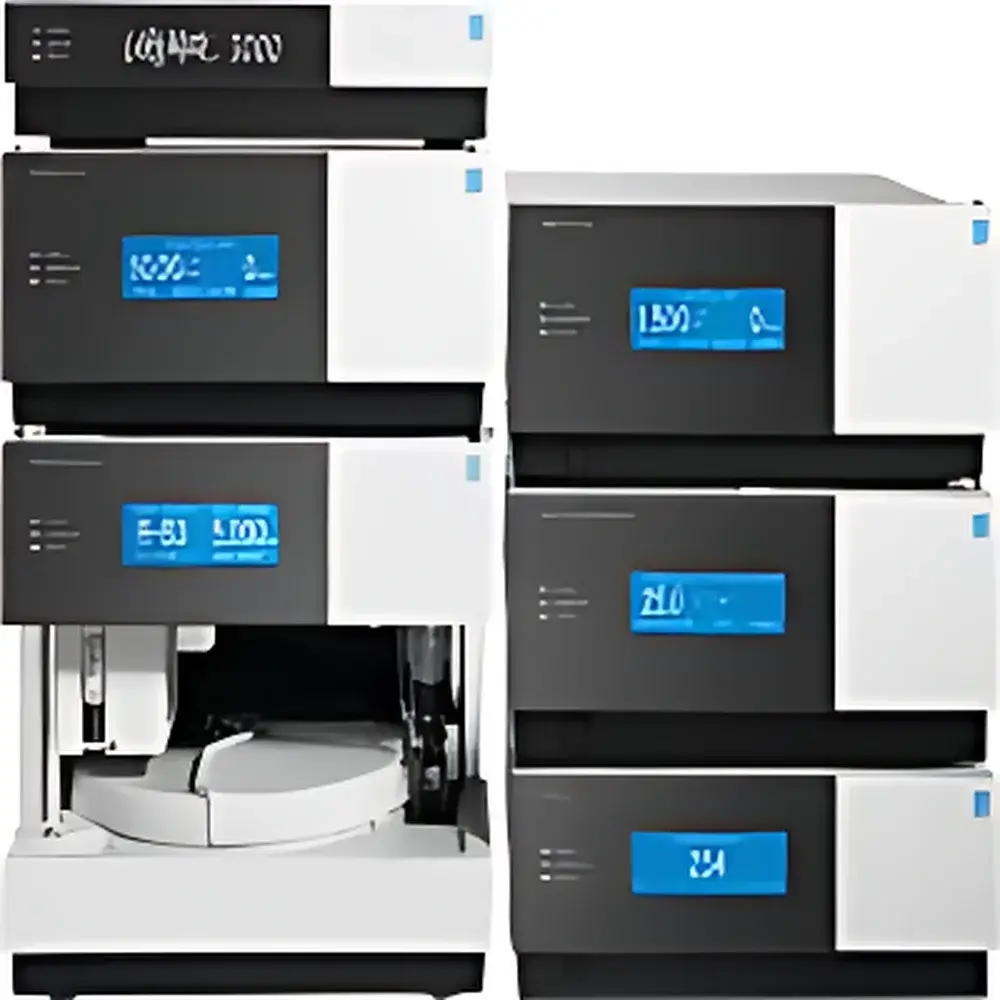
Thermo Fisher UltiMate 3000 Dual Gradient Liquid Chromatography System
| Brand | Thermo Fisher |
|---|---|
| Origin | USA |
| Manufacturer | Thermo Fisher Scientific |
| Category | Imported Instrument |
| Model | UltiMate 3000 DGLC |
| Instrument Type | Multidimensional Liquid Chromatograph |
| Pump Configuration | Dual Ternary Gradient System (Two Independent Ternary Pumps) |
| Solvent Channels | 6 per pump |
| Degasser | Integrated Online Vacuum Degasser |
| Detector Options | UV-Vis, Fluorescence |
| Autosampler | Dual-Position Rack-Based with Needle Wash (Cross-contamination < 0.005%) |
| Injection Cycle Time | ≤15 s |
| Column Oven | Temperature-Controlled (Typical Range: 5–80 °C) |
| Flow Rate Range | 10 mL/min (Analytical), 2.5 mL/min (Micro), 50 nL/min (Nano) |
| Material Options | Stainless Steel or Bio-Inert Titanium System |
| Software | Chromeleon Chromatography Data System (CDS) v7.x or later |
| Compliance | Supports 21 CFR Part 11, GLP/GMP Audit Trail, and ASTM D7974 / ISO 17025 workflows |
Overview
The Thermo Fisher UltiMate 3000 Dual Gradient Liquid Chromatography (DGLC) System is an engineered multidimensional HPLC platform designed for maximum method flexibility, analytical robustness, and operational efficiency in regulated and research-intensive laboratories. Built upon Thermo Fisher’s decades-long leadership in liquid chromatography, the DGLC architecture integrates two independent ternary gradient pumps—each capable of precise solvent blending across three channels—within a single instrument chassis. This dual-pump configuration enables true two-dimensional liquid chromatography (2D-LC), comprehensive online solid-phase extraction (SPE-LC), and parallel or serial gradient elution strategies without hardware duplication. The system operates on fundamental principles of high-pressure liquid separation, where mobile phase composition gradients are dynamically controlled to resolve co-eluting analytes across orthogonal separation mechanisms (e.g., reversed-phase × hydrophilic interaction or size exclusion × ion exchange). Its modular design supports seamless integration with mass spectrometry (LC/MS), making it suitable for applications ranging from small-molecule pharmaceutical QC to intact protein characterization.
Key Features
- Dual ternary gradient architecture: Two fully independent, high-precision pumps (each with six solvent channels and integrated vacuum degassing) enable simultaneous or coordinated gradient delivery for 2D-LC, heart-cutting, or comprehensive modulation.
- Bio-inert titanium fluidic path option: Minimizes metal-catalyzed degradation and adsorption of sensitive biomolecules—including monoclonal antibodies, peptides, and oligonucleotides—ensuring high recovery and reproducibility in biopharmaceutical analysis.
- Shared high-precision autosampler: Rack-based dual-position design with external needle wash delivers ≤15-second injection cycle time and cross-contamination < 0.005%, validated per USP and ICH Q2(R2) guidelines.
- Modular flow-path scalability: Configurable for analytical (up to 10 mL/min), microbore (up to 2.5 mL/min), or nanoflow (down to 50 nL/min) applications—without hardware reconfiguration.
- Intelligent column oven: Maintains temperature stability ±0.1 °C across 5–80 °C range; accommodates up to two columns with independent thermal control for multi-column switching protocols.
Sample Compatibility & Compliance
The UltiMate 3000 DGLC supports a broad spectrum of sample matrices—including plasma, serum, tissue homogenates, fermentation broths, environmental extracts, and synthetic reaction mixtures—without requiring manual sample pre-treatment when coupled with online SPE-LC modules. Its titanium-compatible configuration meets stringent requirements for biologics analysis under ICH Q5E and USP analytical instrument qualification. The system complies with FDA 21 CFR Part 11 for electronic records and signatures, including full audit trail logging, user access controls, and electronic signature enforcement. It is also aligned with ISO/IEC 17025:2017 for testing laboratory competence and supports GLP-compliant workflows through Chromeleon CDS’s validated method templates and change-controlled reporting.
Software & Data Management
Chromeleon Chromatography Data System (CDS) v7.x serves as the unified control and data handling platform. It provides native support for dual-gradient method development, including automated generation of 2D-LC contour plots, retention time alignment algorithms, and peak tracking across orthogonally separated dimensions. The software enables concurrent execution of two independent methods—one per pump—using shared autosampler racks and column ovens, optimizing instrument utilization. All critical parameters—including pressure, flow rate, gradient profile, detector response, and temperature—are continuously monitored and logged with timestamped metadata. Database-driven report generation supports customizable templates compliant with regulatory submission formats (e.g., eCTD, FDA Form 356h). Remote monitoring and secure cloud backup options are available via optional Chromeleon Connect modules.
Applications
- Pharmaceutical impurity profiling: Resolving structurally similar degradants and process-related impurities using comprehensive 2D-LC with orthogonal column chemistries.
- Biopharmaceutical characterization: Intact mass analysis of mAbs, subunit mapping, and glycan profiling via online SPE-LC coupled to high-resolution MS.
- Clinical biomarker discovery: Automated quantification of low-abundance metabolites and peptides in complex biofluids using heart-cut 2D-LC with internal standard calibration.
- Environmental contaminant screening: Multi-residue analysis of pesticides, PFAS, and pharmaceutical residues in wastewater using tandem SPE-LC/MS workflows.
- Quality control of oligonucleotide therapeutics: Separation of failure sequences and diastereomers using ion-pairing RP × AEX 2D-LC under GMP conditions.
FAQ
What distinguishes the UltiMate 3000 DGLC from conventional binary or quaternary HPLC systems?
Unlike single-pump architectures, the DGLC employs two synchronized ternary gradient pumps—enabling true multidimensional separation, online sample cleanup, and method redundancy without external switching valves or secondary instruments.
Can the DGLC be used for both small-molecule and large-biomolecule analysis?
Yes. With stainless steel or optional titanium fluidic paths, plus scalable flow modules, the system supports applications from low-MW drug substances to intact proteins and nucleic acids.
Is Chromeleon CDS qualified for regulated environments?
Yes. Chromeleon v7.x is validated for 21 CFR Part 11 compliance, including electronic signatures, audit trails, and role-based access control—fully documented in Thermo Fisher’s IQ/OQ/PQ protocols.
How does the system handle method transfer between labs?
Chromeleon’s method portability framework preserves all instrument-specific parameters, gradient profiles, and data processing rules—ensuring consistent performance across globally distributed UltiMate 3000 DGLC installations.
What maintenance intervals are recommended for optimal uptime?
Pump seals and check valves require replacement every 6–12 months depending on solvent aggressiveness and daily usage; autosampler syringes and needle seats are inspected quarterly per Thermo Fisher’s Preventive Maintenance Guide (PMG-ULT3000-DGLC).




