
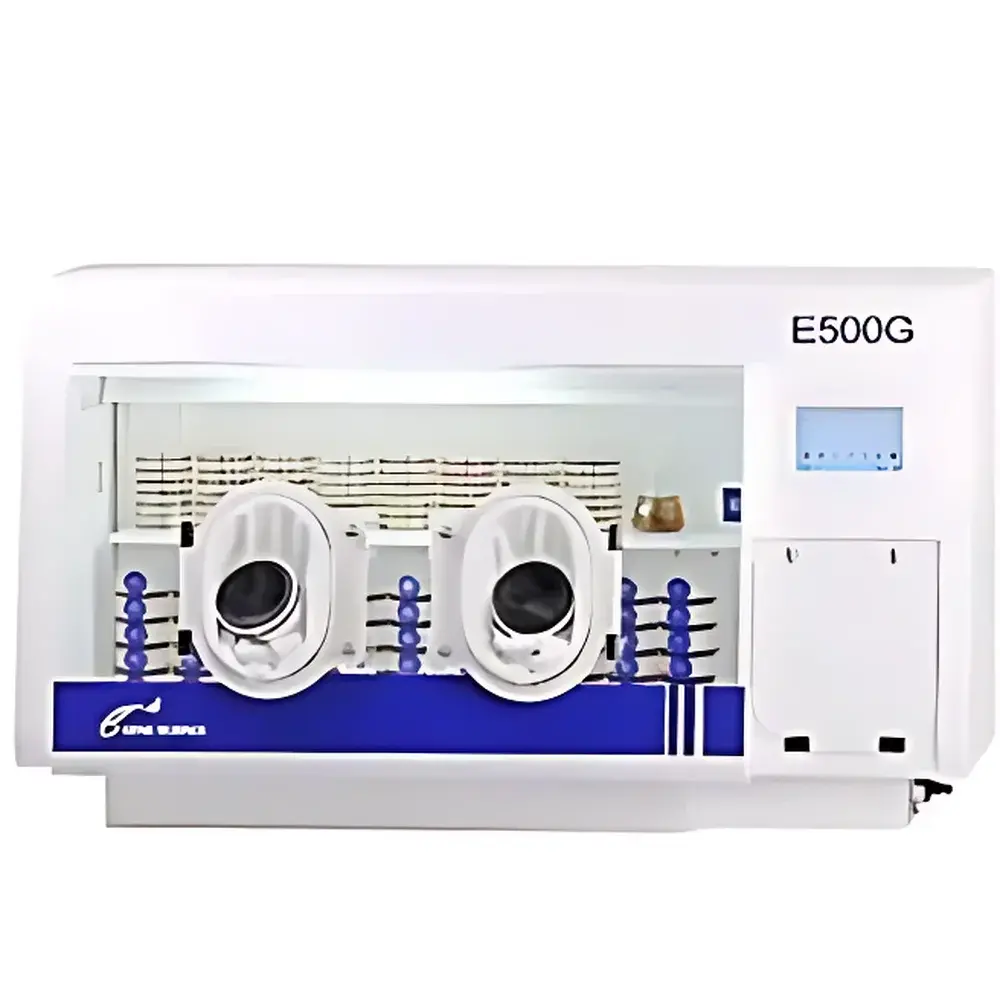
GeneScience E500G Anaerobic Workstation
| Brand | GeneScience |
|---|---|
| Origin | USA |
| Manufacturer Type | Authorized Distributor |
| Origin Category | Imported |
| Model | E500G |
| Price Range | USD $13,500 – $68,000 (FOB) |
| Temperature Control Range | Ambient +3°C to 52°C |
| Temperature Uniformity & Stability | ±0.1°C |
| Humidity Range | Up to 90% RH (with optional ultrasonic humidification) |
Overview
The GeneScience E500G Anaerobic Workstation is an engineered environmental isolation system designed for precise, reproducible cultivation and manipulation of obligate anaerobes, microaerophiles, and oxygen-sensitive cell lines under strictly controlled atmospheric conditions. Utilizing a closed-chamber architecture with continuous gas-phase regulation, the E500G maintains oxygen concentrations below 5 ppm via catalytic deoxygenation—enabled by a high-efficiency palladium catalyst that requires no routine reactivation. Its operational principle relies on nitrogen purging combined with hydrogen-mediated oxygen scavenging in a CO₂-balanced atmosphere (10% H₂ / 10% CO₂ / 80% N₂), ensuring thermodynamic stability of the anaerobic environment during sample transfer, inoculation, subculture, media switching, and real-time colony observation. The workstation meets foundational requirements for ISO 11133:2014 (microbiological culture media preparation), CLSI M45-A3 (methods for antimicrobial susceptibility testing of anaerobes), and supports GLP-compliant workflows in clinical microbiology, food safety testing, and probiotic R&D laboratories.
Key Features
- Integrated rapid-transfer airlock (12 L capacity) enabling full-cycle N₂ purge in ≤60 seconds; accommodates up to 40 × 90 mm Petri dishes or vessels ≤185 mm in height per cycle
- Intelligent airlock protection logic prevents internal atmosphere compromise during door actuation
- One-handed, single-touch operation of inner airlock door via capacitive touch interface
- Large internal volume supporting simultaneous processing: ≥850 × 90 mm Petri dishes, ≥80 × 250 mL Erlenmeyer flasks, ≥60 × 500 mL flasks, ≥100 × 250 mL reagent bottles, or >100 stomacher bags
- Removable side panel for unobstructed access—facilitating insertion of compact ancillary equipment (e.g., colony pickers, mini-centrifuges) and thorough chamber sanitation
- Chemically validated cleaning protocol using EDTA tetrasodium + tert-butylphenol polyoxyethylene lauryl sulfate solution—non-corrosive to stainless-steel interior surfaces (304 grade)
- Dual-gas supply compatibility: single-cylinder (premixed 10% H₂ / 10% CO₂ / 80% N₂) or dual-cylinder (separate N₂ + premix) configuration with automatic gas routing logic
- 7-inch color TFT touchscreen interface for real-time parameter adjustment, system diagnostics, alarm logging (audible + visual), and event history review
- Active humidity control (0–85% RH standard; up to 90% RH with optional ultrasonic humidifier) paired with semiconductor-based condensate removal
- Standard 254 nm UV-C germicidal lamp and fluorescent lighting; optional HEPA filtration (ISO Class 5 / Grade 100 cleanroom equivalent)
- Anaerobic status verification via dual-mode indicator: chemical redox dye pump system (visual endpoint) + optional digital O₂ sensor (0–3000 ppm resolution)
- Palladium catalyst cartridge (600 g) with extended service life (>12 months under typical usage); integrated catalyst regeneration monitoring
- Long-sleeve glove port system featuring vacuum-N₂ exchange cycle—guaranteeing O₂-free hand entry without residual atmospheric ingress
- Foot-switch-actuated vacuum/N₂ cycling; external vacuum pump included as standard
- Internal GFCI-protected AC outlets (110–120 V, 50/60 Hz); USB data export for audit-trail-capable temperature, humidity, O₂, and gas-flow logs
- Auto-shutoff valve triggers after 5 minutes of uninterrupted gas flow—preventing over-pressurization and inert gas waste
Sample Compatibility & Compliance
The E500G supports standardized cultivation of clinically and industrially relevant anaerobes including Shigella spp. (anaerobic, 41.5°C), Helicobacter pylori and Campylobacter jejuni (microaerophilic, 25–42°C), Clostridium perfringens (anaerobic, 36°C), Clostridium botulinum (anaerobic, 35°C), and lactic acid bacteria (anaerobic, 36°C). It enables concurrent multi-gas experiments—e.g., differential CO₂ setpoints for Bifidobacterium (5–10% CO₂) versus Prevotella (0% CO₂). The system complies with ASTM E2924-21 (standard guide for validation of anaerobic systems), aligns with USP / microbial limits testing prerequisites, and supports 21 CFR Part 11–ready electronic record retention when paired with validated data management software.
Software & Data Management
All operational parameters—including chamber temperature (±0.1°C display resolution), relative humidity, O₂ concentration (ppm), gas flow rates, and airlock cycle timestamps—are logged continuously to internal flash memory. Data export occurs via USB 2.0 interface in CSV format, compatible with LIMS integration and statistical process control (SPC) platforms. Alarm events (e.g., O₂ excursion >10 ppm, humidity deviation >±3% RH, temperature drift >±0.3°C) generate timestamped entries with cause-code identifiers. Optional firmware upgrade enables encrypted data export and role-based user access control—supporting audit-ready documentation for FDA inspections and ISO 17025 accreditation.
Applications
- Clinical microbiology: Isolation and identification of fastidious anaerobes from stool, wound, and blood cultures per CLSI M11-A8 guidelines
- Food & beverage safety: Enumeration of Clostridium spp. and Sulphite-reducing clostridia in meat, dairy, and fermented products (ISO 7937, ISO 15213)
- Probiotic development: Anaerobic fermentation optimization for Lactobacillus, Bifidobacterium, and next-generation consortia
- Gut microbiome research: Stable co-culture of obligate anaerobes with facultative strains under physiologically relevant gas gradients
- Pharmaceutical QC: Sterility testing of oxygen-labile biologics and excipients under ISO 11737-1–compliant conditions
- Veterinary diagnostics: Pathogen recovery from avian and porcine gastrointestinal samples requiring microaerobic or strict anaerobic incubation
FAQ
What gas mixtures are supported for anaerobic operation?
The E500G accepts either a single pre-mixed cylinder (10% H₂ / 10% CO₂ / 80% N₂) or dual independent cylinders (pure N₂ + premix), with automatic pressure-balanced switching logic.
Is the internal atmosphere validated to meet ISO Class 5 (Grade 100) standards?
Yes—when equipped with the optional HEPA filtration module and operated within specified maintenance intervals (filter replacement every 12 months), the chamber achieves ≤3,520 particles/m³ ≥0.5 µm, satisfying ISO 14644-1 Class 5.
Can the workstation accommodate instruments such as colony pickers or small centrifuges?
Yes—the removable side panel and internal dimensions (W1405 × H740 × D720 mm) permit installation of benchtop devices up to 650 mm in width and 700 mm in height.
How is catalyst performance monitored over time?
The system tracks cumulative operating hours and logs O₂ breakthrough events; catalyst replacement is recommended after 12 months or upon two consecutive O₂ excursions above 5 ppm.
Does the E500G support 21 CFR Part 11 compliance for electronic records?
With optional firmware and external audit-log server integration, the workstation supports electronic signature capture, user authentication, and immutable record archiving—meeting core technical controls outlined in FDA guidance.






