
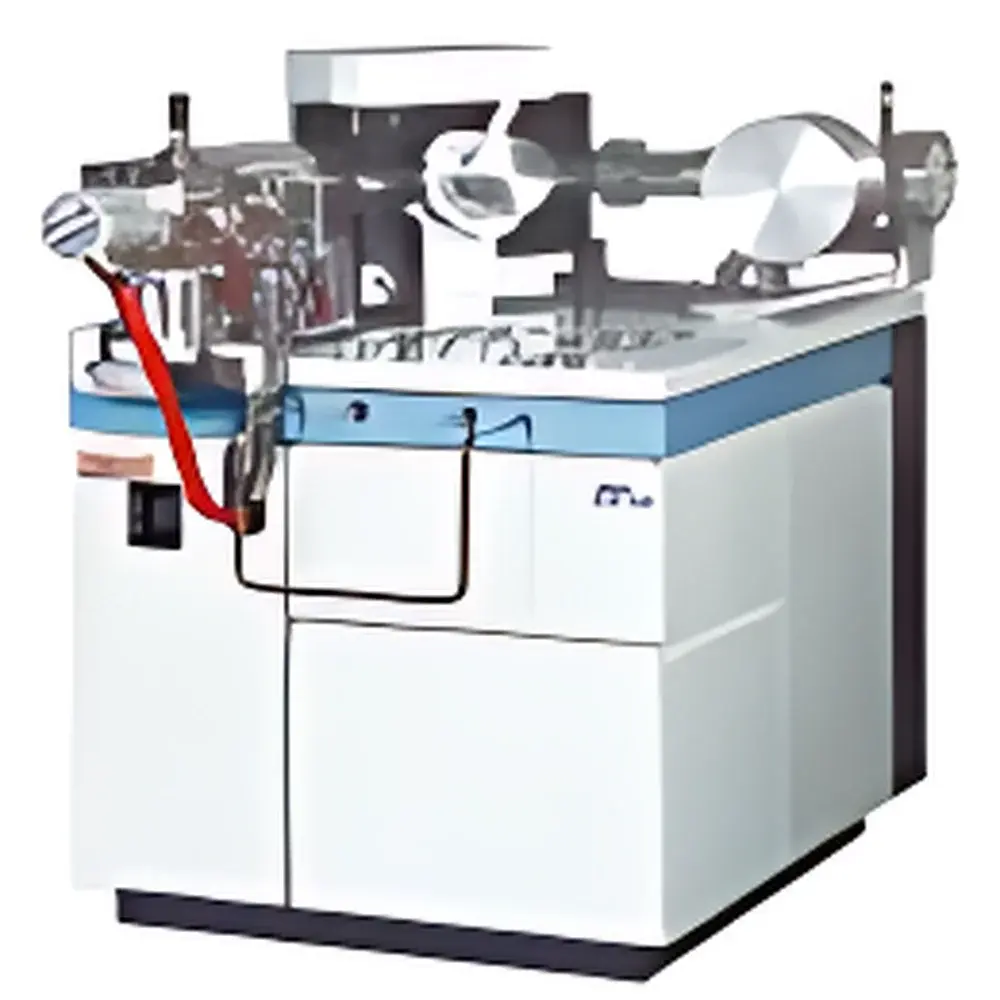
Thermo Scientific MAT 253 Isotope Ratio Mass Spectrometer
| Brand | Thermo Fisher |
|---|---|
| Origin | Germany |
| Manufacturer Type | Original Equipment Manufacturer (OEM) |
| Product Origin | Imported |
| Model | MAT 253 |
| Instrument Type | Stable Gas Isotope Ratio Mass Spectrometer |
| Mass Range | m/z 1–150 |
| Magnet Radius | 460 mm |
| Ion Source & Analyzer | All-Metal Vacuum-Sealed Construction |
| Supported Isotopic Ratios | δ²H, δ¹³C, δ¹⁵N, δ¹⁸O, δ³⁴S (in SO₂ and SF₆), δ²⁹Si, plus noble gases (Ar, Kr, Xe) |
Overview
The Thermo Scientific MAT 253 Isotope Ratio Mass Spectrometer (IRMS) is a high-precision, dual-collector magnetic sector instrument engineered for the accurate and reproducible measurement of stable isotope ratios in gaseous samples. Based on the established principles of magnetic sector mass spectrometry—where ions are accelerated through a fixed potential and separated by momentum in a high-homogeneity magnetic field—the MAT 253 delivers exceptional mass resolution and long-term signal stability. Its design centers on minimizing isotopic fractionation during ionization and transmission, enabling sub-permil (‰) precision for δ-values across multiple element systems. The instrument operates with full-acceleration voltage (typically 10 kV), supporting analysis of molecular ions such as SF₆ (m/z 127/128), SiF₄ (m/z 104/105), CH₃Br (m/z 94/95), and elemental gases (e.g., CO₂, N₂O, SO₂, H₂, O₂, CO) after appropriate conversion or purification. With a 460 mm magnet radius and all-metal vacuum-sealed ion source and analyzer chamber, the MAT 253 ensures thermal and mechanical stability critical for multi-hour, high-sensitivity measurements required in geochemical, environmental, and forensic isotope laboratories.
Key Features
- High-resolution magnetic sector geometry with 460 mm radius magnet for optimal mass dispersion and peak separation.
- Full-acceleration ion optics enabling simultaneous detection of adjacent masses (e.g., 12C16O16O vs. 13C16O16O) with minimal peak tailing.
- All-metal, bakeable vacuum system with metal gasket sealing—eliminating elastomer outgassing and ensuring ultra-high vacuum integrity (<1×10⁻⁹ mbar) essential for low-noise, high-dynamic-range isotope ratio measurement.
- Dual Faraday cup collector array with variable amplifier gain and automated cup switching for real-time normalization and internal standard correction.
- Open architecture interface compatible with a wide range of offline and online sample introduction systems—including GasBench II, TC/EA, Delta V Prep, and custom-built cryogenic trapping or laser fluorination setups.
- Robust, vibration-insensitive mechanical design optimized for continuous operation in shared laboratory environments without active damping requirements.
Sample Compatibility & Compliance
The MAT 253 accepts purified, dry, and pressure-regulated gas streams from external preparation devices. It supports routine analysis of CO₂ (for δ¹³C, δ¹⁸O), N₂O (δ¹⁵N, δ¹⁸O), SO₂ (δ³⁴S, δ¹⁸O), SF₆ (δ³⁴S), H₂ (δ²H), O₂ (δ¹⁸O), and noble gases (Ar, Kr, Xe) following standardized purification protocols per ASTM D7169, ISO 11292, and USP . The system meets GLP and GMP data integrity requirements when operated with compliant software configurations (e.g., Thermo Scientific Qtegra ISM with audit trail and electronic signature enabled). All hardware components comply with IEC 61000-6-3 (EMC) and IEC 61010-1 (safety) standards. Traceable calibration using NIST-traceable reference gases (e.g., USGS24, IAEA-CH-7, NBS-19) is integral to daily operational qualification.
Software & Data Management
Control, acquisition, and post-processing are managed via Thermo Scientific Qtegra Intelligent Scientific Data Solution (ISDS) software, configured for IRMS workflows. Qtegra supports automated peak centering, dynamic cup configuration, multi-point baseline correction, and real-time delta-value calculation using user-defined reference gas sequences. Raw data files (.raw) are stored in vendor-neutral formats compliant with ASTM E1957 and FAIR data principles. The software includes full 21 CFR Part 11 compliance modules—enabling role-based access control, electronic signatures, and immutable audit trails for regulated environments. Export options include CSV, ASCII, and direct integration with LIMS platforms via ODBC or API.
Applications
The MAT 253 serves as a primary reference instrument in national metrology institutes, university isotope geochemistry labs, environmental monitoring agencies, and food authenticity testing facilities. Typical applications include paleoclimate reconstruction (δ¹⁸O in foraminifera CaCO₃), nitrogen cycle tracing in soils and aquatic systems (δ¹⁵N in NO₃⁻, NH₄⁺), carbon source apportionment in atmospheric CO₂ (δ¹³C, Δ¹⁴C cross-calibration), sulfur biogeochemistry in acid mine drainage (δ³⁴S in SO₄²⁻), hydrogen isotopic fingerprinting of water origins (δ²H in H₂O), and silicon isotope systematics in semiconductor-grade materials (δ²⁹Si in SiF₄). Its capacity to measure trace-level samples (as low as 10–50 nmol of target gas) makes it indispensable for rare or precious samples—such as extraterrestrial materials, single-cell metabolites, or microfossil extracts.
FAQ
What sample forms are compatible with the MAT 253?
The MAT 253 analyzes purified, gaseous species only. Solid or liquid samples must first be converted to target gases (e.g., CO₂, N₂, SO₂, H₂) using peripheral preparation devices such as elemental analyzers (EA), thermal conversion units (TC/EA), or high-vacuum line manifolds.
Does the MAT 253 support continuous flow (CF-IRMS) operation?
Yes—when coupled with a GC or LC interface and appropriate combustion/pyrolysis reactors, the MAT 253 can perform compound-specific isotope analysis (CSIA) in continuous-flow mode, provided inlet pressure and gas composition remain within specified limits.
How is mass discrimination corrected during analysis?
Mass-dependent fractionation is corrected using repeated measurements of certified reference gases interspersed with unknowns, applying the linear two-point normalization method or multipoint bracketing per IUPAC recommendations.
Is remote diagnostics supported?
Thermo Scientific offers optional remote maintenance connectivity via secure TLS-encrypted channels, allowing authorized service engineers to monitor vacuum status, detector performance, and magnet stability without physical access.
Can the MAT 253 be upgraded to accommodate new isotopic systems?
Yes—the open-source ion optical design and modular detector configuration permit hardware reconfiguration (e.g., additional Faraday cups or SEM detectors) and firmware updates to support emerging applications such as triple-oxygen isotopes (¹⁷O excess) or clumped-isotope thermometry (e.g., Δ₄₇ in CO₂).
Related Products






