
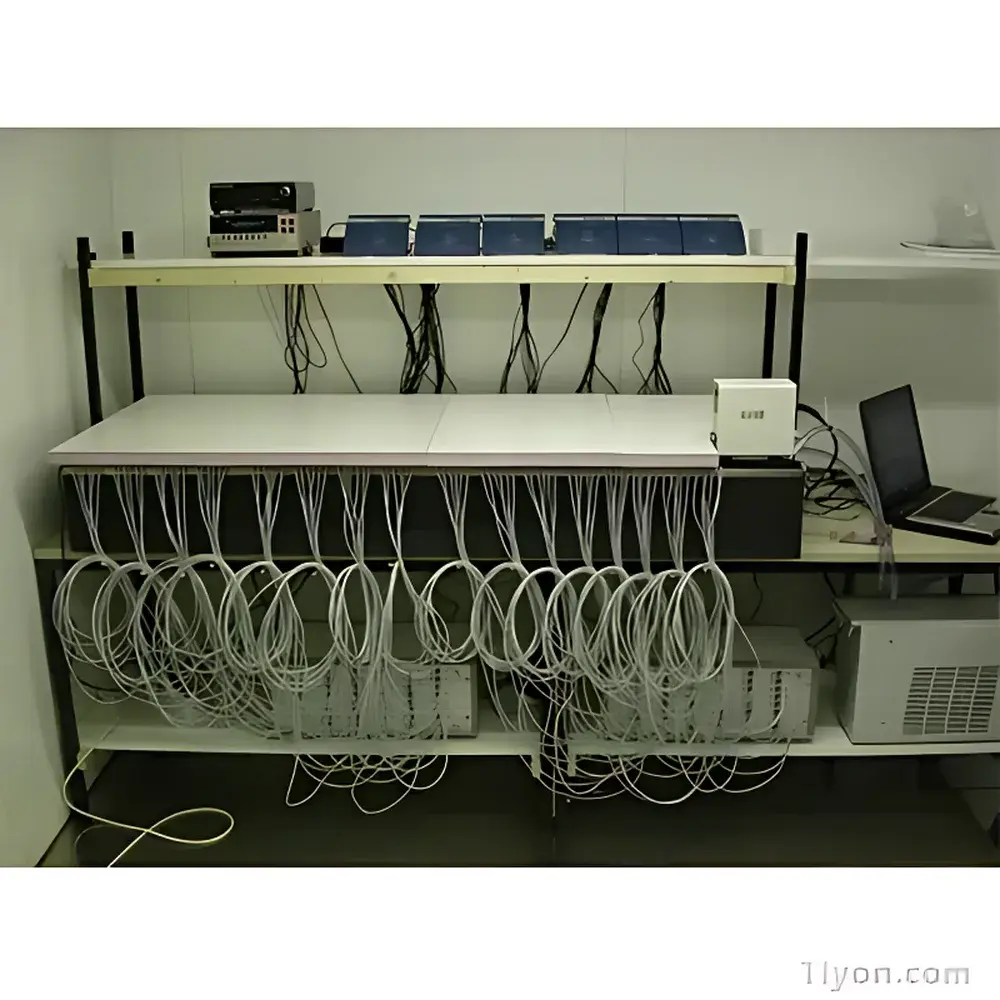
Respicond VIII High-Throughput Soil Respiration Analysis System
| Origin | Sweden |
|---|---|
| Manufacturer Type | Authorized Distributor |
| Origin Category | Imported |
| Model | Respicond VIII |
| Instrument Type | Multifunctional Soil Respirometry System |
Overview
The Respicond VIII High-Throughput Soil Respiration Analysis System is a precision-engineered, non-dispersive electrochemical respirometer designed for long-term, continuous measurement of CO₂ evolution from soil samples under controlled temperature conditions. It operates on the principle of conductometric CO₂ capture: CO₂ released during microbial respiration dissolves in an aqueous potassium hydroxide (KOH) solution within each sealed incubation chamber, forming carbonate and bicarbonate ions. This reaction reduces the concentration of OH⁻ ions, resulting in a measurable, linear decrease in solution conductivity—quantified in real time via platinum electrode pairs immersed in each KOH reservoir. The system’s dual-temperature, 96-channel architecture enables comparative assessment of soil respiratory response across thermal gradients—making it uniquely suited for determining temperature sensitivity parameters such as Q₁₀, a critical metric in climate–soil carbon feedback modeling and biogeochemical process studies.
Key Features
- Dual independent thermostatically controlled water baths, each housing 48 sample chambers (total 96 channels), allowing simultaneous incubation at two distinct, stable temperatures (e.g., 10 °C and 20 °C) with ±0.1 °C stability.
- High-precision conductometric detection using calibrated platinum electrodes; resolution better than 0.02 mS/cm, enabling detection of sub-microgram CO₂ fluxes over extended periods.
- Automated, programmable sampling intervals: full 96-channel scans every 20 minutes (standard mode); optional high-frequency mode supports up to 4 channels per minute for targeted kinetic profiling.
- Long-duration baseline respiration monitoring: up to 60 days without KOH replenishment when using standard 0.05 M KOH; higher dilution (e.g., 0.01 M) extends dynamic range but requires scheduled reagent refresh.
- Integrated environmental monitoring: each chamber includes embedded Pt100 temperature sensors and optional humidity/pressure logging for full environmental traceability.
- Rugged, corrosion-resistant chamber design with gas-tight silicone septa and standardized 125 mL borosilicate glass vials—compatible with ASTM D5919 and ISO 16072 soil respiration test protocols.
Sample Compatibility & Compliance
The Respicond VIII accommodates a wide range of solid-phase environmental matrices including mineral and organic soils, composts, sediments, rhizosphere cores, and biochar-amended substrates. Sample volumes range from 5 to 50 g (dry weight), with customizable headspace-to-solid ratios. All wetted components comply with EU Directive 2002/95/EC (RoHS) and are inert to alkaline KOH solutions. Data acquisition meets GLP-compliant requirements: audit-trail-enabled software logs operator ID, timestamp, calibration events, and parameter changes. Exported datasets include ISO/IEC 17025-aligned metadata fields (sample ID, treatment code, incubation start/end, ambient pressure, bath temperature setpoint and deviation) for seamless integration into LIMS or regulatory reporting workflows.
Software & Data Management
The Windows-based Respicond Control Suite provides real-time visualization, configuration, and export functionality. Users define experimental parameters—including temperature profiles, scan frequency, KOH concentration, and sample metadata—via intuitive wizards. During operation, live plots display conductivity (mS), cumulative CO₂ (mg), and hourly CO₂ release rate (mg·h⁻¹) simultaneously across all active channels. List views support sorting by treatment group, time point, or statistical outlier flagging. Raw data exports as UTF-8 CSV files with header annotations compliant with FAIR data principles; timestamps adhere to ISO 8601 format. Batch processing tools enable automated Q₁₀ calculation (using the Arrhenius-derived two-point method), normalization to SOC content, and statistical grouping via ANOVA-ready column structures. Software validation documentation (IQ/OQ/PQ summary) is provided for FDA 21 CFR Part 11 readiness.
Applications
- Climate change research: quantifying temperature-dependent soil organic carbon mineralization rates across biome gradients.
- Agricultural soil health assessment: evaluating impacts of tillage, cover cropping, fertilizer regimes, and bioinoculants on heterotrophic respiration.
- Contaminant biodegradation studies: monitoring CO₂ burst kinetics during hydrocarbon or pesticide degradation assays.
- Wetland and permafrost carbon dynamics: low-flux respiration tracking under suboptimal redox conditions.
- Method validation and inter-laboratory comparison: serving as a reference platform for ISO/ASTM soil respiration method harmonization.
FAQ
How does the Respicond VIII differ from IRGA-based soil respirometers?
Unlike infrared gas analyzers (IRGAs), which require complex gas handling, flow control, and frequent zero/span calibration, the Respicond VIII uses a passive, solution-phase conductometric method—eliminating drift, cross-sensitivity to H₂O or CH₄, and dependence on carrier gas purity.
Can I measure respiration from frozen or waterlogged soils?
Yes—samples may be pre-equilibrated at target temperature prior to chamber sealing; the system tolerates condensate accumulation and supports low-oxygen incubations when paired with N₂-purged headspaces.
Is the software compatible with networked lab environments?
The Control Suite supports UNC path data storage, SQL Server database logging (optional), and TLS 1.2-secured remote desktop access for centralized instrument management across multi-site deployments.
What maintenance is required between experiments?
Routine tasks include electrode cleaning with 0.1 M HCl followed by DI water rinse, KOH solution replacement (frequency depends on respiration rate and concentration), and annual verification of bath temperature uniformity per ASTM E740.







