
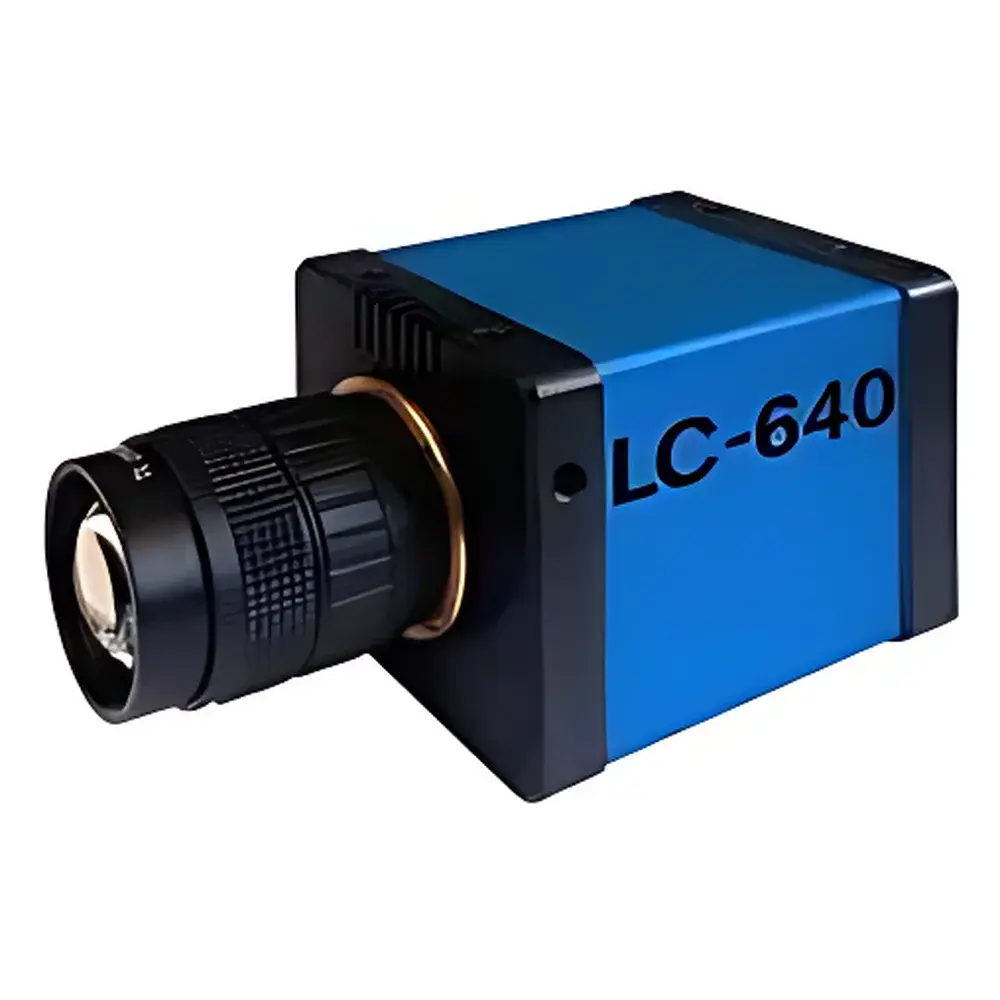
HighFinesse Lynceus 640 InGaAs Near-Infrared Camera
| Brand | HighFinesse |
|---|---|
| Origin | Germany |
| Model | Lynceus 640 |
| Sensor Type | InGaAs Focal Plane Array |
| Spectral Range | 0.9–1.7 µm |
| Resolution | 640 × 512 pixels |
| Pixel Size | 30 × 30 µm |
| Frame Rate | 50 fps (full frame, global shutter) |
| A/D Resolution | 14 bit |
| Dynamic Range | 60 dB (1600:1, low gain) |
| Exposure Time | 40 µs – 40 ms |
| Nonlinearity | < 2% |
| Gain Options | 0.77 / 14.38 µV/e⁻ (25 °C) |
| Cooling | Passive (uncooled) |
| Interface | USB 2.0 (power + data) |
| Lens Mount | C-mount |
| Operating Temperature | 0–50 °C, non-condensing humidity |
| Dimensions | 89 × 63 × 78 mm |
| Weight | 380 g |
Overview
The HighFinesse Lynceus 640 is a high-performance, uncooled InGaAs near-infrared (NIR) camera engineered for precision imaging and quantitative measurement in the 0.9–1.7 µm spectral band. Based on a global-shutter 640 × 512 pixel InGaAs focal plane array with 30 µm pitch, it delivers full-frame acquisition at 50 frames per second—enabling real-time observation of fast transient phenomena such as laser beam profiling, semiconductor wafer inspection, thermographic process monitoring, and NIR spectroscopic imaging. Its passive thermal design eliminates cryogenic cooling requirements while maintaining stable responsivity and low temporal noise across industrial and laboratory environments. The integration of USB 2.0 for both power delivery and high-bandwidth data transfer ensures plug-and-play compatibility with standard Windows-based workstations—no external power supply or frame grabber is required. This architecture supports rapid deployment in OEM instrumentation, R&D test benches, and automated quality control systems where space, weight, and electrical simplicity are critical constraints.
Key Features
- 640 × 512 pixel InGaAs sensor with global shutter readout and 14-bit digitization
- Native spectral response from 900 nm to 1700 nm—optimized for telecom, SWIR imaging, and material analysis
- Full-resolution frame rate of 50 fps with exposure control ranging from 40 µs to 40 ms
- USB 2.0 interface providing bus-powered operation (no auxiliary power supply needed)
- Passive thermal management—no moving parts, no vibration, no maintenance
- C-mount lens interface for flexible optical integration with standard NIR optics
- Compact form factor (89 × 63 × 78 mm) and lightweight construction (380 g)
- Dynamic range of 60 dB (1600:1) in low-gain mode with <2% nonlinearity
Sample Compatibility & Compliance
The Lynceus 640 is compatible with a wide range of NIR-transparent and reflective samples, including silicon wafers, polymer films, biological tissues (ex vivo), battery electrode coatings, and laser-generated plasmas. Its 30 µm pixel pitch enables diffraction-limited resolution when paired with f/1.4 or faster C-mount lenses (e.g., included 16.2 mm f/1.4 objective). The camera operates within ambient temperature ranges of 0–50 °C under non-condensing humidity conditions—meeting IEC 60601-1 mechanical environmental class II and conforming to CE marking requirements for electromagnetic compatibility (EMC Directive 2014/30/EU) and low-voltage safety (LVD Directive 2014/35/EU). While not certified for medical device use out-of-the-box, its deterministic USB-controlled acquisition, timestamped frame metadata, and reproducible gain/offset calibration support GLP-compliant documentation workflows when integrated into validated systems.
Software & Data Management
HighFinesse provides a comprehensive SDK (C/C++, Python, MATLAB bindings) and native Windows application for immediate operation. The software stack supports hardware-synchronized triggering via optional TTL input, enabling precise temporal alignment with pulsed lasers or motion stages. Image processing features include real-time histogram visualization, line-profile extraction along arbitrary axes, gamma correction, contrast/brightness adjustment, and bidirectional image flipping (top-bottom/left-right). Built-in flat-field and dark-frame correction algorithms ensure spatial uniformity across the array. All acquired images and video sequences are saved in lossless TIFF or compressed AVI formats with embedded metadata (exposure time, gain, timestamp, sensor temperature). The SDK exposes low-level register access for custom synchronization protocols and supports integration into LabVIEW, HALCON, and OpenCV-based pipelines. Audit-trail logging and user-defined annotation fields facilitate compliance with internal QA procedures and ISO/IEC 17025 traceability requirements.
Applications
- Laser beam characterization (M², centroid tracking, pulse shape analysis) in fiber-optic and solid-state laser development
- In-line inspection of silicon solar cells and photovoltaic modules under NIR illumination
- Thermal emission mapping of microelectronic packages during functional stress testing
- SWIR reflectance imaging for agricultural product sorting (e.g., moisture content, bruise detection)
- Non-destructive evaluation (NDE) of composite materials using active thermography
- Time-resolved fluorescence lifetime imaging (FLIM) in life sciences using gated acquisition modes
- Gas leak detection via absorption imaging with tunable NIR diode lasers
FAQ
Is the Lynceus 640 suitable for quantitative radiometric measurements?
Yes—when calibrated with NIST-traceable reference sources and used with calibrated optics, the camera supports relative radiometry. Absolute calibration requires individual sensor characterization; HighFinesse offers optional factory calibration reports.
Can the camera operate in triggered or free-running mode?
Yes—both modes are supported. External TTL triggering is optional but fully programmable via the SDK for sub-millisecond jitter performance.
What is the maximum sustained data throughput over USB 2.0?
At full resolution and 50 fps, the camera transmits ~48 MB/s—within the theoretical limit of USB 2.0 (60 MB/s), ensuring zero frame drop under proper host controller configuration.
Does the SDK support Linux or macOS?
The official SDK is Windows-native (x64); however, community-supported wrappers exist for Linux via libusb, and HighFinesse provides technical guidance for cross-platform integration upon request.
Are lens filters included or available separately?
A visible-light cut filter is available as an accessory; additional bandpass, longpass, and notch filters for specific NIR wavelengths can be ordered directly from HighFinesse or authorized distributors.



