
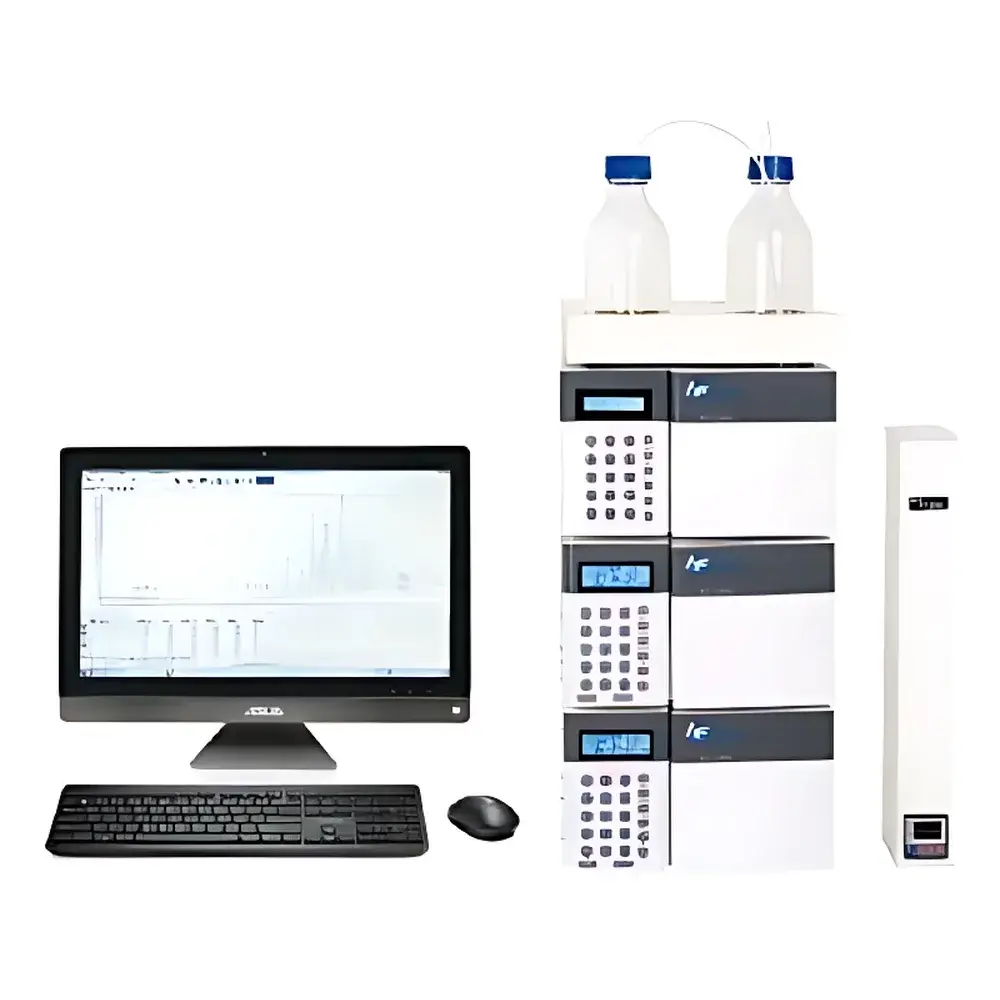
ZHONGKEHUIFEN LC-1220A Analytical-to-Semi-Preparative Re-Circulation Liquid Chromatograph
| Brand | ZHONGKEHUIFEN |
|---|---|
| Origin | Beijing, China |
| Model | LC-1220A |
| Pump Type | Tandem Dual-Piston |
| Flow Rate Range | 0.01–100 mL/min |
| Flow Accuracy | ±2% or ±20 µL/min (whichever is greater, at 0.1–100 mL/min) |
| Flow Precision | ≤0.6% RSD |
| Maximum Pressure | 20 MPa (3000 psi) |
| Gradient Configuration | High-Pressure Binary |
| UV Detector Wavelength Range | 190–700 nm |
| Wavelength Accuracy | ±1 nm |
| Wavelength Repeatability | ±0.1 nm |
| Spectral Bandwidth | <6 nm |
| D₂ Lamp Lifetime | 2000 h |
| Data Output | 2 AU/V |
| Dimensions (W×D×H) | 400 × 300 × 180 mm |
| Weight | 10.0 kg |
| Power Supply | 100–240 VAC, 50–60 Hz, 80 W |
Overview
The ZHONGKEHUIFEN LC-1220A is an analytical-to-semi-preparative liquid chromatograph engineered for high-fidelity re-circulation separations—particularly suited for resolving structurally similar compounds such as positional isomers, diastereomers, and closely eluting analogs where conventional linear gradient or isocratic methods reach resolution limits. Its core architecture integrates a high-stability tandem dual-piston pump with floating seal technology and self-priming check valves, minimizing pulsation and column-exit dispersion—critical factors in iterative re-injection workflows. Unlike standard HPLC systems optimized for single-pass analysis, the LC-1220A’s fluidic design mitigates extra-column band broadening during repeated loop-through cycles, enabling up to dozens of consecutive re-circulations without measurable peak degradation. This capability is especially valuable in method development for chiral separations, natural product purification, and impurity profiling where baseline resolution cannot be achieved in one pass.
Key Features
- Tandem dual-piston pump with floating seal ring design—reduces mechanical wear and extends seal lifetime under continuous operation.
- Self-priming check valve technology—eliminates manual priming steps and improves solvent compatibility during rapid mobile phase transitions.
- Programmable solvent compressibility compensation—automatically adjusts flow delivery based on real-time solvent composition and temperature-dependent compressibility data.
- Integrated pre-wash function—enables rapid, residue-free solvent exchange between runs, reducing carryover and downtime in multi-method sequences.
- High-pressure binary gradient system—supports precise, reproducible gradient formation without low-pressure mixing artifacts or dwell volume variability.
- D₂ lamp-based UV-Vis detector with automated wavelength calibration and zero-baseline stabilization—ensures long-term photometric stability across extended acquisition periods.
Sample Compatibility & Compliance
The LC-1220A accommodates standard 4.6 mm I.D. analytical columns as well as 10–21.2 mm I.D. semi-preparative columns, supporting both reversed-phase and normal-phase chemistries. Its pressure rating (up to 20 MPa) allows use of sub-3 µm particle packings when operated within validated flow and backpressure parameters. The system meets fundamental design requirements aligned with ISO/IEC 17025 for test equipment verification and supports GLP-compliant documentation through external data acquisition software. While not certified to FDA 21 CFR Part 11 out-of-the-box, its digital I/O interface and timestamped analog output enable integration with compliant LIMS or CDS platforms that implement audit trail, electronic signature, and data integrity controls per ALCOA+ principles.
Software & Data Management
Control and data acquisition are implemented via PC-based software supporting pump parameter programming (flow rate, gradient profile, pressure limits), detector configuration (wavelength selection, gain scaling, time constant), and real-time chromatogram display. Raw signal output is provided as analog voltage (2 AU/V full scale) compatible with third-party integrators or DAQ systems. All detector parameters—including wavelength positioning, zero adjustment, and range switching—are motorized and software-addressable. The system logs operational metadata (start time, flow setpoint, pressure reading, lamp hours) to non-volatile memory, facilitating traceability in regulated environments. Export formats include ASCII text and CSV, ensuring interoperability with statistical analysis tools and laboratory informatics infrastructure.
Applications
- Re-circulation chromatography of isomeric drug substances and metabolites—enabling separation of ortho/meta/para-substituted aromatics or E/Z alkenes unresolvable by conventional elution.
- Purification support for synthetic chemistry workflows—fraction collection synchronized with re-circulation cycles improves yield and purity of target intermediates.
- Method scouting for complex matrices (e.g., botanical extracts, polymer additives)—where iterative band sharpening reveals co-eluting components masked in initial chromatograms.
- Stability-indicating assay development—monitoring degradation pathways via repeated injection of stressed samples under identical re-circulation conditions.
- Academic and contract research applications requiring flexible, cost-effective access to semi-preparative separation capability without dedicated preparative hardware.
FAQ
Can the LC-1220A operate in true preparative mode (e.g., >20 mm I.D. columns)?
No—the system is rated for semi-preparative use up to 21.2 mm I.D. columns at ≤20 MPa; larger diameters or higher flow rates require dedicated preparative pumps with enhanced thermal management and pulse dampening.
Is the UV detector compliant with pharmacopeial wavelength accuracy requirements (e.g., USP <621>)?
Yes—its ±1 nm absolute accuracy and ±0.1 nm repeatability satisfy USP general chapter <621> criteria for qualification of UV detectors used in quantitative analysis.
Does the system support method transfer from other HPLC platforms?
Yes—gradient dwell volume is minimized (<1.2 mL), and flow/pressure profiles are highly reproducible, facilitating robust retention time alignment across platforms when column dimensions and mobile phase composition are matched.
What maintenance intervals are recommended for the pump seals and D₂ lamp?
Pump seals should be inspected every 2,000 operating hours; D₂ lamp replacement is advised at 2,000 hours or upon observed signal drift >5% in baseline noise or peak area reproducibility.
Can the LC-1220A be integrated into an automated sample processing workflow?
Yes—it features TTL-compatible start/stop triggers and analog voltage outputs compatible with most autosamplers and fraction collectors, enabling unattended multi-run sequences in regulated or high-throughput settings.
Related Products




