
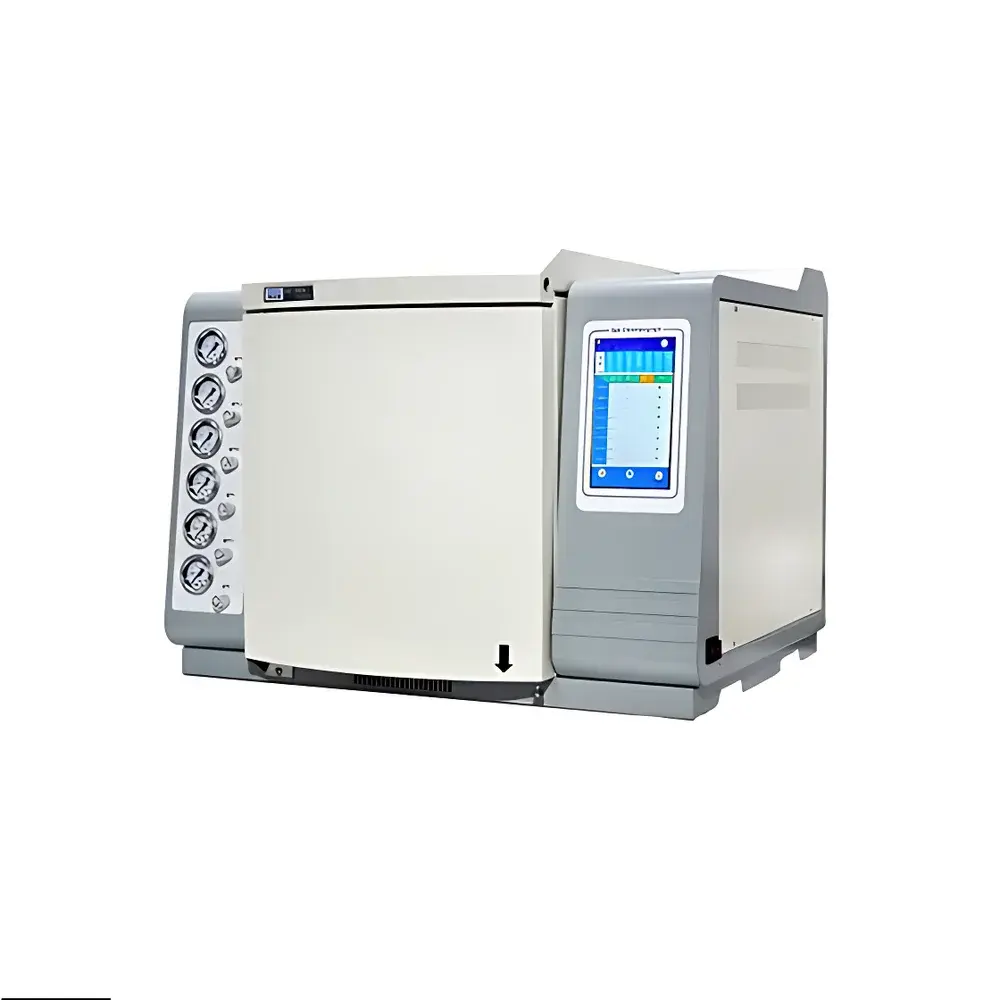
Zhongkehuifen GC-7820 Dedicated Gas Chromatograph for Automotive Gasoline
| Brand | Zhongkehuifen |
|---|---|
| Origin | Beijing, China |
| Model | GC-7820 Dedicated Gas Chromatograph for Automotive Gasoline |
| Instrument Type | Laboratory Gas Chromatograph |
| Temperature Control Range | Ambient + 3 °C to 450 °C |
| Oven Ramp Rate | 0.1–40 °C/min |
| Cooling Rate | ~8 min (450 °C to 50 °C) |
| Carrier Gas Flow Range | 0–1200 mL/min |
| Carrier Gas Pressure Range | 0–970 kPa |
| Injector Max Temp | 450 °C |
| Injector Pressure Setting Range | 0–970 kPa |
| Injector Total Flow Setting Range | 0–1200 mL/min |
Overview
The Zhongkehuifen GC-7820 Dedicated Gas Chromatograph for Automotive Gasoline is a purpose-built analytical system engineered for precise, repeatable quantification of oxygenates (alcohols and ethers) and aromatic hydrocarbons—specifically benzene and toluene—in finished gasoline formulations. It operates on the principle of capillary gas chromatography with dual-column heart-cutting and backflushing, enabling selective separation and accurate detection of regulated components in compliance with Chinese national standards including GB 17930–2011 (Automotive Gasoline), GB 18351–2004 (Ethanol Gasoline for Vehicles), SH/T 0663–1998 (Determination of Alcohols and Ethers in Gasoline), and SH/T 0693–2000 (Determination of Aromatic Hydrocarbons in Gasoline). The instrument employs temperature-programmed elution across two fused-silica columns—TCEP pre-separation column and WCOT analytical column—with automated valve switching (e.g., 6-port or 10-port valves) to isolate target analytes while removing interfering light and heavy hydrocarbons. This architecture ensures high resolution, low carryover, and robust performance under routine QC laboratory conditions.
Key Features
- Modular, field-upgradable platform with independent control of oven, injector, and detector zones via embedded EPC (Electronic Pressure Control) modules—eliminating mechanical pressure regulators and analog flow meters.
- Dual-method capability: Simultaneous support for SH/T 0663–1998 (oxygenates) and SH/T 0693–2000 (aromatics) without hardware reconfiguration; method switching performed via software-defined valve timing and temperature ramps.
- FID detector with <5 pg C/s minimum detectable mass (n-hexadecane), auto-ignition sequence, H2 leak monitoring, flame-out safety interlock (gas cutoff + power disable), and thermally stabilized signal amplification board.
- Three independent Ethernet communication threads: Local data acquisition, supervisory review (e.g., QA manager), and regulatory oversight (e.g., provincial market supervision bureau)—all accessible via standard TCP/IP stack with static or DHCP-assigned IP.
- Vacuum fluorescent display (VFD) with daylight-readable contrast; bilingual (English/Chinese) GUI with context-sensitive help and audit-trail-enabled method editing.
- IBrain Chromatography Data System (CDS) supporting up to 253 concurrent instruments; integrated Modbus/TCP server for seamless integration into plant-level DCS environments (e.g., Emerson DeltaV, Honeywell Experion).
Sample Compatibility & Compliance
The GC-7820 is validated for direct injection of neat gasoline samples (ASTM D4057-compliant sampling protocol recommended). It accommodates liquid introduction via split/splitless injectors or optional autosampler interfaces. Internal standardization is implemented per standard methods: DME (1,2-dimethoxyethane) for oxygenates and 2-hexanone for aromatics. All hardware—including column oven, inlet, and detector—meets IEC 61010-1 safety requirements for laboratory electrical equipment. The system supports 21 CFR Part 11-compliant electronic records when deployed with IBrain CDS configured for user authentication, electronic signatures, and immutable audit trails. Routine operation complies with GLP principles for fuel quality testing laboratories accredited to CNAS-CL01 (equivalent to ISO/IEC 17025).
Software & Data Management
IBrain CDS provides full instrument control, peak integration, calibration curve generation (linear, quadratic, or multi-point weighted), and report export in PDF, CSV, and XML formats. All acquisition parameters—including valve actuation times, oven ramp profiles, and EPC setpoints—are stored with timestamps and user IDs. The system logs every hardware event (e.g., “FID ignited at 14:22:07”, “Oven cooled to 50 °C in 7 min 42 s”) for traceability. Raw data files (.ibd) are digitally signed and tamper-evident. Remote access is secured via TLS 1.2 encryption; no cloud storage is required—the workstation operates as an on-premise server with configurable database retention policies (SQL Server Express or PostgreSQL).
Applications
- Quantitative determination of methanol, ethanol, propanols, butanols, tert-amyl alcohol, MTBE, TAME, DIPE, and other regulated oxygenates in reformulated gasoline.
- Accurate measurement of benzene (<1.0% v/v) and toluene (<35% v/v) per GB 17930–2011 specifications for environmental and health compliance.
- Batch release testing in refinery QC labs, third-party fuel certification bodies, and provincial metrology institutes.
- Method development and validation studies for emerging biofuel blends (e.g., ETBE, n-butanol-enriched gasoline).
- Support for ASTM D4815 (MTBE), ASTM D5599 (oxygenates), and ASTM D5769 (benzene) through custom method templates.
FAQ
Does the GC-7820 support both SH/T 0663 and SH/T 0693 analyses on a single run?
No—these are separate, sequential methods requiring distinct column configurations, valve timing, and temperature programs. However, method switching is software-controlled and requires no manual hardware changes.
Is the FID detector compatible with hydrogen carrier gas?
Yes; the FID supports H2, He, or N2 as carrier, with optimal sensitivity achieved using H2 at flow rates between 30–45 mL/min.
Can the system be integrated into a LIMS environment?
Yes—IBrain CDS provides ODBC-compliant database access and HL7/ASTM E1384-compliant result export for LIMS ingestion.
What is the typical maintenance interval for the EPC modules?
EPC transducers require no scheduled calibration; drift verification is performed during daily system suitability tests using certified gas standards.
Is training provided for method transfer from legacy GC systems?
Yes—Zhongkehuifen offers on-site application support, including method translation from Agilent 7890, Thermo ISQ, or Shimadzu GC-2010 platforms, with retention time alignment and peak identification validation reports.





