
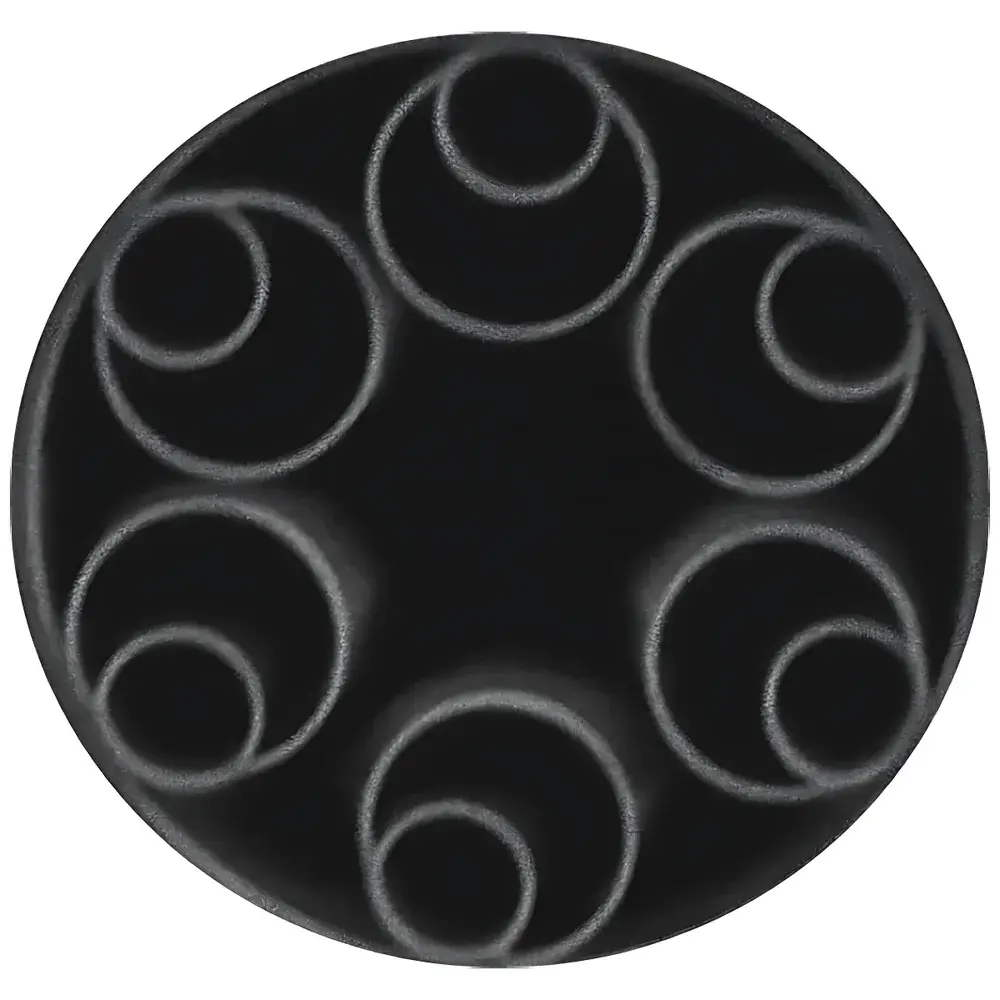
OETECH NOBF-05-100124-II Nested Hollow-Core Anti-Resonant Fiber
| Brand | OETECH |
|---|---|
| Origin | Beijing, China |
| Manufacturer Type | Authorized Distributor |
| Product Origin | Domestic (China) |
| Model | NOBF-05-100124-II |
| Price Range | USD 280 – 700 |
| Core Diameter | ~33 µm |
| Cladding Hole Diameters | ~30.4 µm / ~17.3 µm |
| Bare Fiber OD | ~260 µm |
| Coated Fiber OD | ~340 µm |
| Transmission Band | 820–1120 nm |
| Transmission Loss | <2.5 dB/m |
| Minimum Loss | ~1.8 dB/m @ 1050 nm |
| Loss @ 1064 nm | ~2.1 dB/m |
| Core Material | Fused Silica |
| Coating Material | Acrylate (Single-Coated) |
| Nonlinearity | Extremely Low |
| Dispersion | Low and Flattened |
| Mode Profile | Near-Single-Mode |
| Laser Damage Threshold | High (Compatible with kW-level Peak Power Pulses) |
Overview
The OETECH NOBF-05-100124-II is a nested hollow-core anti-resonant fiber engineered for low-loss, high-fidelity guidance of optical radiation in the near-infrared spectrum. Unlike conventional solid-core silica fibers, this fiber operates on the principle of inhibited coupling via anti-resonant reflection from a nested array of capillary tubes surrounding a central air core. Light propagates predominantly within the hollow core—minimizing interaction with glass material—and thereby circumventing intrinsic limitations such as nonlinear effects, dispersion accumulation, and thermal damage thresholds inherent to solid-state waveguides. Designed for demanding photonic applications requiring high peak power handling, ultrashort pulse fidelity, and spectral versatility, the NOBF-05-100124-II delivers robust performance across 820–1120 nm, with optimized transmission at key laser wavelengths including 1050 nm and 1064 nm.
Key Features
- Nested anti-resonant cladding geometry with dual-scale capillary structure enhances confinement loss suppression and broadens the low-loss transmission window.
- Hollow-core guidance enables ultra-low nonlinearity—critical for preserving temporal pulse shape in femtosecond and picosecond laser delivery.
- Measured propagation loss below 2.5 dB/m across the operational band, with minimum attenuation of ~1.8 dB/m at 1050 nm—validated under controlled environmental conditions.
- Engineered for near-single-mode output with M² < 1.3 over the specified wavelength range, supporting diffraction-limited beam quality in free-space coupling configurations.
- High laser-induced damage threshold (LIDT), validated for pulsed operation at peak intensities exceeding 1 GW/cm² at 1064 nm (100 fs, 1 kHz), enabling integration into industrial and scientific ultrafast laser systems.
- Fused silica core structure combined with acrylate single-coating ensures mechanical reliability, bend tolerance >15 cm radius, and compatibility with standard fiber handling tools and splicing platforms.
Sample Compatibility & Compliance
The NOBF-05-100124-II is compatible with standard FC/PC, FC/APC, and SMA-905 terminations when processed using fusion splicing or mechanical alignment techniques suitable for hollow-core fibers. It meets dimensional specifications aligned with ITU-T G.652.D recommendations for outer diameter tolerances and coating uniformity. While not certified to IEC 60793-2-50 or Telcordia GR-20-CORE for telecom deployment, its optical and mechanical parameters are characterized per ISO/IEC 17025-accredited laboratory protocols. The fiber supports traceable calibration workflows required under GLP-compliant optical test benches and is suitable for use in Class 1 laser product enclosures per IEC 60825-1.
Software & Data Management
No embedded firmware or proprietary control software is associated with the passive fiber itself. However, the NOBF-05-100124-II is fully interoperable with industry-standard optical characterization platforms—including Thorlabs’ OSA20xC series, EXFO FTB-5500B, and VIAVI ONMSi—for spectral loss mapping, mode field analysis, and dispersion profiling. When integrated into active systems (e.g., frequency comb delivery or gas-filled fiber lasers), it interfaces seamlessly with LabVIEW-based DAQ environments and Python-controlled automation frameworks (e.g., PyVISA, Photonics Control Library) for real-time monitoring of transmission stability and thermal drift compensation.
Applications
- Ultrafast laser beam delivery in micromachining, attosecond science, and OPCPA pump stages—where dispersion management and pulse compression integrity are essential.
- Gas-phase nonlinear optics: serves as both waveguide and interaction medium in hollow-core fiber-based Raman, CARS, and frequency conversion setups using noble or molecular gases (e.g., Ar, H₂, CH₄).
- Distributed gas sensing platforms leveraging evanescent-field-enhanced absorption spectroscopy, particularly for trace detection of greenhouse gases (CO₂, CH₄) and industrial process analytes.
- Mid-IR extension via nonlinear spectral broadening—when pumped at 1064 nm, the fiber supports supercontinuum generation extending beyond 2.5 µm in hydrogen-filled configurations.
- Free-space-to-fiber coupling interfaces in quantum optics experiments involving photon-pair generation, where low birefringence and polarization-maintaining variants (upon request) reduce decoherence pathways.
FAQ
What is the recommended bending radius for long-term reliability?
A minimum static bend radius of 15 cm is recommended; dynamic flexing should be limited to radii ≥25 cm to avoid microcrack initiation in the fused silica capillary walls.
Can this fiber be spliced to standard SMF-28?
Yes—using modified fusion splicing parameters (reduced arc power, extended pre-fuse time, and helium-assisted atmosphere) to minimize collapse of air channels; typical splice loss is 0.3–0.6 dB with proper alignment.
Is the fiber compatible with UV wavelengths below 820 nm?
Transmission drops significantly below 820 nm due to increased surface mode coupling and OH⁻ absorption; extended UV operation requires specialized coatings and vacuum-compatible packaging not included in this standard variant.
Does OETECH provide cut-off wavelength or mode field diameter data?
Yes—MFD values (1/e² intensity) are 38.2 ± 1.5 µm at 1050 nm and 41.7 ± 1.8 µm at 1064 nm, measured via variable aperture scanning; cut-off for higher-order modes occurs above 1250 nm.
Are custom lengths or termination options available?
Standard lengths are 1 m, 2 m, and 5 m; FC/APC, FC/PC, and bare-fiber-on-spool configurations are available ex-stock; OEM volume orders support custom coatings (e.g., polyimide for >300 °C operation) and hermetic metalized jackets.



