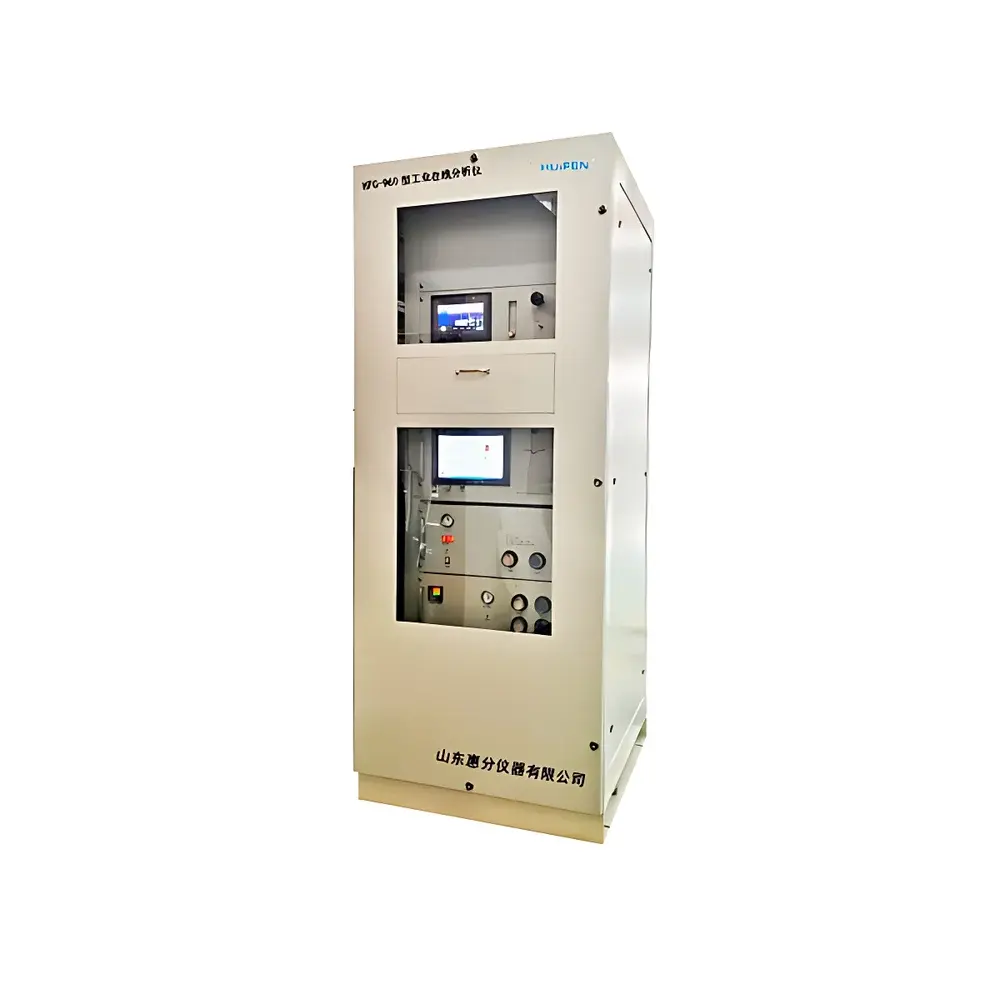
Zhongkehuifen HFG-960 Online Industrial Gas Chromatograph
| Brand | Zhongkehuifen |
|---|---|
| Origin | Beijing, China |
| Manufacturer Type | Authorized Distributor |
| Country of Origin | China |
| Model | HFG-960 Online Industrial Gas Chromatograph |
| Price Range | USD 14,000 – 70,000 |
| Category | Online Gas Chromatograph |
| Detection Principles | Capillary Column Separation + Flame Ionization Detector (FID) / Thermal Conductivity Detector (TCD) / Flame Photometric Detector (FPD) |
| Enclosure Rating | IP65 |
| Explosion Protection | Ex d IIC T6 Gb |
| Operating Temperature | −5 °C to +45 °C |
| Humidity | ≤90% RH (non-condensing) |
| Power Supply | 200–240 VAC, 50/60 Hz |
| Sample Introduction | Extractive Sampling |
| Flow Rate | 100 ± 50 mL/min (customizable) |
| Line Material | 316L Stainless Steel, PTFE, Passivated Stainless Steel |
| Heating Zone | Full-path heated to ≥120 °C (no cold spots) |
| Drift | <3% FS over 30 days |
| Repeatability | RSD <3% |
| Filtration Precision | <5 µm |
| Output Signals | 4–20 mA, RS232/RS485 (Modbus RTU), Ethernet (Modbus TCP) |
Overview
The Zhongkehuifen HFG-960 Online Industrial Gas Chromatograph is an engineered solution for continuous, real-time compositional analysis of process gas streams in demanding industrial environments. Based on proven capillary gas chromatography (GC) separation principles, the system employs temperature-programmed elution through high-resolution fused-silica columns, coupled with selectable detectors—including Flame Ionization Detector (FID), Thermal Conductivity Detector (TCD), and Flame Photometric Detector (FPD)—to deliver quantitative and qualitative data on hydrocarbon fractions, permanent gases, sulfur compounds, and oxygenates. Designed for integration into distributed control systems (DCS) or supervisory control and data acquisition (SCADA) architectures, the HFG-960 operates unattended for extended periods under ambient conditions ranging from −5 °C to +45 °C, meeting the operational rigor required in refinery, petrochemical, coal chemical, and fine chemical manufacturing facilities.
Key Features
- Full-path heated sampling train: All components—from probe tip to detector inlet—are maintained at ≥120 °C using integrated trace heating and insulation, eliminating condensation, adsorption, and freezing risks in high-humidity or low-temperature ambient installations.
- Explosion-proof certified architecture: Compliant with IEC 60079-1 (Ex d IIC T6 Gb), featuring a pressurized explosion-proof cabinet, intrinsically safe sampling probe, explosion-proof heated sample lines, and ATEX-certified human-machine interface (HMI) peripherals including keyboard and display.
- Robust sample conditioning: Integrated particulate filtration (<5 µm), coalescing water removal, pressure regulation, and flow stabilization ensure consistent sample integrity prior to column injection—critical for long-term baseline stability and detector longevity.
- Modular detector configuration: Field-selectable detector modules (FID, TCD, FPD) support application-specific optimization—e.g., FID for total hydrocarbons and individual C1–C6 speciation; TCD for H2, O2, N2, CH4; FPD for sulfur- and phosphorus-containing compounds.
- Self-recovering operation: Automatic restart after power interruption includes sequence-controlled gas supply re-establishment, column oven re-thermalization, detector ignition (for FID), and system purge—enabling resumption of valid data acquisition without manual intervention.
- High-integrity fluidic path: Wetted parts constructed from 316L stainless steel, passivated stainless steel, and PTFE—resistant to corrosion from acidic, chlorinated, or sulfurous process streams commonly encountered in refining and chemical synthesis.
Sample Compatibility & Compliance
The HFG-960 accommodates complex, multi-component gas matrices typical of cracked naphtha, syngas, fuel gas, flare gas, and reactor off-gas streams. Its extractive sampling design supports representative analysis of gases containing particulates, moisture, and condensables—provided upstream conditioning meets specified filtration and dew point limits. The instrument conforms to key international standards for industrial instrumentation, including IEC 61000-6-2 (EMC immunity), IEC 61000-6-4 (EMC emissions), and ISO 9001:2015 quality management requirements. While not pre-certified to FDA 21 CFR Part 11, its audit-trail-capable software architecture supports validation for GLP/GMP environments when deployed with appropriate SOPs and electronic signature protocols.
Software & Data Management
Embedded microprocessor-based control runs proprietary firmware supporting scheduled auto-calibration, programmable backflushing, retention time locking, and alarm-triggered maintenance sequences (e.g., column bake-out, detector cleaning). Data output interfaces include isolated 4–20 mA analog channels for primary component concentrations, dual serial ports (RS232/RS485) compliant with Modbus RTU for PLC integration, and a 10/100 Mbps Ethernet port implementing Modbus TCP for SCADA connectivity. Raw chromatograms and processed results are timestamped and stored locally on industrial-grade flash memory with configurable retention policies (up to 90 days). Remote diagnostics and firmware updates are supported via secure SSH or HTTPS access—subject to customer network security policy alignment.
Applications
- Petroleum refining: Continuous monitoring of reformate composition, LPG C3/C4 split, FCC off-gas hydrocarbon distribution, and hydrogen purity in hydrotreater loops.
- Chemical synthesis: Real-time tracking of ethylene oxide reactor effluent, methanol synthesis gas (H2/CO/CO2 ratio), and ammonia purge gas composition.
- Coal-to-chemicals: Quantification of syngas impurities (H2S, COS, NH3) and Fischer–Tropsch product gas profiles.
- Fine chemicals & pharmaceuticals: In-line verification of solvent recovery efficiency (e.g., acetone, ethanol, THF) and residual monomer content in polymerization vent streams.
- Environmental compliance: Emission source testing per EPA Method 18 and EN 15467 for VOC speciation in stack gas and fugitive emission monitoring points.
FAQ
What certifications does the HFG-960 hold for hazardous area installation?
The system carries IECEx and CNEx certification for Ex d IIC T6 Gb protection, covering the main enclosure, sampling probe, heated sample lines, and field operator interface devices. Certificate numbers are provided upon request and vary by configuration.
Can the HFG-960 be configured for dual-detector operation (e.g., FID + TCD)?
Yes—dual-detector configurations are supported via parallel column routing and independent signal processing paths, enabling simultaneous quantification of hydrocarbons and permanent gases within a single analysis cycle.
Is remote calibration supported, and what traceability standards apply?
Remote calibration is enabled via secure network access; all calibrations must be performed using NIST-traceable certified gas standards, with calibration logs—including cylinder lot numbers, expiration dates, and span/gain coefficients—automatically archived in the system database.
What is the recommended maintenance interval for the sampling probe and filter elements?
Under typical refinery service conditions, the heated probe and coalescing filter require inspection every 90 days; replacement frequency depends on particulate loading and is tracked via built-in differential pressure monitoring and predictive alerts.
Does the system support integration with DeltaV, Emerson DCS, or Siemens PCS7?
Yes—native Modbus TCP and 4–20 mA outputs ensure seamless interoperability; optional OPC UA gateway modules are available for direct integration with major DCS platforms, including full alarm and event forwarding capability.