
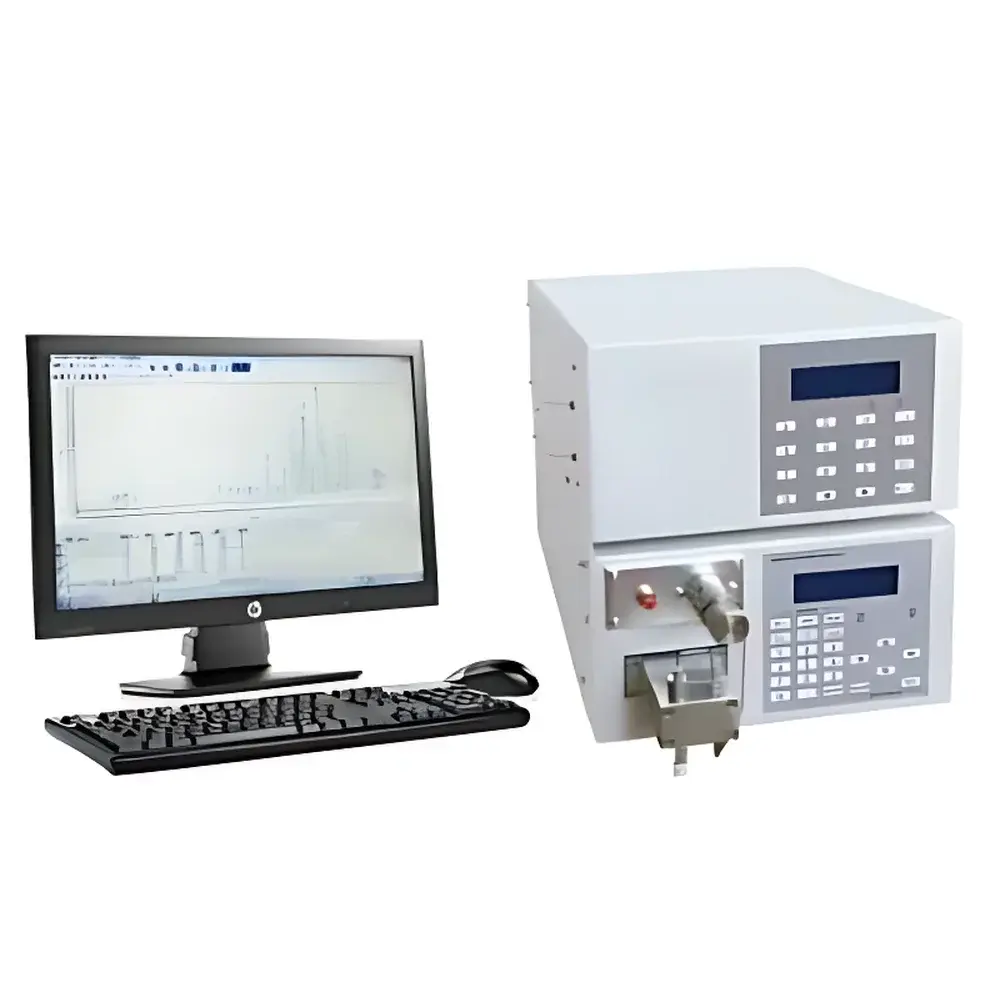
ZHONGKEHUIFEN LC-1220A Isocratic Liquid Chromatograph
| Brand | ZHONGKEHUIFEN |
|---|---|
| Origin | Beijing, China |
| Model | LC-1220A |
| Pump Type | Tandem Dual-Piston |
| Flow Rate Range | 0.01–100 mL/min |
| Flow Accuracy | ±2% or ±20 µL/min (whichever is greater, at 0.1–100 mL/min) |
| Flow Precision | ≤0.6% RSD |
| Maximum Pressure | 20 MPa (3000 psi) |
| Gradient Capability | High-Pressure Binary |
| UV Detector Wavelength Range | 190–700 nm |
| Wavelength Accuracy | ±1 nm |
| Wavelength Repeatability | ±0.1 nm |
| Spectral Bandwidth | <6 nm |
| Lamp | Deuterium (D₂), 2000 h lifetime |
| Data Output | 2 AU/V |
| Dimensions (W×D×H) | 400 × 300 × 180 mm |
| Weight | 10.0 kg |
| Power Supply | 100–240 VAC, 50–60 Hz, 80 W |
Overview
The ZHONGKEHUIFEN LC-1220A Isocratic Liquid Chromatograph is a robust, benchtop HPLC system engineered for routine isocratic separations in quality control laboratories, academic research settings, and small-scale method development workflows. Unlike gradient-capable platforms optimized for complex multi-component analysis, the LC-1220A is purpose-built for high-stability, reproducible isocratic elution—particularly advantageous for targeted quantitation of known analytes, stability-indicating assays, and repeated batch analysis where mobile phase composition remains constant throughout the run. Its tandem dual-piston pump architecture delivers pulse-free solvent delivery across its full flow range (0.01–100 mL/min), enabling both analytical-scale and semi-preparative applications—including closed-loop recirculation chromatography. This capability is critical for resolving structurally similar compounds (e.g., positional isomers, diastereomers) that exhibit minimal retention time differences under standard linear elution. The system’s low column-exit dispersion design minimizes extra-column band broadening—especially when paired with analytical columns (e.g., 4.6 mm ID), thereby preserving peak capacity and resolution over multiple recirculation cycles.
Key Features
- Tandem dual-piston pump with floating seal technology and self-priming check valves—designed to reduce seal wear and extend service intervals without compromising pressure stability.
- Programmable solvent compressibility compensation ensures consistent volumetric delivery across diverse mobile phases (e.g., water/acetonitrile, methanol/water, THF-based systems).
- Integrated pre-wash function enables rapid solvent exchange between methods, reducing carryover risk and downtime during multi-method sequences.
- High-pressure binary gradient module (optional activation via firmware) provides flexibility for future method scalability without hardware replacement.
- UV-Vis detector equipped with a long-life deuterium lamp (rated ≥2000 h), automatic wavelength calibration, zero-baseline correction, and selectable gain ranges (0.0005–10 AU/mV) to accommodate wide dynamic absorbance spans.
- Compact footprint (400 × 300 × 180 mm) and low power consumption (80 W) support deployment in space-constrained labs or shared instrumentation facilities.
Sample Compatibility & Compliance
The LC-1220A supports standard 1/16″ stainless steel or PEEK capillary tubing, industry-standard 1/4″–28 fittings, and common HPLC column formats (analytical: 2.1–4.6 mm ID; semi-preparative: up to 10 mm ID). It is compatible with reversed-phase (C18, C8, phenyl), normal-phase (silica, cyano), and ion-exchange columns. All fluidic pathways are chemically resistant to aqueous buffers, organic solvents (acetonitrile, methanol, tetrahydrofuran), and dilute acids/bases within standard HPLC operating limits. The system meets fundamental electrical safety requirements per IEC 61010-1 and electromagnetic compatibility (EMC) standards per CISPR 11 Group 1, Class B. While not pre-certified for 21 CFR Part 11 compliance, its detector data output (2 AU/V analog signal) and PC-controllable pump parameters enable integration into validated environments when paired with compliant chromatography data systems (CDS) supporting audit trails, electronic signatures, and secure user access controls.
Software & Data Management
The LC-1220A operates via host PC control using vendor-provided acquisition software compatible with Windows 10/11 (64-bit). The interface supports real-time chromatogram display, method parameter configuration (flow rate, pressure limit, wavelength, integration events), and raw data export in ASCII (.txt) or .csv format for third-party processing (e.g., Excel, Origin, Python/Pandas). Detector signals are digitized at ≥10 Hz sampling rate, ensuring adequate point density for narrow peaks (≥12 points per baseline width). All method files include metadata timestamps, operator ID fields, and instrument serial logging—facilitating GLP-aligned documentation. Raw signal files retain full detector response resolution (16-bit ADC), permitting retrospective reintegration with modified baselines or slope detection thresholds.
Applications
- Isocratic assay of pharmaceutical actives and related substances per USP/EP monographs requiring fixed mobile phase composition.
- Quality control testing of food additives, preservatives, and synthetic dyes where regulatory methods specify isocratic conditions.
- Recirculation chromatography for chiral or structural isomer separation—leveraging extended residence time to amplify small Δk′ differences.
- Stability-indicating methods for forced degradation studies (acid/base/hydrolysis, oxidation, photolysis) where isocratic runs improve inter-day reproducibility.
- Educational use in undergraduate analytical chemistry labs for teaching retention mechanism fundamentals, calibration curve construction, and LOD/LOQ determination.
FAQ
Can the LC-1220A perform gradient elution?
Yes—the system includes a high-pressure binary gradient module. Although configured for isocratic operation by default, gradient methods can be activated and controlled via the PC-based software interface.
What column dimensions are supported for recirculation mode?
The system is optimized for analytical columns (e.g., 150 × 4.6 mm, 250 × 4.6 mm) and semi-preparative columns (e.g., 250 × 10 mm) in recirculation setups. Extra-column volume minimization is achieved through short, narrow-bore transfer lines and low-dead-volume detector flow cells.
Is the UV detector compliant with pharmacopeial wavelength accuracy requirements?
With ±1 nm absolute accuracy and ±0.1 nm repeatability—verified using holmium oxide or didymium filters—the detector satisfies USP , EP 2.2.25, and JP 6.02 specifications for wavelength verification.
Does the pump support low-flow microbore applications?
While the minimum programmed flow is 0.01 mL/min, optimal precision (<0.6% RSD) is maintained above 0.1 mL/min. For sub-100 µL/min applications, post-column splitting or dedicated micro-pumps are recommended.
How is maintenance tracked and documented?
The software logs pump seal usage hours, lamp operating time (with D₂ lamp life counter), and error codes with timestamps. These records can be exported for preventive maintenance scheduling and regulatory review.





