
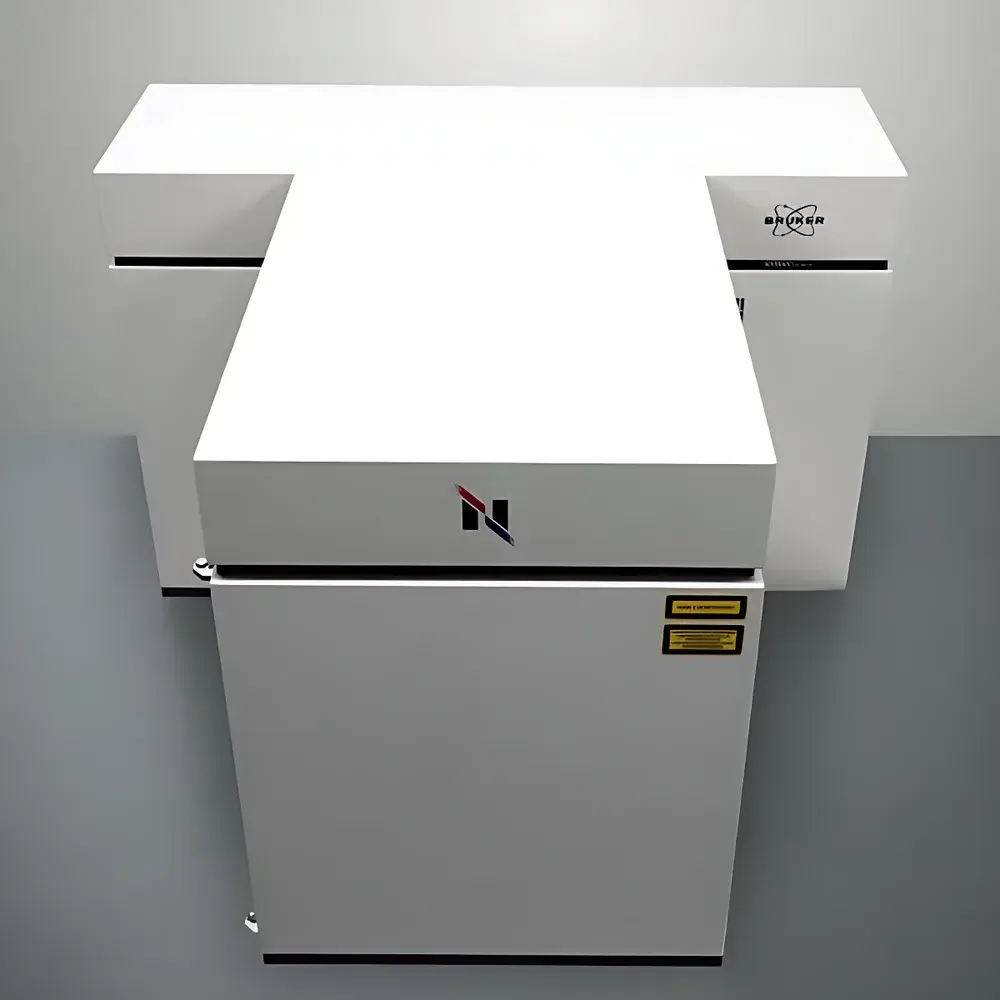
Bruker RAMANtouch Raman Microscope
| Brand | Bruker |
|---|---|
| Origin | Germany |
| Manufacturer Type | Authorized Distributor |
| Origin Category | Imported |
| Model | RAMANtouch |
| Instrument Type | Fourier Transform Raman Spectrometer |
| Spatial Resolution | 350 nm in X, 500 nm in Y |
| Objective Lenses | 5×, 10×, 20×, 50×, 100× |
| Spectral Resolution | <0.9 cm⁻¹ (grating-dependent |
| Stage | Motorized XYZ stage (30 × 30 × 35 mm travel range) |
| Calibration | Fully automated lamp- and sample-based calibration |
| Alignment | Real-time auto-alignment of optical path |
| Laser Safety | Class I interlocked safety enclosure |
Overview
The Bruker RAMANtouch Raman Microscope represents a paradigm shift in confocal Raman imaging—engineered for high-fidelity chemical mapping at nanoscale spatial resolution without compromising spectral fidelity or acquisition speed. Unlike conventional point-scanning or step-scan Raman microscopes, the RAMANtouch employs a proprietary wide-field illumination and detection architecture combined with high-throughput spectral filtering and pixel-synchronized CCD/CMOS readout. This enables true hyperspectral Raman imaging where every pixel in a 2D field-of-view delivers a full, background-corrected Raman spectrum—captured in seconds rather than hours. The system operates on the fundamental principle of inelastic light scattering, leveraging monochromatic laser excitation (typically 532 nm, 633 nm, or 785 nm options) to probe vibrational modes of molecular bonds. Its design targets applications demanding rigorous chemical identification, phase distribution analysis, and structural heterogeneity assessment across materials science, pharmaceutical development, semiconductor metrology, and life sciences research laboratories.
Key Features
- Sub-micron spatial resolution: 350 nm lateral (X), 500 nm lateral (Y), and 1 µm axial (Z) resolution—achievable with high-NA objective lenses and optimized confocal pinhole geometry.
- Multi-grating spectral flexibility: Three interchangeable holographic gratings support selectable spectral resolution down to <0.9 cm⁻¹, enabling optimization for broad-band fingerprinting or high-resolution peak deconvolution.
- Motorized XYZ stage with 30 × 30 × 35 mm travel range: Ensures precise, repeatable positioning for large-area mosaic mapping and depth profiling.
- Fully automated optical alignment and calibration: Self-referencing alignment routines maintain beam path integrity across thermal drift or mechanical perturbation; calibration uses integrated tungsten-halogen lamp and certified reference samples (e.g., silicon, polystyrene).
- Class I laser safety enclosure: Interlocked door mechanism and embedded beam shutter ensure compliance with IEC 60825-1:2014 and FDA CDRH requirements—no external laser safety officer oversight required during routine operation.
- Integrated hardware synchronization: All components—including laser modulation, stage motion, detector exposure, and grating selection—are governed by a deterministic real-time control engine to eliminate timing jitter and spectral misregistration.
Sample Compatibility & Compliance
The RAMANtouch accommodates a broad range of solid, thin-film, and encapsulated samples—from polished metal alloys and battery cathode cross-sections to tissue sections mounted on CaF₂ slides or polymer-coated wafers. Its non-destructive, label-free measurement modality supports ambient, inert-gas, or temperature-controlled environments (with optional stage accessories). From a regulatory standpoint, the instrument’s audit-trail-enabled software architecture aligns with GLP and GMP documentation requirements. Data files conform to ASTM E131-22 (Standard Terminology Relating to Molecular Spectroscopy) and are structured using HDF5 format—ensuring long-term readability and interoperability with third-party chemometric tools. The system supports 21 CFR Part 11-compliant user authentication, electronic signatures, and immutable metadata logging when deployed with Bruker’s OPUS-LAB Suite.
Software & Data Management
Control and analysis are unified within Bruker’s OPUS-LAB platform—a modular, scriptable environment supporting both guided workflows and advanced customization via Python API. The software provides real-time spectral preview, automatic cosmic ray removal, fluorescence background subtraction (using iterative polynomial fitting or asymmetric least squares), and multivariate analysis including PCA, cluster analysis (k-means, hierarchical), and spectral unmixing (MCR-ALS). Hyperspectral datasets are rendered as interactive 2D/3D chemical maps with overlay capability onto optical images. All processing steps are recorded in a traceable log file, and raw spectra are stored with embedded instrument parameters, environmental metadata (temperature, humidity), and operator ID—facilitating full data provenance per ISO/IEC 17025:2017 clause 7.5.2.
Applications
- Pharmaceutical: Polymorph distribution mapping in tablet cross-sections; API-excipient interaction analysis; counterfeit drug detection via spectral library matching (USP compliant).
- Materials Science: Grain boundary chemistry in Ni-based superalloys; stress-induced shifts in SiC wafers; carbon nanotube chirality assignment.
- Geosciences: Inclusion fluid characterization in mineral specimens; oxidation state mapping of transition metals in layered oxides.
- Life Sciences: Lipid droplet composition in fixed adipocytes; amyloid-β aggregate morphology in brain tissue sections; bacterial biofilm matrix component differentiation.
- Semiconductors: Strain mapping in SiGe heterostructures; dopant activation verification; residue identification post-CMP.
FAQ
What laser wavelengths are available for the RAMANtouch?
The standard configuration includes 532 nm, 633 nm, and 785 nm diode-pumped solid-state lasers—each optimized for signal-to-noise ratio and fluorescence suppression depending on sample matrix.
Can the RAMANtouch perform depth profiling?
Yes—via motorized Z-axis control and confocal gating, enabling sequential spectral acquisition at defined intervals (e.g., 100 nm steps) through layered structures or coatings.
Is remote operation supported?
OPUS-LAB supports secure remote desktop access and browser-based monitoring via Bruker’s LabScape Connect module—fully compatible with corporate VPN and TLS 1.2+ encryption protocols.
How is spectral calibration verified during routine use?
Automated daily calibration checks against silicon (520.7 cm⁻¹) and polystyrene (1001 cm⁻¹, 1601 cm⁻¹) reference bands; deviations >0.2 cm⁻¹ trigger recalibration alerts logged in the audit trail.
Does the system comply with ISO 17025 analytical method validation requirements?
While the instrument itself is not “validated,” its documented performance specifications, traceable calibration procedures, and software audit capabilities provide foundational evidence required for laboratory-developed method validation under ISO/IEC 17025:2017 section 7.2.2.





