
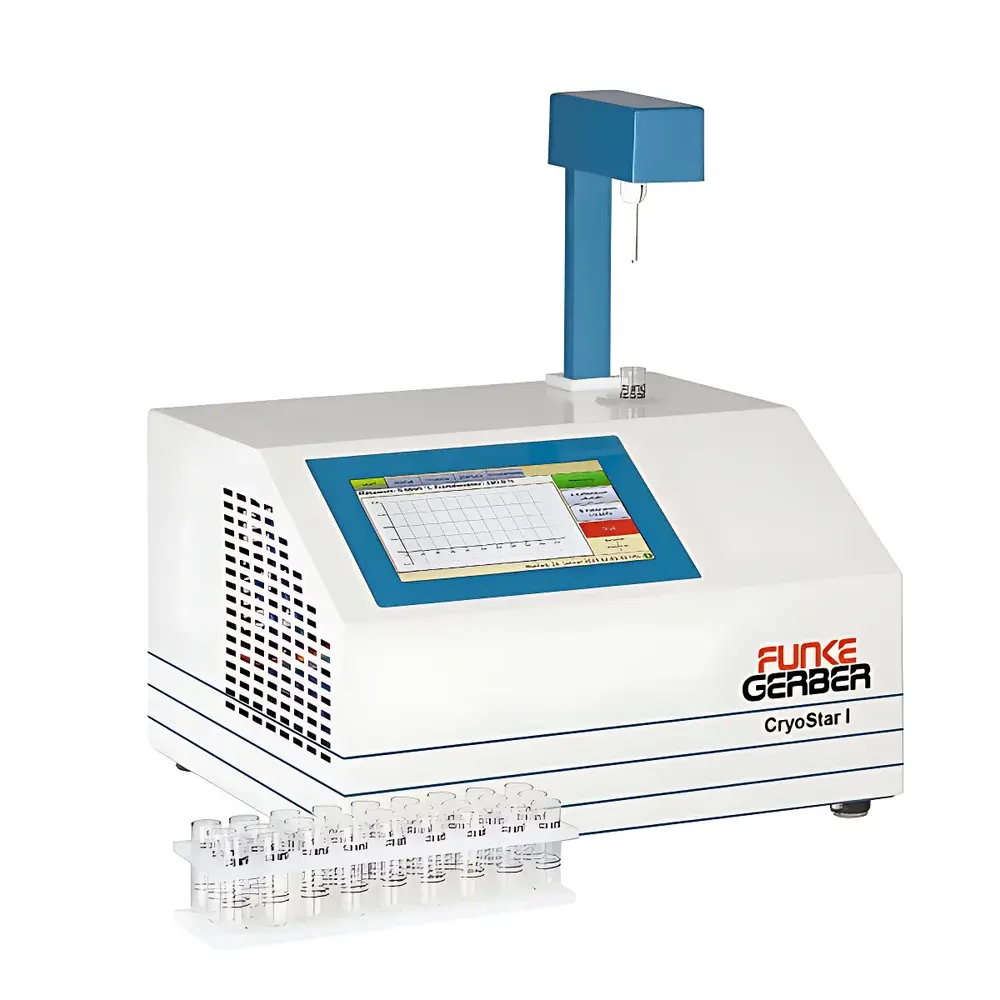
Funke Gerber CryoStar I Milk Cryoscope
| Brand | Funke Gerber |
|---|---|
| Origin | Germany |
| Model | CryoStar I |
| Automation | Fully Automatic |
| Analysis Speed | 40 samples/hour |
| Measurement Range | 0.000 °C to −1.500 °C |
| Repeatability | ±0.002 °C |
| Accuracy | 0.0001 °C |
| Sample Volume | 2.2 mL |
| Interface | RS-232 port, 6 V printer port |
| Power Supply | 230 V / 115 V AC (50–60 Hz), 180 W |
| Dimensions (W×H×D) | 29 cm × 19 cm × 38 cm |
| Weight | 12 kg |
Overview
The Funke Gerber CryoStar I Milk Cryoscope is a precision thermometric instrument engineered for the quantitative determination of water adulteration in raw and processed bovine milk through cryoscopic analysis. Based on the colligative property of freezing point depression, the device measures the exact temperature at which a milk sample transitions from liquid to solid phase under controlled supercooling and controlled recrystallization conditions. Pure water freezes at 0.000 °C; however, dissolved solutes—including lactose, minerals, proteins, and salts—lower the freezing point of milk to a characteristic baseline range of −0.520 °C to −0.530 °C. Any dilution with potable water elevates the observed freezing point proportionally: approximately +0.0053 °C per 1% added water. The CryoStar I detects this shift with metrological rigor, enabling trace-level quantification of adulteration down to 0.1% (v/v) with full traceability.
Key Features
- Fully automated measurement cycle (≤90 seconds per sample), eliminating operator-dependent timing and manual intervention during nucleation detection.
- High-resolution platinum resistance thermometer (PRT) probe with glass-sheathed construction, calibrated to ITS-90 standards and certified for long-term thermal stability.
- Integrated thermoelectric cooling system with active temperature regulation, ensuring consistent thermal gradient control across the entire −1.500 °C to 0.000 °C operating range.
- Real-time ice-point curve visualization, displaying supercooling depth, crystallization onset, plateau stabilization, and final equilibrium temperature.
- Onboard calculation engine applying the internationally accepted Gerber–Lactometer correction algorithm (DIN 10180, ISO 5725-2) to derive % water addition directly from measured freezing point deviation.
- Dual-voltage compatibility (115 V / 230 V AC or 12 V DC) supports deployment in mobile labs, dairy collection centers, and off-grid quality control stations.
Sample Compatibility & Compliance
The CryoStar I is validated for use with raw cow’s milk, standardized and homogenized pasteurized milk, reconstituted skim milk powder solutions, and whey-based liquids. It complies with critical international standards governing dairy authenticity testing, including ISO 5725-2 (accuracy and precision of analytical methods), DIN 10180 (determination of freezing point of milk), and IDF Standard 103A (Milk – Determination of freezing point). All calibration and verification procedures adhere to GLP principles, supporting audit readiness for regulatory inspections under EU Regulation (EC) No 853/2004 and FDA 21 CFR Part 11 when paired with secure data export protocols.
Software & Data Management
Data output is structured via RS-232 serial interface for direct integration into LIMS environments or legacy QC databases. Each measurement record includes timestamp, sample ID (user-definable), freezing point value (to 0.0001 °C), calculated water adulteration (%), recrystallization curve metadata, and operator ID. Optional PC software provides batch reporting, statistical process control (SPC) charting (X̄ & R charts), calibration log management, and electronic signature support compliant with 21 CFR Part 11 Annex 11 requirements. Audit trails capture all parameter modifications, calibration events, and user logins with immutable timestamps.
Applications
- Routine incoming raw milk inspection at dairy processing plants to enforce supplier contracts and prevent economic adulteration.
- Regulatory surveillance by national food safety authorities (e.g., FSSAI, DG SANTE, CFIA) for market monitoring and fraud detection.
- Research applications in dairy science laboratories studying osmotic behavior, mineral composition effects on freezing point, and thermal history impacts on crystallization kinetics.
- Quality assurance in infant formula manufacturing, where strict compliance with Codex Alimentarius Standard 72-1981 mandates freezing point verification as part of compositional integrity screening.
- Training and method validation in accredited food testing laboratories seeking ISO/IEC 17025:2017 accreditation for milk authenticity testing.
FAQ
What principle does the CryoStar I use to detect water adulteration?
It applies colligative freezing point depression theory, measuring the precise temperature at which milk undergoes phase transition under controlled supercooling, then calculates water content using the linear relationship between freezing point elevation and dilution ratio.
Is calibration traceable to national standards?
Yes — factory calibration uses NIST-traceable reference standards (−0.5250 °C and −0.2500 °C certified cryoscopic solutions), and users perform daily verification with supplied A/B calibration fluids traceable to PTB (Physikalisch-Technische Bundesanstalt).
Can the instrument differentiate between natural freezing point variation and intentional adulteration?
Yes — built-in statistical filters reject outliers caused by high somatic cell count, mastitis-related solute shifts, or excessive fat globule aggregation, ensuring specificity for water addition only.
What maintenance is required beyond routine calibration?
Annual thermistor verification and cooling system performance validation are recommended; no consumable parts require replacement except for disposable sample vials and calibration fluids.
Does the CryoStar I support multi-language operation?
The base firmware supports English and German UI; optional localized firmware packages (French, Spanish, Chinese) are available upon request for global deployment.




