
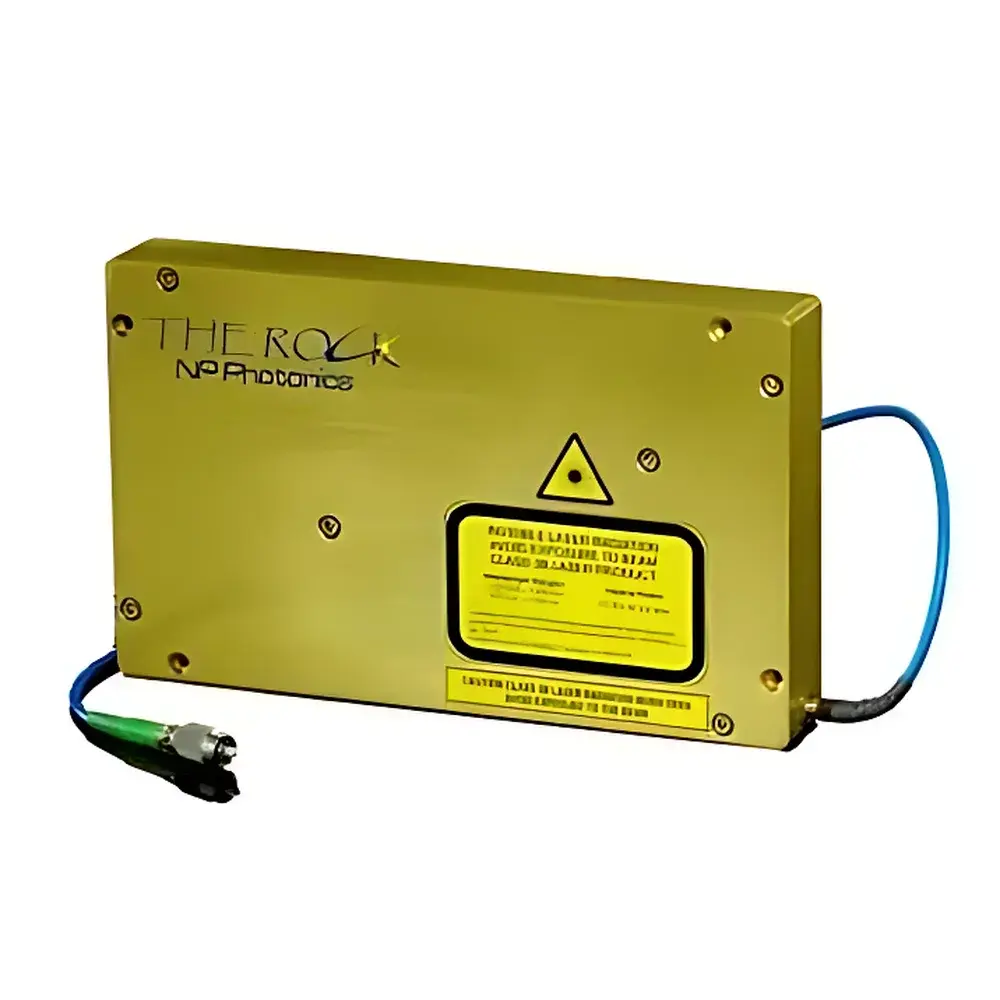
NP Photonics ROCK Series Single-Frequency Ultra-Narrow Linewidth Fiber Laser
| Origin | USA |
|---|---|
| Manufacturer Type | Authorized Distributor |
| Origin Category | Imported |
| Model | ROCK |
| Pricing | Upon Request |
Overview
The NP Photonics ROCK Series Single-Frequency Ultra-Narrow Linewidth Fiber Laser is a high-stability, low-noise optical source engineered for demanding applications in precision metrology, coherent lidar, fiber-optic sensing, and advanced photonic test systems. Based on NP Photonics’ proprietary Erbium-doped Micro-Structured Fiber (EMF™) technology, the ROCK platform delivers exceptional spectral purity through fundamentally stable cavity design, telecom-grade thermoelectric (T/E) cooling, and monolithic all-fiber architecture. Unlike conventional distributed feedback (DFB) or external cavity diode lasers, the ROCK leverages a short-length, single-mode erbium-doped micro-fiber gain medium pumped by a high-reliability semiconductor laser, enabling intrinsic suppression of mode-hopping and nonlinear effects. Its sub-kilohertz intrinsic linewidth—measured via heterodyne beat-note analysis—translates to coherence lengths exceeding 100 km, making it suitable for long-baseline interferometry, optical atomic clocks, and coherent optical communication systems requiring ultra-low phase noise. The system operates in true single longitudinal mode (SLM) with side-mode suppression ratio (SMSR) >50 dB and polarization extinction ratio (PER) >23 dB, ensuring deterministic polarization output critical for polarization-sensitive measurements.
Key Features
- Ultra-narrow intrinsic linewidth: <1 kHz (1530–1565 nm), <2 kHz (1030–1080 nm) — selectable options available
- High output power: Up to 125 mW across dual wavelength bands (C-band: 1530–1565 nm; Y-band: 1030–1080 nm)
- Single longitudinal mode operation with SMSR >50 dB and RIN <−110 dB/Hz @ 1 MHz (1550 nm), <−100 dB/Hz @ 1 MHz (1064 nm)
- Integrated active power stabilization loop with real-time front-panel power readout and RS232 digital interface
- Dual-stage frequency control: Wide-range thermal tuning (±15 GHz per °C, total ~30 GHz) + high-speed PZT-based modulation (±150 MHz, bandwidth up to 30 kHz)
- Low phase noise architecture: Frequency stability ≤50 MHz over 1 hour (after 30-min warm-up, ΔT ≤2 °C ambient drift)
- Robust mechanical design: Benchtop version features rigid aluminum chassis (257 × 119 × 313 mm); module version optimized for OEM integration (200 × 120 × 26.3 mm) with PM fiber pigtail (1 m, FC/APC)
- Onboard microcontroller with intuitive front-panel controls, wavelength display, and programmable setpoints
Sample Compatibility & Compliance
The ROCK laser is compatible with standard single-mode and polarization-maintaining fiber infrastructure (SMF-28, PM1550, PM980). Its FC/APC panel-mounted or fiber-pigtailed output ensures low back-reflection coupling into interferometric or amplification chains. The system complies with IEC 61000-6-3 (EMC emission limits) and IEC 60825-1:2014 (laser safety Class 3B). While not certified for medical or aerospace use out-of-the-box, its design meets foundational requirements for GLP/GMP-aligned calibration labs—including traceable power monitoring, audit-ready parameter logging via RS232, and stable operation under ISO 17025 environmental conditions (23 ±2 °C, <60% RH). Optional factory calibration reports include wavelength accuracy (±50 MHz), absolute power uncertainty (±3%), and linewidth verification per ASTM E2750-18 (Standard Practice for Spectral Linewidth Measurement of Lasers).
Software & Data Management
The ROCK supports ASCII-based serial command protocol over RS232 for full remote control of wavelength, output power, PZT voltage, and temperature setpoint. A Windows-compatible SDK (C/C++, Python bindings) enables integration into LabVIEW, MATLAB, or custom Python automation frameworks for closed-loop experiments. All operational parameters—including real-time power readings, internal TEC current, and laser diode bias—are accessible via query commands. Data logging is supported at user-defined intervals (10 Hz max), with timestamped CSV export for post-processing. Audit trail functionality (enabled via firmware v2.3+) records configuration changes with user ID and UTC timestamps—meeting baseline FDA 21 CFR Part 11 requirements for electronic records when deployed on validated host systems.
Applications
- Fiber-optic hydrophone and strain sensor interrogation (e.g., Φ-OTDR, BOTDA)
- Coherent Doppler wind and aerosol lidar systems requiring long coherence length and low phase noise
- Optical frequency comb seeding and master oscillator power amplifier (MOPA) architectures
- High-resolution spectroscopy (cavity ring-down, saturated absorption)
- Gravitational wave detector prototype testing and interferometer stabilization
- Photonic integrated circuit (PIC) characterization and wafer-level testing
- Replacement source for legacy Nd:YAG/Nd:YLF bulk lasers in metrology-grade setups
- Quantum optics experiments requiring high degree of first-order coherence
FAQ
What wavelength options are available beyond the standard C-band and Y-band?
Custom wavelengths between 1000–1600 nm are available upon request, subject to EMF fiber gain profile and pump laser availability. Typical lead time for non-standard configurations is 12–16 weeks.
Is the laser qualified for space or airborne environments?
The module version has passed MIL-STD-810G vibration testing (5–500 Hz, 7.7 g RMS). Full qualification for launch or flight requires customer-specific environmental screening; contact engineering support for DO-160 or ECSS-E-ST-10-04C compliance planning.
Can the ROCK be used as an injection seed for high-power fiber amplifiers?
Yes. Its narrow linewidth, high SMSR, and PM output make it ideal for seeding cladding-pumped Yb- or Er-doped amplifiers. Maximum recommended seed power into amplifiers is 50 mW to avoid nonlinear threshold effects in the pre-amplifier stage.
Does the system include NIST-traceable calibration documentation?
Standard delivery includes factory calibration certificate for output power and center wavelength. NIST-traceable calibration (including linewidth verification) is available as an optional service with accredited third-party lab reporting.
What is the expected lifetime of the pump laser diode?
Based on accelerated life testing per Telcordia GR-468-CORE, median lifetime exceeds 100,000 hours at rated operating current and 25 °C case temperature. Field failure rate is <100 FIT (failures in time) under controlled thermal management.



