
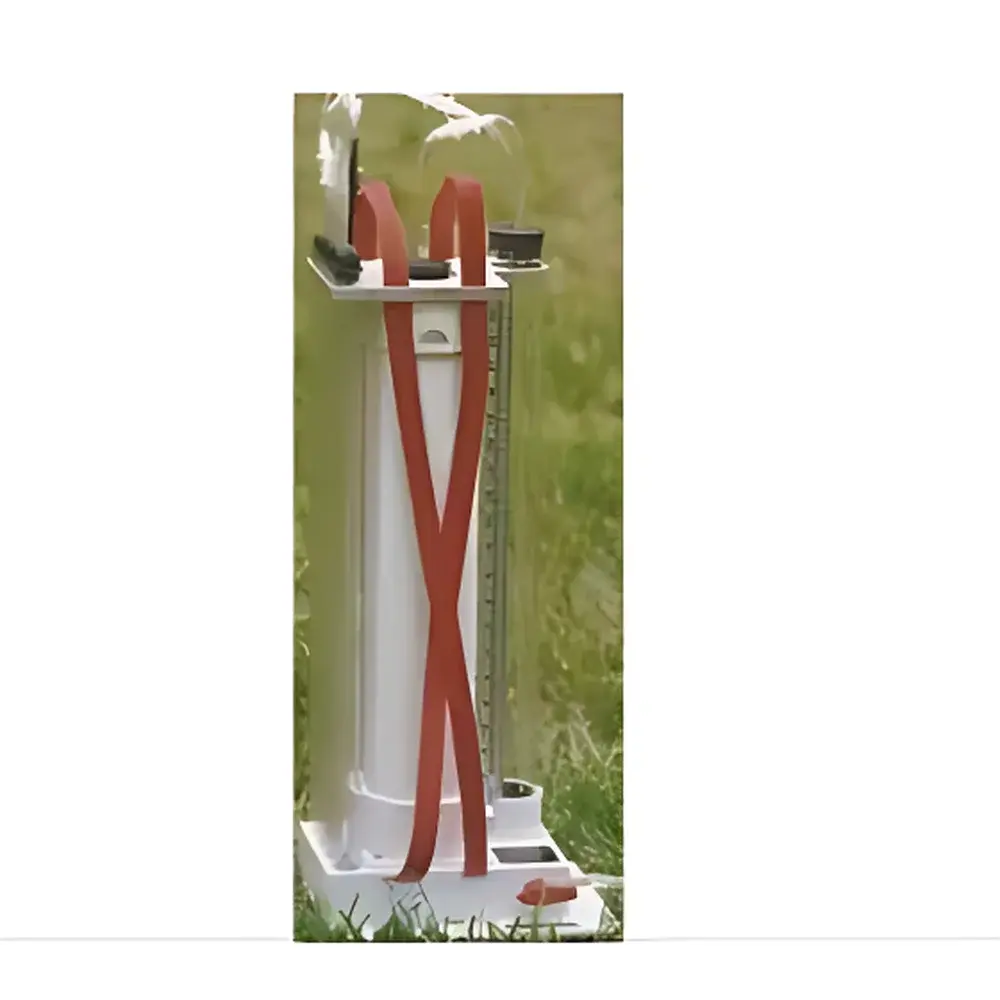
CHPP-KSAT Soil Saturated Hydraulic Conductivity Measurement System
| Origin | USA |
|---|---|
| Manufacturer Type | Authorized Distributor |
| Origin Category | Imported |
| Model | CHPP-KSAT |
| Instrument Type | Soil Moisture / Matric Potential Analyzer |
| Ksat Range | 0.01–5000 cm/d |
| Ceramic Plate Ksat | 20,000 cm/d |
| Measurement Accuracy | ±2% |
| Pressure Sensor Resolution | 1 Pa |
| Temperature Sensor Accuracy | ±0.2 °C |
| Sample Volume | 250 mL |
| Core Ring Dimensions | 50 mm height × 80 mm internal diameter |
| Automatic Temperature Compensation | Yes |
| Evaporation-Free Measurement Design | Yes |
| Repeatability | High |
Overview
The CHPP-KSAT Soil Saturated Hydraulic Conductivity Measurement System is a laboratory-based, steady-state permeameter engineered for precise determination of saturated hydraulic conductivity (Ks) in undisturbed soil cores. It operates on the fundamental principle of Darcy’s Law—measuring volumetric water flux under a controlled hydraulic gradient across a fully saturated soil column. Water flows vertically upward through the sample, driven by a defined pressure differential maintained between the lower ceramic plate and upper reservoir. This configuration eliminates gravitational bias and ensures laminar, one-dimensional flow conditions essential for rigorous hydrological parameterization. The system is designed for reproducible, traceable Ks quantification in support of vadose zone modeling, irrigation scheduling validation, landfill liner performance assessment, and regulatory compliance testing per ASTM D5084 and ISO 11274 standards.
Key Features
- Steady-state measurement protocol compliant with established soil physics methodology, minimizing transient flow artifacts
- Integrated high-resolution pressure transducers (±1 Pa) and precision temperature sensors (±0.2 °C) enabling real-time monitoring and automatic thermal correction of viscosity-dependent Ks calculations
- Dual-ceramic-plate configuration with certified high-permeability base plate (Ks ≥ 20,000 cm/d), ensuring negligible resistance to inflow and eliminating boundary layer error
- Evaporation-suppressed design: sealed top reservoir and inert gas purging option prevent mass loss during extended measurements (critical for low-conductivity clays)
- Standardized 250 mL soil core geometry (50 mm height × 80 mm ID) compatible with widely adopted field sampling protocols and international inter-laboratory comparison frameworks
- Robust mechanical architecture with stainless-steel fluid pathways and chemically resistant seals, suitable for long-term use with aqueous electrolyte solutions and leachate simulants
Sample Compatibility & Compliance
The CHPP-KSAT accommodates intact or reconstituted soil cores ranging from coarse sands to compacted silty clays. Its operational range (0.01–5000 cm/d) covers the full spectrum of natural soils, including engineered barrier materials used in containment systems. All wetted components comply with USP Class VI biocompatibility requirements, and pressure control modules meet IEC 61000-6-3 EMC emission standards. Data acquisition workflows support GLP-compliant documentation: timestamped sensor logs, operator ID tagging, and audit-trail-enabled parameter changes align with FDA 21 CFR Part 11 readiness when integrated with validated LIMS platforms.
Software & Data Management
The system interfaces via USB or Ethernet with proprietary Windows-based acquisition software that implements ISO/IEC 17025-aligned calibration management. Real-time Ks computation applies dynamic water viscosity correction using ITS-90 temperature interpolation. Export formats include CSV (for MATLAB/Python post-processing), PDF test reports with embedded metadata (sample ID, date/time, ambient lab conditions), and XML files structured for ingestion into environmental data warehouses. Optional API integration enables automated triggering from external scheduling systems or IoT-based lab infrastructure controllers.
Applications
- Quantifying Ks for agricultural drainage design and subsurface drip irrigation modeling
- Evaluating compaction effects on infiltration capacity in highway embankment and airport runway subgrades
- Characterizing hydraulic performance of geosynthetic clay liners (GCLs) and bentonite-amended backfill
- Validating numerical simulations of contaminant transport in unsaturated–saturated transition zones
- Supporting regulatory submissions under EPA Method 1312 (SPLP) and EU Council Directive 2006/12/EC for waste disposal facility licensing
- Long-term monitoring of soil structural recovery following tillage or biochar amendment trials
FAQ
What soil sample preparation is required prior to measurement?
Undisturbed cores must be saturated from below using deaired water over 24–48 h; gravimetric water content and bulk density should be recorded independently.
Can the system measure anisotropic conductivity?
Yes—by rotating the core orientation (vertical vs. horizontal bedding plane alignment) and repeating the test under identical hydraulic gradients.
Is calibration traceable to national standards?
Pressure and temperature sensors are supplied with NIST-traceable calibration certificates; ceramic plate permeability is verified against reference sand columns per ASTM D5084 Annex A3.
How does the system handle low-Ks samples requiring extended runtimes?
The software supports multi-step gradient testing and adaptive time-sampling algorithms to maintain statistical confidence in flux estimation without manual intervention.
Are replacement ceramic plates available with different entry pressures?
Yes—standard 100 kPa and optional 50 kPa and 200 kPa entry pressure variants are stocked for specialized applications such as peat or fractured rock interface studies.
Related Products







