
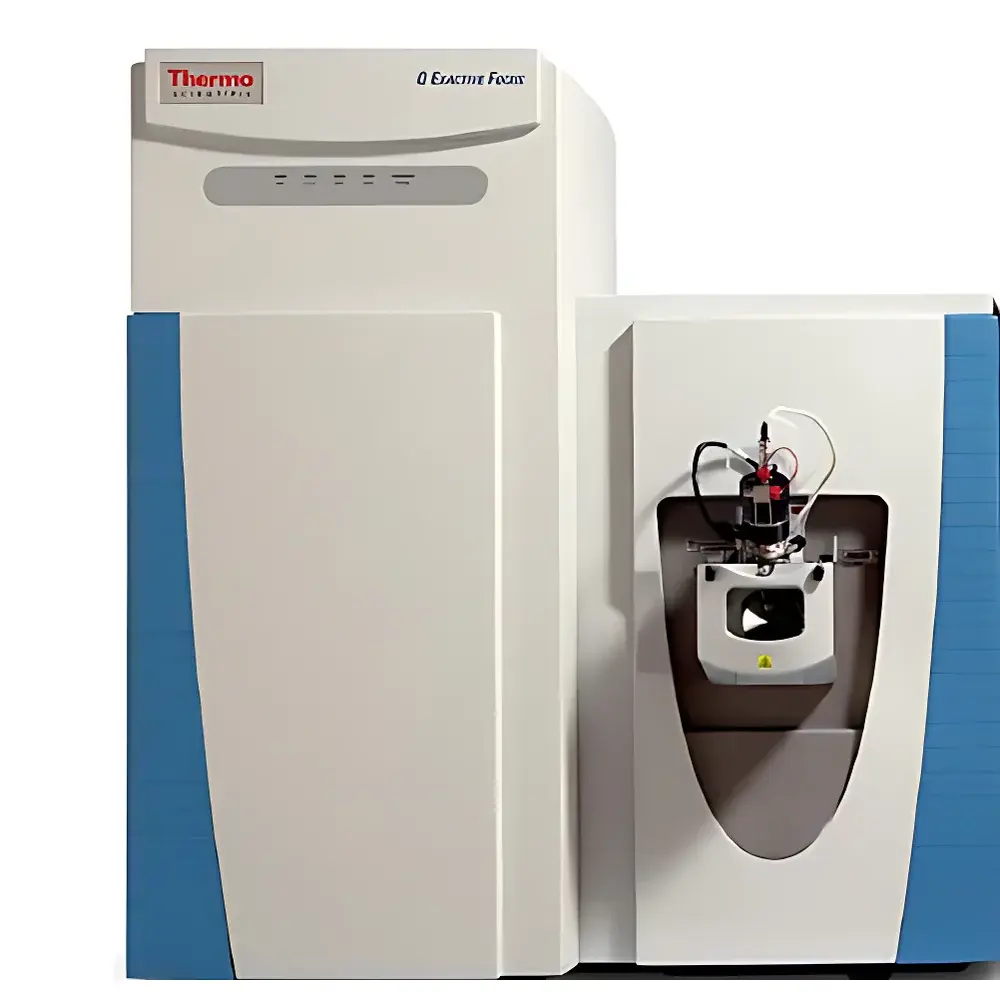
Thermo Scientific Q Exactive Focus LC-MS/MS System
| Brand | Thermo Fisher |
|---|---|
| Origin | USA |
| Manufacturer Type | Original Equipment Manufacturer (OEM) |
| Product Category | Imported Instrument |
| Model | Q Exactive Focus LC-MS/MS |
| Price Range | USD 260,000 – 390,000 (based on configuration and regional duties) |
| Instrument Type | Hybrid Quadrupole-Orbitrap Mass Spectrometer |
Overview
The Thermo Scientific Q Exactive Focus LC-MS/MS System is a hybrid quadrupole-Orbitrap mass spectrometer engineered for robust, high-resolution, accurate-mass analysis of small molecules in routine laboratory environments. It leverages the proven architecture of the Q Exactive platform—featuring a high-transmission heated electrospray ionization (HESI) source, a robust dual-pressure quadrupole mass filter, and a high-field Orbitrap mass analyzer operating at 17,500 resolution (at m/z 200). Unlike time-of-flight (TOF) or triple quadrupole (QqQ) systems, the Q Exactive Focus acquires full-scan MS and MS/MS spectra with sub-ppm mass accuracy, enabling untargeted screening, structural elucidation, and quantitative analysis within a single acquisition. Its design prioritizes operational stability, minimal downtime, and reproducible performance across multi-day sequences—critical for regulated environments such as food safety testing labs, pharmaceutical quality control, forensic toxicology units, and academic metabolomics core facilities.
Key Features
- Hybrid quadrupole-Orbitrap architecture: Combines selective precursor ion filtering (quadrupole) with high-resolution, accurate-mass detection (Orbitrap), delivering both sensitivity and specificity without sacrificing scan speed.
- Full-scan MS and data-dependent MS/MS (dd-MS2) in a single run: Enables retrospective data mining and confident identification of unknowns without re-injection.
- Mass accuracy < 3 ppm RMS (internal calibration) and < 5 ppm (external calibration) across m/z 100–2000, compliant with ASTM E2874 and ISO/IEC 17025 requirements for method validation.
- Dynamic range > 4 orders of magnitude for quantitative applications, supporting both low-abundance metabolites and high-concentration analytes in complex matrices.
- Integrated Thermo Scientific SyncScan technology: Simultaneously acquires high-resolution MS1 and targeted MS/MS scans, improving duty cycle efficiency without compromising spectral fidelity.
- Robust HESI source with temperature-controlled desolvation and adjustable gas flows, optimized for polar and thermally labile small molecules (e.g., pesticides, mycotoxins, pharmaceutical impurities).
Sample Compatibility & Compliance
The Q Exactive Focus supports liquid chromatography (UHPLC/HPLC) interfaces—including Thermo Scientific Vanquish and UltiMate 3000 systems—with compatibility for reversed-phase, HILIC, and ion-pairing separations. It accommodates diverse sample types: aqueous extracts (food, environmental), plasma/serum digests (clinical toxicology), cell lysates (metabolomics), and synthetic reaction mixtures (process chemistry). The system complies with regulatory frameworks governing analytical instrument qualification, including FDA 21 CFR Part 11 (electronic records/signatures), EU Annex 11, and GLP/GMP documentation standards. IQ/OQ/PQ protocols are supported via Thermo Scientific Chromeleon CDS software, and audit trails meet ISO/IEC 17025 traceability requirements.
Software & Data Management
Controlled by Thermo Scientific Compound Discoverer 3.3 and TraceFinder 5.1 software, the system provides integrated workflows for compound identification, relative quantitation, and reporting. Compound Discoverer enables automated peak detection, formula prediction (using isotopic pattern matching and elemental composition scoring), and library matching against mzCloud, mzVault, and NIST MS Libraries. TraceFinder supports validated quantitative methods with internal standard calibration curves, matrix-matched standards, and automatic integration flagging per USP . All raw data files (.raw) are stored in vendor-neutral formats compatible with open-source tools (e.g., ProteoWizard, OpenMS), ensuring long-term archival integrity and interoperability with LIMS and ELN platforms.
Applications
- Food safety: Multi-residue screening of pesticides, veterinary drugs, and mycotoxins in cereals, dairy, and infant formula per EU SANTE/11312/2021 guidelines.
- Pharmaceutical development: Impurity profiling, forced degradation studies, and metabolite identification (MetID) aligned with ICH M7 and Q5C recommendations.
- Forensic toxicology: Targeted and untargeted detection of novel psychoactive substances (NPS), opioids, and benzodiazepines in blood and urine per SWGTOX best practices.
- Clinical research: Small-molecule biomarker discovery in plasma and CSF using differential expression analysis and pathway mapping (KEGG, HMDB).
- Environmental analysis: Quantification of emerging contaminants (e.g., PFAS, pharmaceuticals) in wastewater and surface water per EPA Method 1694 adaptations.
FAQ
What distinguishes the Q Exactive Focus from the original Q Exactive platform?
The Q Exactive Focus retains identical quadrupole and Orbitrap hardware but features an optimized electronics architecture for improved duty cycle in routine workflows, reduced maintenance intervals, and enhanced robustness under continuous operation.
Is the system compatible with non-Thermo LC systems?
Yes—it accepts standard analog/digital signals from third-party UHPLC systems (e.g., Agilent 1290, Waters Acquity) via TTL triggering and mass spectrometer synchronization protocols.
Can it perform scheduled MRM-like quantitation?
While not a triple quadrupole, its parallel reaction monitoring (PRM) mode delivers comparable selectivity and precision to MRM, with full-spectrum confirmation and retention of fragment ion abundances for orthogonal verification.
What calibration standards are required for daily operation?
A single-point lock mass correction using fluoranthene (m/z 241.0127) or sodium formate cluster ions ensures ongoing mass accuracy; no daily full calibration is mandated under routine use per Thermo’s PQ documentation.
Does the system support 21 CFR Part 11-compliant electronic signatures?
Yes—when deployed with Chromeleon CDS v7.3.3 or later and configured with role-based user accounts, digital signature enforcement, and immutable audit trails.





