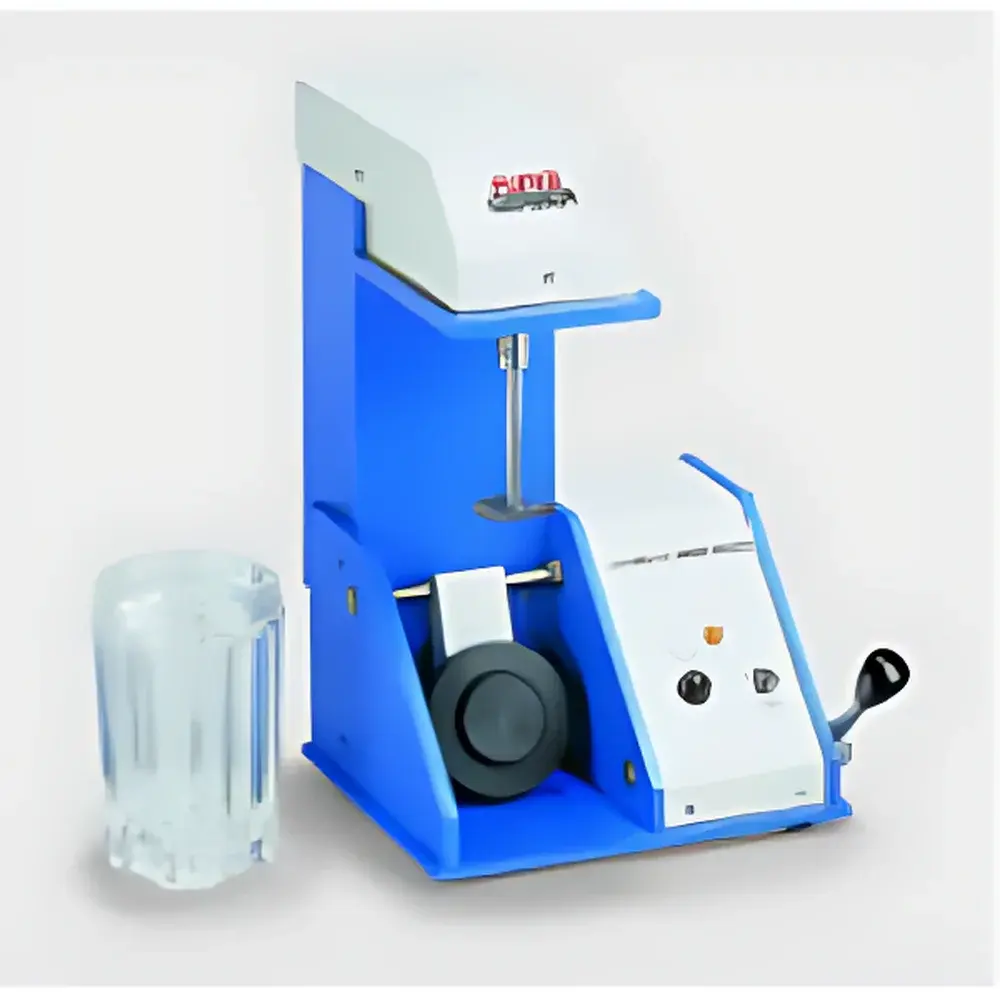
Funke 761 Milk Insolubility Index Stirrer
| Brand | Funke |
|---|---|
| Origin | Germany |
| Manufacturer Type | Authorized Distributor |
| Origin Category | Imported |
| Model | 761 |
| Detection Parameter | Milk Insolubility Index (MII) |
| Automation Level | Semi-Automatic |
| Analysis Speed | 60 samples/hour |
| Measurement Range | 0–15 MII units |
| Repeatability | ±1% RSD |
| Accuracy | <1% error |
| Stirring Speed | 3600 ± 100 rpm |
| Timer Precision | ±0.01 s (electronic, preset 90 s) |
| Power Supply | AC 220 V, 50 Hz |
| Motor Power | 30 W |
| Construction | Stainless steel stirring paddle & cup assembly |
| Dimensions | 250 × 240 × 400 mm |
| Weight | 9.5 kg |
| Compliance | IDF Standard 129A, ISO 8156, ADMA/DLG specifications, GB/T 5413.29–2023 |
Overview
The Funke 761 Milk Insolubility Index Stirrer is a precision-engineered laboratory instrument designed specifically for the standardized determination of insolubility index (MII) in liquid and reconstituted dairy products—including raw milk, pasteurized milk, skim milk, whey, ice cream mix, and dairy-based nutritional powders. It operates on the principle of controlled mechanical agitation under strictly defined rotational speed, time, and geometry to induce particle aggregation and sedimentation—enabling quantification of suspended insoluble matter after centrifugation per internationally recognized protocols. The device implements the hydrodynamic shear conditions specified in IDF 129A (International Dairy Federation), ISO 8156 (Milk and milk products — Determination of insolubility index), and GB/T 5413.29–2023 (Chinese national standard for infant formula and dairy products). Its fixed-speed, high-reproducibility stirring mechanism ensures consistent dispersion energy input across batches, forming the foundational step in quality control workflows for dairy processors, regulatory laboratories, and R&D facilities engaged in powder solubility optimization and shelf-life stability assessment.
Key Features
- Stainless steel stirring paddle and sample cup assembly engineered for corrosion resistance, cleanability, and dimensional fidelity to GB/T 5413.29 and ISO 8156 geometrical requirements.
- Brushless DC motor delivering stable 3600 ± 100 rpm rotation with minimal torque fluctuation—critical for achieving uniform shear history across replicate samples.
- Microprocessor-controlled electronic timer with dual-mode operation: factory-preset 90-second cycle (±0.01 s accuracy) and continuous run mode for method development or extended dispersion studies.
- Vertical height-adjustable platform enabling precise positioning of the mixing cup relative to the stirrer shaft—ensuring compliance with the 20 mm immersion depth and 10 mm clearance tolerances mandated by IDF 129A.
- Integrated safety interlock preventing motor activation unless cup is correctly seated and lid secured—supporting GLP-compliant operation in audited environments.
- Compact footprint (250 × 240 × 400 mm) and low thermal signature (30 W nominal power) suitable for benchtop deployment in QC labs with limited space and HVAC constraints.
Sample Compatibility & Compliance
The Funke 761 accommodates standard 100 mL borosilicate glass or polypropylene mixing cups conforming to GB/T 5413.29 Annex A dimensions. It supports direct analysis of liquid milk, whey permeate, reconstituted infant formula, and ice cream base formulations. For powdered samples, it serves as the primary dispersion unit prior to centrifugation in accordance with ISO 8156 Section 6. All mechanical and timing parameters are traceable to national metrology standards, and the instrument’s operational envelope satisfies the performance verification criteria outlined in ISO/IEC 17025:2017 Clause 6.4.2 for equipment used in accredited testing laboratories. Documentation includes EU Declaration of Conformity (2014/30/EU EMC Directive), CE marking, and full calibration certificate upon request.
Software & Data Management
While the Funke 761 is hardware-centric and operates without embedded software, its deterministic electromechanical design ensures full compatibility with LIMS-integrated workflows. Timestamped operation logs (start/stop, duration, error flags) can be captured via external USB data loggers or PLC interfaces. For laboratories operating under FDA 21 CFR Part 11 or EU Annex 11 requirements, optional RS-232 or analog output modules enable audit-trail recording of run parameters—including actual rpm (via tachometer feedback), elapsed time, and thermal status—into validated electronic lab notebooks. Routine performance verification checks (e.g., speed calibration using optical tachometer, timer validation per ISO/IEC 17025) are supported by downloadable SOP templates aligned with GMP and ISO 9001 quality management systems.
Applications
- Quantitative assessment of milk powder solubility during production line release testing.
- Root cause analysis of batch-to-batch variability in whey protein concentrate (WPC) and isolate (WPI) dispersion behavior.
- Method validation for AOAC Official Method 2012.05 (Dairy Solubility Index) and equivalent regional adaptations.
- Stability monitoring of fortified dairy beverages containing calcium phosphate or micronutrient premixes prone to phase separation.
- Supporting shelf-life studies where insolubility index serves as an early indicator of Maillard reaction progression or lipid oxidation-induced aggregation.
- Training and proficiency testing in ISO/IEC 17043-accredited interlaboratory comparison schemes.
FAQ
What standards does the Funke 761 comply with?
IDF Standard 129A, ISO 8156, ADMA and DLG specifications for dairy testing, and GB/T 5413.29–2023.
Can the stirring time be adjusted beyond 90 seconds?
Yes—the instrument features a continuous run mode allowing user-defined durations; however, 90 seconds remains the normative value for MII determination per all cited standards.
Is the stirring speed verified and traceable?
Yes—each unit undergoes factory calibration against NIST-traceable tachometric reference; calibration certificate and verification procedure documentation are provided.
Does the system require routine maintenance?
Only periodic visual inspection of the stainless steel paddle for wear and cleaning of the shaft coupling; no lubrication or consumable replacement is required within the first 5 years of typical use.
How is sample cup alignment ensured for reproducible results?
The height-adjustable platform incorporates engraved depth markers and tactile stops calibrated to maintain 20 mm paddle immersion and 10 mm cup-bottom clearance—both critical for shear field consistency per ISO 8156 Annex B.