
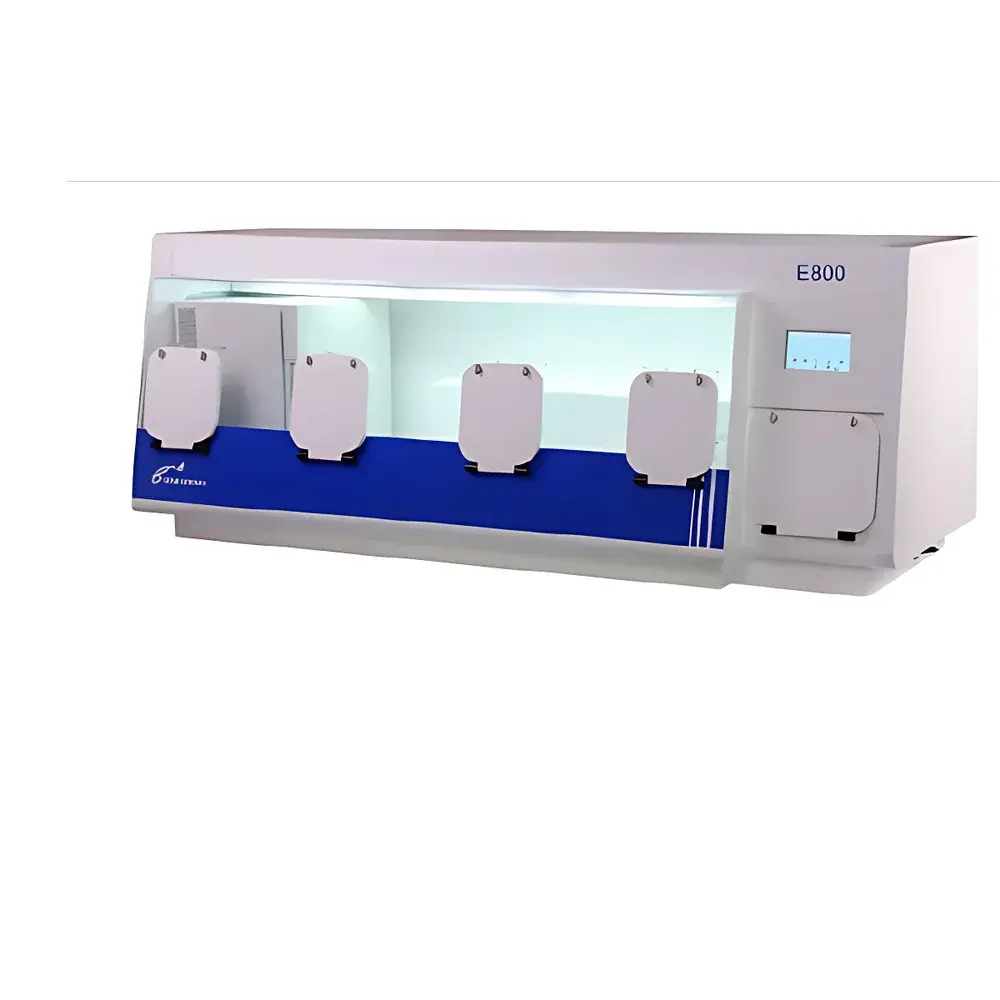
GeneScience E800 Anaerobic & Microaerophilic Workstation
| Brand | GeneScience |
|---|---|
| Origin | USA |
| Model | E800 |
| Temperature Range | +3°C to 52°C |
| Temperature Uniformity & Stability | ±0.3°C |
| Humidity Control Range | Ambient to 90% RH |
| O₂ Control (Anaerobic Mode) | <50 ppm |
| O₂ Control (Microaerophilic Mode) | 0.1–20.0% (0.1% increments) |
| CO₂ Control Range | 0.1–20.0% (0.1% increments) |
| Internal Chamber Capacity | 1200 × 90 mm Petri Dishes |
| Transfer Lock Volume | 20 L (60 × 90 mm plates per cycle) |
| HEPA Filtration | U16 Class, 99.99995% @ 0.12 µm |
| Data Logging | USB-based, 30-day continuous recording of O₂, temperature, humidity, and gas flow events |
Overview
The GeneScience E800 Anaerobic & Microaerophilic Workstation is an engineered environmental control platform designed for precise, reproducible cultivation and manipulation of oxygen-sensitive microorganisms under strictly defined atmospheric conditions. Utilizing a dual-gas (N₂/H₂/CO₂) and triple-gas (N₂/CO₂/compressed air) delivery architecture, the E800 enables stable maintenance of anaerobic environments (<50 ppm O₂) and tunable microaerophilic atmospheres (0.1–20.0% O₂), meeting critical requirements for regulatory-compliant microbiological testing in food safety, clinical diagnostics, and pharmaceutical quality control laboratories. Its sealed, positive-pressure chamber—equipped with U16-grade HEPA filtration (ISO 14644-1 Class 3 compliant)—ensures particulate-free operation while maintaining sterility during extended incubation cycles. The system supports simultaneous multi-strain cultivation per ISO 11133, FDA Bacteriological Analytical Manual (BAM), and USP guidelines, including standardized growth of Shigella spp. (anaerobic, 41.5°C), Campylobacter jejuni (microaerophilic, 25°C), Clostridium perfringens (anaerobic, 36°C), Clostridium botulinum (anaerobic, 35°C), and lactic acid bacteria (anaerobic, 36°C).
Key Features
- Integrated 20-L rapid-transfer airlock with nitrogen purge cycle completing in ≤60 seconds—capable of transferring up to 60 × 90 mm Petri dishes, sterile triangular flasks (≤185 mm height), or stomacher bags per cycle
- Intelligent airlock interlock system preventing internal atmosphere compromise during transfer operations
- Single-hand, one-touch actuation of inner airlock door for ergonomic workflow integration
- Large internal capacity: accommodates ≥1200 × 90 mm Petri dishes, ≥120 × 250 mL Erlenmeyer flasks, ≥80 × 500 mL flasks, ≥160 × 250 mL reagent bottles, or >160 stomacher bags
- Removable side panels enabling unobstructed access for instrument insertion, routine cleaning, or validation probe placement
- Autoclavable-compatible cleaning protocol using EDTA tetrasodium + tert-butylphenol lauryl polyoxyethylene ether sodium sulfate formulation—validated for non-corrosive surface decontamination without compromising acrylic viewport integrity
- 7-inch full-color touchscreen interface for real-time parameter configuration, system status monitoring, and event-driven alarm visualization
- Ultrasonic humidification module with closed-loop feedback control delivering ambient-to-90% RH precision across all operational modes
- Dual illumination system: daylight-balanced fluorescent lighting for visual inspection and 254 nm UV-C germicidal lamp for periodic chamber decontamination
- Onboard O₂ sensor with ±5 ppm accuracy and continuous digital display; integrated Pd-catalyst monitoring system tracking catalyst activity degradation over time (rated service life: ≥4 years)
- No-sleeve, gloveless operation enabled by internal positive pressure and catalytic O₂ scavenging—eliminating vacuum-purge dependency and reducing procedural complexity
- Four dedicated internal GFCI-protected AC outlets (110–240 V, 50/60 Hz) supporting concurrent use of pipettes, centrifuges, or colony counters
Sample Compatibility & Compliance
The E800 maintains strict adherence to internationally recognized standards governing anaerobic culture practices. Its oxygen control fidelity (<50 ppm in anaerobic mode) satisfies ISO 11133 Annex C requirements for obligate anaerobe isolation and enumeration. The microaerophilic range (0.1–20.0% O₂, 0.1% resolution) aligns with CLSI M45-A2 recommendations for Campylobacter and Helicobacter cultivation. All internal surfaces are constructed from medical-grade stainless steel (ASTM A240 Type 316L) and borosilicate glass, facilitating repeatable cleaning validation per FDA 21 CFR Part 11 Annex 11 data integrity protocols. Chamber sterilization cycles are compatible with hydrogen peroxide vapor (HPV) bio-decontamination procedures when performed externally, and internal UV-C irradiation meets ISO 15858 performance thresholds for surface microbial reduction.
Software & Data Management
Data integrity is ensured via embedded USB-archived logging capturing timestamped records of O₂ concentration (ppm/%), chamber temperature (°C), relative humidity (%RH), gas inlet durations, and catalyst status flags. Log files are stored in CSV format, supporting post-hoc analysis in Excel or LIMS-integrated platforms. The system complies with ALCOA+ principles—data entries are attributable, legible, contemporaneous, original, accurate, complete, consistent, enduring, and available—enabling audit readiness for GLP and GMP environments. Alarm logs include severity tagging (warning vs. critical), automatic timestamping, and persistent storage even during power interruption. Optional firmware updates are delivered via encrypted USB key with SHA-256 hash verification.
Applications
- Routine enumeration and isolation of obligate anaerobes in foodborne pathogen testing (e.g., Clostridium, Bifidobacterium) per ISO 11133 and AOAC Official Methods
- Clinical microbiology workflows requiring simultaneous culture of Campylobacter jejuni, Helicobacter pylori, and Prevotella melaninogenica under differential O₂ tensions
- Pharmaceutical microbiological testing of non-sterile products per USP and EP 2.6.12
- Fermentation process development for probiotic strains under controlled redox potentials
- Antibiotic susceptibility testing (AST) under physiologically relevant O₂ gradients
- Environmental monitoring of anaerobic digesters and bioremediation consortia
FAQ
What gas mixtures are required for anaerobic versus microaerophilic operation?
For anaerobic mode, two cylinders are needed: one containing 10% H₂ / 10% CO₂ / 80% N₂, and one pure N₂ cylinder. For microaerophilic mode, three cylinders are required: CO₂, N₂, and compressed air (oil-free, particle-filtered).
Is the E800 compliant with FDA 21 CFR Part 11 for electronic records?
Yes—the onboard data logger generates attributable, tamper-evident, time-stamped records with user login tracking and audit trail functionality, satisfying core Part 11 requirements for electronic signatures and record retention.
How often must the palladium catalyst be replaced?
The integrated Pd-catalyst has a rated service life of ≥4 years under normal usage (≤8 h/day, 5 days/week); its real-time activity status is continuously monitored and displayed on the touchscreen interface.
Can standard laboratory equipment be placed inside the chamber?
Yes—removable side panels allow entry of benchtop centrifuges, vortex mixers, or automated colony pickers, provided their external dimensions do not exceed 780 mm (W) × 810 mm (H) × 780 mm (D) and they operate within the chamber’s ambient temperature and humidity envelope.
What validation support documentation is provided?
GeneScience supplies IQ/OQ documentation templates aligned with ASTM E2500-13, including temperature mapping protocols, O₂ sensor calibration certificates (NIST-traceable), HEPA filter test reports (EN 1822-3), and alarm response verification checklists.



