
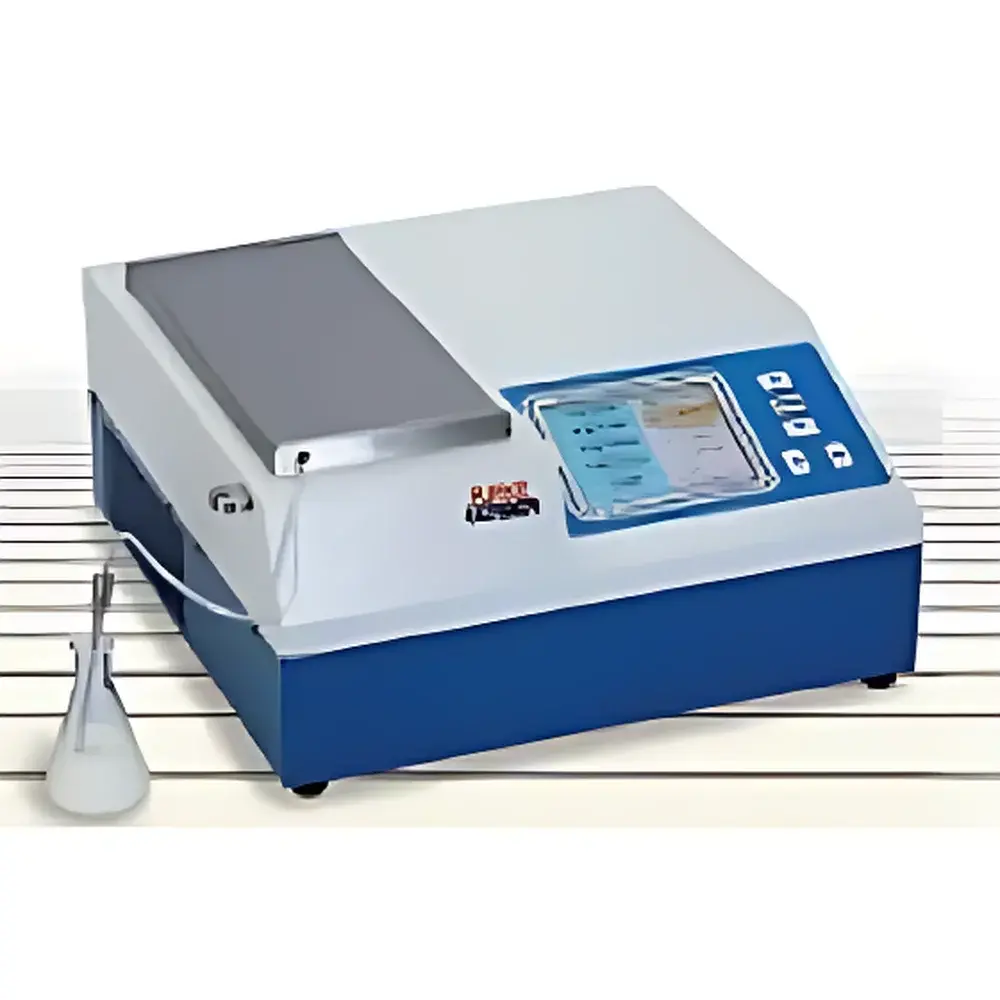
Gabo LactoStar Breast Milk and Dairy Analyzer
| Brand | Funke |
|---|---|
| Origin | Germany |
| Manufacturer Type | Authorized Distributor |
| Origin Category | Imported |
| Model | LactoStar 1 |
| Power Supply | 230 V / 180 V, 50–60 Hz or 12 V DC |
| Sample Throughput | 40 samples/hour |
| Sample Volume | 12–20 mL |
| Dimensions (W × L × D) | 44 × 44 × 20 cm |
| Weight | 15.5 kg |
| Fat Measurement Range | 0.01–35% (±0.02% repeatability) |
| Protein Range | 0.01–10% (±0.02%) |
| Lactose Range | 0.01–10% (±0.02%) |
| SNF Range | 0.01–15% (±0.02%) |
| Minerals Range | 0.01–5% (±0.02%) |
| Freezing Point Range | –0.001 °C (±0.002 °C repeatability) |
Overview
The Gabo LactoStar Breast Milk and Dairy Analyzer is a benchtop near-infrared (NIR) and thermometric hybrid analyzer engineered for rapid, non-destructive quantification of key compositional parameters in raw and processed dairy matrices. Designed and manufactured in Germany under strict DIN EN ISO 9001 quality management protocols, the instrument employs dual-mode measurement principles: optical absorption spectroscopy in the NIR region (700–2500 nm) for fat, protein, lactose, and solids-not-fat (SNF), coupled with high-resolution thermistor-based cryoscopy for freezing point depression analysis — a critical parameter for detecting adulteration and estimating total solute concentration. Its architecture conforms to the physical-chemical behavior of unfermented, non-additive dairy liquids, making it suitable for human breast milk, bovine milk, ovine milk, raw milk, whole milk, skim milk, and cream. It is explicitly not validated for fermented products (e.g., yogurt, kefir), whey, cheese curd, or samples containing stabilizers, acids, colorants, salts, or preservatives — as these interfere with optical path integrity and thermal equilibration.
Key Features
- Integrated dual-sensor platform: NIR optical cell (“Blue Box”) and precision thermistor module (“Red Box”) co-registered within a single flow path for simultaneous multi-parameter acquisition.
- Intuitive user interface: 7-inch full-color TFT LCD display with five tactile membrane keys enabling menu navigation, parameter adjustment, and real-time status feedback without external peripherals.
- Multi-matrix calibration library: Stores up to 20 pre-validated calibration sets — individually optimized for human milk, bovine milk, ovine milk, raw milk, whole milk, skim milk, and cream — eliminating recalibration between sample types.
- Automated maintenance protocol: Self-initiated zero-point calibration, programmable auto-cleaning cycles (triggered after >5 min idle time), and integrated peristaltic pump system (sample, rinse, and pure water pumps) ensure analytical consistency across extended operation.
- Built-in thermal stabilization: Peltier-controlled sample chamber maintains consistent inlet temperature (±0.1 °C), minimizing thermal drift during sequential analysis.
- Onboard data handling: Integrated thermal printer for immediate hard-copy reporting; RS232 serial interface compliant with ANSI/TIA/EIA-232-F standards for bidirectional communication with laboratory information systems (LIS) or PC-based data logging software.
Sample Compatibility & Compliance
The LactoStar is validated exclusively for liquid dairy samples meeting ISO 9622:2013 (Milk — Determination of fat, protein, lactose, other nitrogen-containing compounds and non-fat dry matter — Guidance on use of mid-infrared spectrometry) and IDF 141-2:2017 (International Dairy Federation standard for rapid milk composition analyzers). Samples must be free of particulates >50 µm, non-homogenized but fluid (no coagulation, acidity < pH 6.4, no visible cream separation), and devoid of exogenous additives. It complies with CE marking requirements (2014/30/EU EMC Directive and 2014/35/EU Low Voltage Directive) and meets IEC 61010-1 safety standards for laboratory equipment. While not FDA 21 CFR Part 11-certified out-of-the-box, its audit trail-capable firmware (v3.2+) supports GLP/GMP-aligned data integrity when deployed with validated third-party LIS integration.
Software & Data Management
The analyzer operates on embedded firmware with configurable data export modes via RS232. Raw measurement values (fat %, protein %, lactose %, SNF %, minerals %, freezing point °C), timestamp, calibration ID, and operator code are transmitted in ASCII-delimited format. Optional PC software (LactoSoft v4.x) enables batch report generation, statistical trend analysis (mean, SD, CV%), calibration curve visualization, and CSV/Excel export. All data fields support user-defined metadata tagging (e.g., donor ID, lactation stage, collection date), facilitating longitudinal clinical or quality control studies. Audit logs record every calibration event, cleaning cycle, and firmware update with immutable timestamps — supporting traceability in accredited human milk banking environments per HMBANA (Human Milk Banking Association of North America) guidelines.
Applications
- Clinical lactation support: Quantitative assessment of macronutrient profiles in expressed breast milk for personalized fortification in NICUs.
- Dairy quality assurance: Real-time verification of raw milk compliance with contractual fat/protein specifications at collection centers.
- Research in maternal nutrition: Longitudinal tracking of compositional shifts across lactation stages (colostrum → transitional → mature milk).
- Regulatory screening: Freezing point validation for detection of water dilution in commercial milk supply chains (per EU Regulation No. 1308/2013 Annex VII).
- Small-scale artisanal dairies: Rapid compositional profiling of sheep/goat milk batches prior to cheese-making decisions.
FAQ
What sample types are compatible with the LactoStar?
Human breast milk, bovine milk, ovine milk, raw milk, whole milk, skim milk, and cream — provided they are unfermented, non-acidified, and free of additives or particulates.
Is the instrument suitable for yogurt or whey analysis?
No. Fermented, coagulated, or highly viscous matrices disrupt optical transmission and thermal equilibrium; results will lack accuracy and repeatability.
How often does the system require manual cleaning?
None — automated cleaning is triggered after each measurement and upon idle timeout (>5 minutes); only periodic replacement of tubing and filter elements is required per maintenance schedule.
Can calibration curves be transferred between instruments?
Yes, via USB memory stick (optional accessory) using standardized .cal file format; however, cross-instrument transfer requires verification against reference materials per ISO/IEC 17025 clause 7.7.
Does the LactoStar meet regulatory requirements for clinical use?
It satisfies technical prerequisites for CLIA-waived testing in US hospital labs when operated within defined SOPs and supported by documented IQ/OQ/PQ validation; final determination rests with institutional biomedical engineering and pathology departments.





