
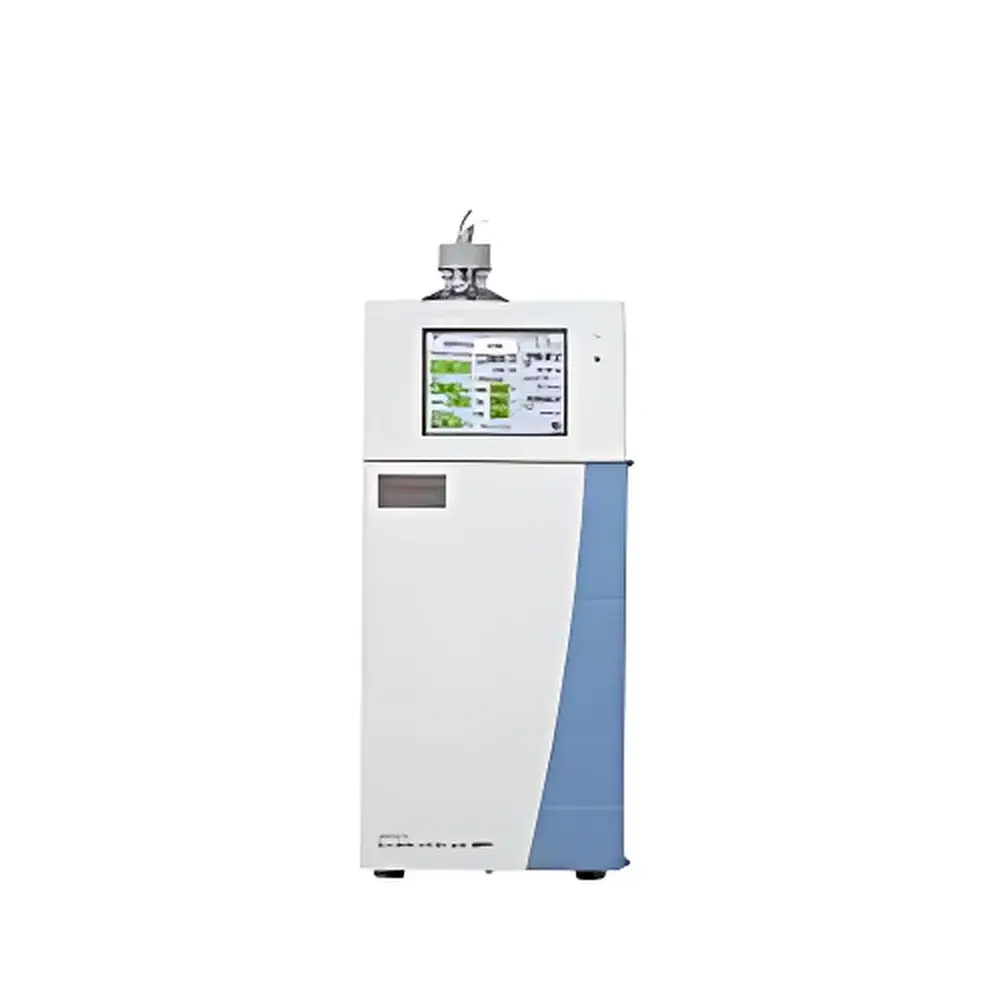
Thermo Fisher Dionex ICS-4000 CD Conductivity Detector
| Brand | Thermo Fisher |
|---|---|
| Origin | USA |
| Manufacturer Type | Original Equipment Manufacturer (OEM) |
| Product Origin | Imported |
| Model | ICS-4000 CD |
| Instrument Category | Laboratory Benchtop Ion Chromatograph Detector |
| Detection Principle | Suppressed/Unsuppressed Conductivity Detection |
| Dynamic Range | 0–15,000 µS/cm |
| Cell Volume | 0.02 µL (Capillary Mode) |
| Temperature Control | Independent, Microprocessor-Regulated Detector Thermostat |
| Interface | Plug-and-Play Auto-Recognition via Chromeleon™ CDS |
| Mounting | Tool-Free Snap-In Mechanism |
| Compatible Configurations | Series or Parallel Dual-Detector Setup |
| Flow Path Options | Capillary, Analytical (Standard-Bore and Microbore) |
Overview
The Thermo Fisher Dionex ICS-4000 CD Conductivity Detector is a high-performance, microprocessor-controlled electrochemical detection module engineered for integration into the ICS-4000 Reagent-Free™ Ion Chromatography (RFIC™) platform. It operates on the principle of conductivity detection—measuring changes in solution conductance following ion exchange separation—to deliver quantitative analysis of anions and cations across a broad concentration spectrum. Unlike analog predecessors, the ICS-4000 CD employs digital signal processing (DSP) architecture to minimize baseline drift, suppress electronic noise originating from detector-cell coupling, and ensure linear response over its full dynamic range of 0–15,000 µS/cm. Its design supports both suppressed and unsuppressed modes, enabling method flexibility for diverse matrices including environmental water, pharmaceutical excipients, food extracts, and semiconductor process chemicals. The detector’s thermal stability is maintained through an independent, closed-loop temperature regulation system—decoupled from column oven or ambient fluctuations—ensuring reproducible retention times and peak area precision under extended run conditions.
Key Features
- Digital signal processing with real-time noise reduction algorithms, eliminating reliance on external analog filters
- Independent detector thermostat with ±0.1 °C temperature stability, critical for long-gradient analyses and low-conductivity eluents
- Ultra-low-volume detection cell (0.02 µL in capillary configuration), reducing sample consumption and improving mass sensitivity
- Tool-free snap-in mechanical interface compatible with ICS-4000 chassis—no cables, no alignment tools, no firmware reconfiguration required
- Automatic hardware recognition by Thermo Scientific Chromeleon™ Chromatography Data System (CDS) v7.3+, including automatic assignment of flow rate limits and calibration parameters
- Modular port configuration supporting serial (e.g., CD + UV/VIS) or parallel dual-conductivity detection for orthogonal validation or multi-analyte quantification
- Support for three physical formats: capillary (0.4 mm ID), analytical standard-bore (4 mm ID), and microbore (2 mm ID), each with optimized cell geometry and electrode surface area
Sample Compatibility & Compliance
The ICS-4000 CD accommodates aqueous and weakly organic eluents used in RFIC workflows—including KOH, NaOH, methanesulfonic acid (MSA), and carbonate/bicarbonate buffers—without requiring post-column chemical suppression in all applications. Its corrosion-resistant electrode housing and PEEK fluidic path comply with ISO 9001-certified manufacturing standards and are validated for use in GLP- and GMP-regulated environments. When operated with Chromeleon CDS under 21 CFR Part 11-compliant audit trail and electronic signature configurations, the system satisfies FDA requirements for data integrity in pharmaceutical QC labs. Method transfer between capillary and analytical formats adheres to ICH Q2(R2) guidelines for analytical procedure validation, particularly linearity, LOD/LOQ, and robustness assessments.
Software & Data Management
Chromeleon CDS provides native support for the ICS-4000 CD through embedded device drivers that auto-configure acquisition parameters—including sampling rate (up to 20 Hz), gain scaling, and temperature setpoint—based on selected detector mode and column dimensions. Raw conductivity data is stored in vendor-neutral .cdf format with embedded metadata (detector serial number, calibration date, thermostat log, and user-defined annotations). Batch processing workflows enable automated peak integration using second-derivative baseline correction and conductivity-specific deconvolution algorithms for overlapping anion clusters (e.g., F⁻/Cl⁻/NO₂⁻). All audit trails—including parameter edits, calibration events, and report generation—are time-stamped, user-locked, and exportable as PDF/A-1a for regulatory submission.
Applications
This detector is routinely deployed in environmental laboratories for EPA Methods 300.0, 300.1, and 316.0 compliance testing of drinking water and wastewater; in biopharmaceutical settings for residual salt profiling in monoclonal antibody formulations (USP ); in food safety labs for nitrate/nitrite quantification per AOAC 999.10; and in battery electrolyte R&D for trace HF and PF₆⁻ monitoring. Its low cell volume and thermal inertia make it especially suited for fast gradient separations (<10 min) and high-throughput screening where carryover and equilibration time must be minimized.
FAQ
Is the ICS-4000 CD compatible with non-Thermo chromatography systems?
No—it is designed exclusively for the ICS-4000 RFIC platform and requires proprietary electrical and mechanical interfacing.
Can the detector operate without Chromeleon software?
Hardware initialization and basic diagnostics are possible via front-panel controls, but full acquisition, calibration, and reporting require Chromeleon CDS v7.2 or later.
What maintenance intervals are recommended for the conductivity cell?
Electrode polishing and cell cleaning are advised every 200 injections or quarterly—whichever occurs first—using 0.1 M HNO₃ followed by DI water rinse.
Does the detector support gradient elution with changing background conductivity?
Yes—the DSP firmware includes real-time baseline compensation for eluent strength variation, maintaining quantitative accuracy during potassium hydroxide or MSA gradients.
Is the 0.02 µL cell volume applicable to all flow rates?
Optimal performance is achieved at ≤0.025 mL/min in capillary mode; higher flows require analytical-cell configuration to maintain laminar flow and avoid dispersion artifacts.




