
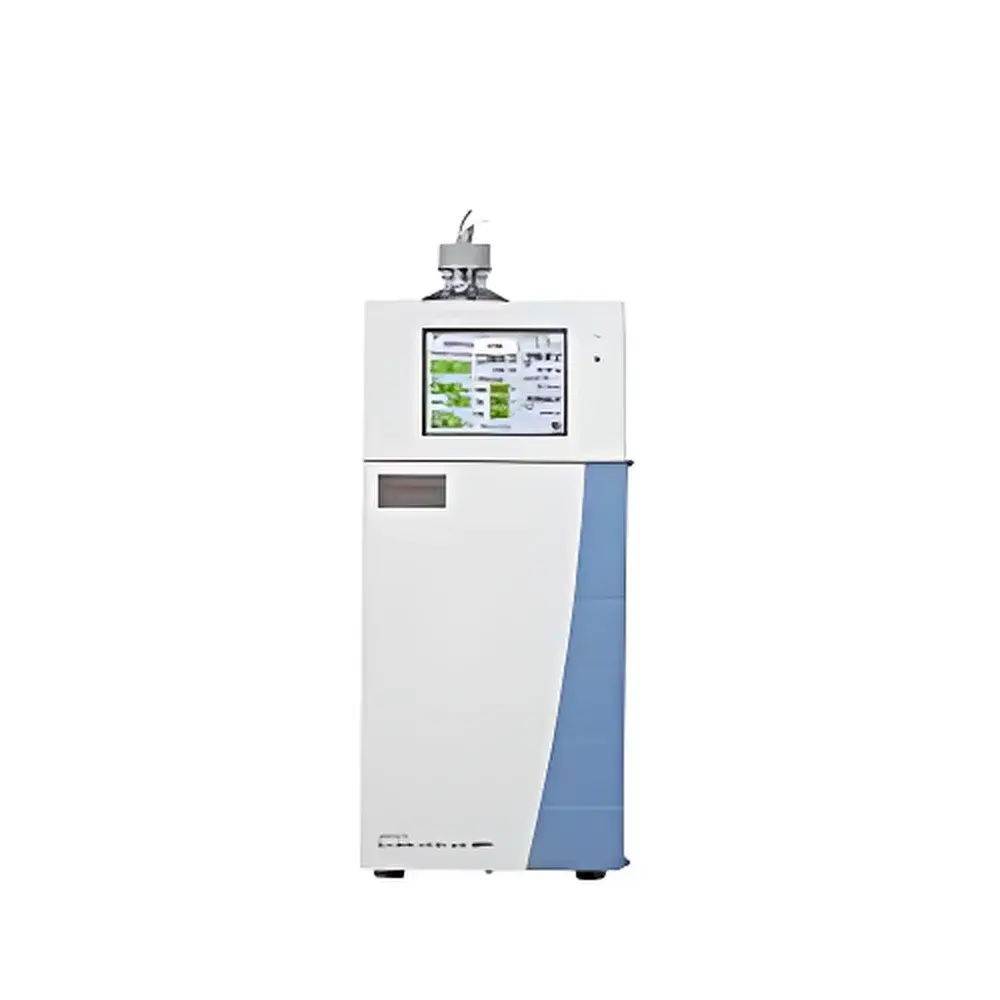
Dionex ICS-4000 Electrochemical Detector
| Brand | Thermo Fisher Scientific |
|---|---|
| Origin | USA |
| Manufacturer Type | Original Equipment Manufacturer (OEM) |
| Product Category | Imported Instrument |
| Model | ICS-4000 ED |
| Application Environment | Laboratory-Based |
| Detection Modes | DC Amperometry, Pulsed Amperometric Detection (PAD), Integrated Pulsed Amperometric Detection (IPAD) |
| Electrode Compatibility | pH-Ag/AgCl, Ag/AgCl, Palladium-Hydrogen (PdH) Reference Electrodes |
| Control Interface | Chromeleon Chromatography Data System (CDS) via Ethernet |
| Thermal Stability | Engineered for minimal thermal drift in detector electronics and flow cell housing |
| Electrical Architecture | Fully integrated flow cell and detector electronics with optimized shielding, galvanic isolation, and low-noise signal conditioning |
Overview
The Dionex ICS-4000 Electrochemical Detector (ED) is a high-performance, laboratory-grade electrochemical detection module engineered specifically for integration with Thermo Fisher Scientific’s ICS-4000 Reagent-Free™ Ion Chromatography (RFIC) system. It operates on the principle of amperometric detection—measuring current generated by oxidation or reduction reactions of analytes at a working electrode surface under controlled potential. This technique delivers exceptional sensitivity for electroactive species—including carbohydrates, amino acids, organic acids, thiols, and halides—without requiring derivatization. The detector employs a precision-machined, stainless-steel flow cell with a fixed-torque electrode mounting mechanism, ensuring repeatable mechanical alignment and long-term electrode positioning stability across hundreds of injections. Its thermally isolated architecture minimizes baseline drift during extended gradient runs or ambient temperature fluctuations, supporting robust quantitation in regulated environments.
Key Features
- Constant-torque flow cell design guarantees consistent working electrode seating and reproducible hydrodynamic conditions—critical for inter-day and inter-operator method transfer.
- Digital microprocessor-controlled signal processing enables real-time waveform generation and data acquisition for DC amperometry, pulsed amperometric detection (PAD), and integrated pulsed amperometric detection (IPAD).
- IPAD mode supports user-defined waveform segmentation: up to 8 independent voltage segments per cycle, each with individually programmable duration (1–1000 ms) and applied potential (−1.0 V to +1.2 V vs. reference).
- Triple-reference-electrode compatibility: accepts standard pH-Ag/AgCl and Ag/AgCl electrodes, plus the proprietary integrated palladium-hydrogen (PdH) reference electrode—engineered for low impedance, minimal junction potential drift, and extended service life (>6 months under continuous operation).
- Fully embedded electronics co-located with the flow cell reduce cable-induced noise, improve common-mode rejection ratio (CMRR > 100 dB), and eliminate ground-loop artifacts commonly observed in externally wired detector configurations.
- Onboard self-diagnostics include electrode impedance monitoring, baseline offset verification, and gain calibration traceability—each logged with timestamp and operator ID in Chromeleon audit trail.
Sample Compatibility & Compliance
The ICS-4000 ED is validated for use with aqueous eluents compatible with RFIC systems—including KOH, NaOH, methanesulfonic acid (MSA), and carbonate/bicarbonate buffers—across pH 3–13. It accommodates flow rates from 0.1 to 2.0 mL/min and operates at ambient or column-heated temperatures (up to 60 °C). The detector meets electromagnetic compatibility (EMC) requirements per IEC 61326-1:2013 and safety standards per IEC 61010-1:2010. When operated with Chromeleon 7.3 or later under configured audit trail, electronic signature, and data integrity settings, it supports compliance with FDA 21 CFR Part 11, EU Annex 11, and GLP/GMP documentation requirements. Method validation reports may reference ASTM D5292 (carbohydrate analysis in food), ISO 15512 (amino acid determination), and USP (conductivity and electrochemical detection in purified water testing).
Software & Data Management
Control, calibration, and data acquisition are managed exclusively through Thermo Fisher’s Chromeleon Chromatography Data System (CDS) v7.3 or higher. The ED communicates via TCP/IP Ethernet with full bidirectional command/response protocol support—including remote start/stop, waveform upload, zero-baseline correction, and hardware diagnostic initiation. All detector parameters—including applied potentials, integration windows, filter time constants, and gain settings—are stored within method files and version-controlled alongside sequence tables. Raw current-time data are acquired at 100 Hz with 24-bit resolution and archived in vendor-neutral .CDF format. Audit trail entries record every parameter change, calibration event, and hardware status transition—including timestamps synchronized to NTP servers and operator authentication via Windows Active Directory or LDAP.
Applications
This detector is routinely deployed in pharmaceutical QC labs for monosaccharide profiling in biologics excipients (e.g., sucrose, trehalose), in environmental laboratories for trace iodide/bromide speciation in drinking water per EPA Method 300.1, and in food safety testing for sulfite residue quantification in wines and dried fruits. Its high signal-to-noise ratio (<0.5 pA RMS baseline noise at 1 nA full scale) enables sub-nanomolar detection limits for glucose in cerebrospinal fluid matrices. In research settings, it supports kinetic studies of electrocatalytic surface reactions when coupled with disposable screen-printed electrodes or custom-modified carbon-fiber microelectrodes.
FAQ
What reference electrodes are supported—and why is the PdH electrode recommended for carbohydrate analysis?
The ICS-4000 ED supports pH-Ag/AgCl, Ag/AgCl, and PdH reference electrodes. The integrated PdH electrode eliminates liquid-junction potential variability and chloride leaching—key sources of baseline instability during multi-step PAD waveforms used for alditol oxidation.
Can the ED be retrofitted to legacy ICS-3000 systems?
No. The ICS-4000 ED requires native communication protocols and power delivery architecture exclusive to the ICS-4000 platform; it is not electrically or mechanically compatible with prior-generation systems.
Is hardware calibration traceable to NIST standards?
Yes. Internal gain and offset calibrations are performed using onboard precision voltage references traceable to NIST SRM 2702; calibration certificates include uncertainty budgets per ISO/IEC 17025.
Does Chromeleon support automated re-calibration during unattended sequences?
Yes—via scheduled “calibration-on-demand” triggers embedded in sequence methods, including post-run baseline verification and pre-injection zero-current checks.
What maintenance intervals are specified for the flow cell and reference electrode?
Thermo Fisher recommends quarterly inspection of electrode surfaces and annual replacement of the PdH reference element; flow cell O-rings require replacement every 12 months or after 2000 injections, whichever occurs first.





