
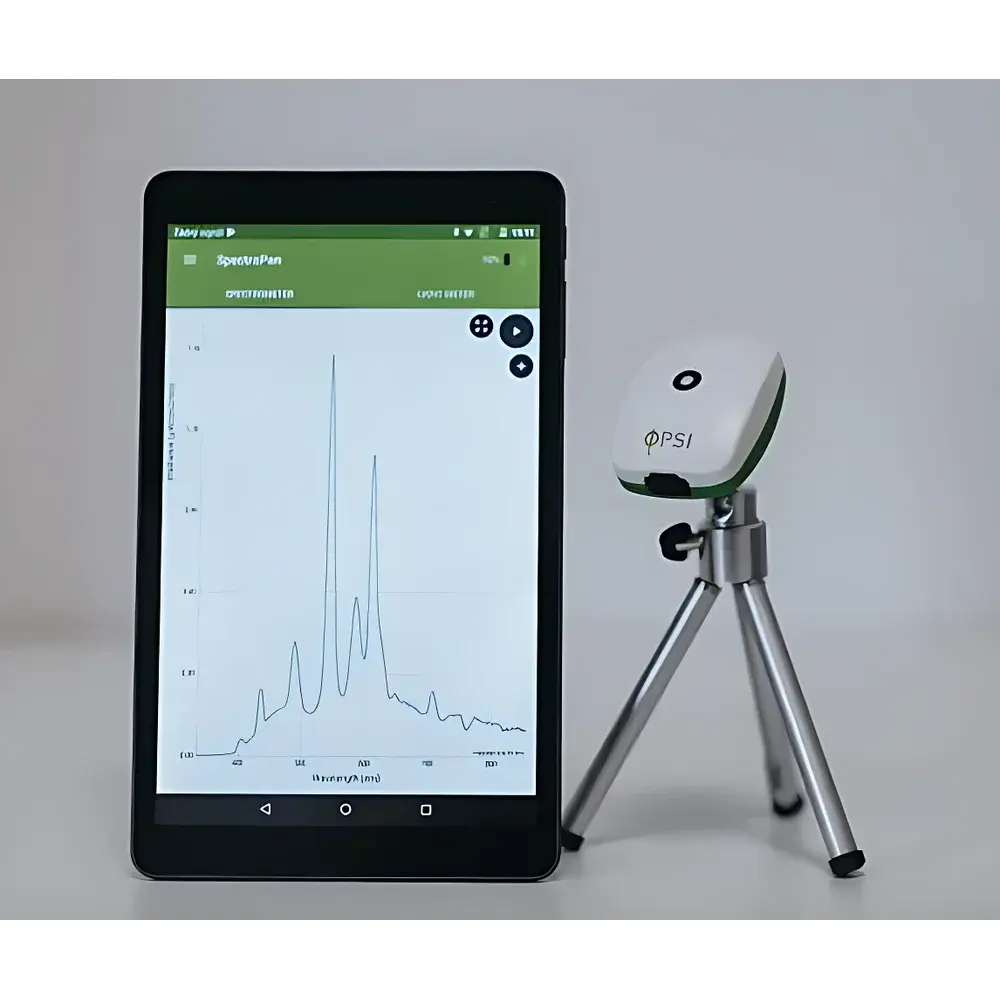
PSI SpectraPen mini Handheld Spectroradiometer & Quantum Sensor
| Brand | PSI/Photon Systems Instruments |
|---|---|
| Origin | Czech Republic |
| Model | SpectraPen mini |
| Spectral Range | 340–850 nm |
| Spectral Resolution (FWHM) | 15 nm |
| Wavelength Reproducibility | ±0.5 nm |
| Integration Time | 1 ms – 5 s |
| ADC Resolution | 16-bit |
| Connectivity | Bluetooth 4.2 |
| Operating System Compatibility | Android 5.0 or later |
| Dimensions | 50 × 70 × 28 mm |
| Weight | 60 g |
| Enclosure | Splash-resistant housing |
| Battery | 650 mAh Li-ion, USB-rechargeable |
| Operating Temperature | 5–55 °C |
| Storage Temperature | −20–70 °C |
| Optical Input | Cosine-corrected diffuser |
| Data Export | Email, USB transfer via mobile app |
Overview
The PSI SpectraPen mini is a compact, handheld spectroradiometer and quantum sensor engineered for field-deployable spectral characterization of photosynthetically active radiation (PAR) and broadband irradiance. Based on a fixed-grating optical architecture with a back-thinned CMOS linear array detector, it operates on the principle of dispersive spectroscopy—capturing full spectral radiance or photon flux density across the 340–850 nm range in a single acquisition. Its cosine-corrected optical input ensures angular response compliance with CIE 69:2020 and ISO/CIE 19476:2014 standards for irradiance measurement, enabling accurate quantification of both spectral irradiance (W·m⁻²·nm⁻¹) and photosynthetic photon flux density (PPFD, µmol·m⁻²·s⁻¹). Designed for rapid, non-invasive optical assessment without external power or benchtop infrastructure, the SpectraPen mini bridges laboratory-grade spectral fidelity with operational agility in uncontrolled environments—from greenhouse canopies and outdoor crop trials to industrial lighting validation and material reflectance screening.
Key Features
- True dual-mode operation: simultaneous acquisition of spectroradiometric data (irradiance spectra) and integrated quantum metrics (PPFD, YPF, UVA/UVB ratios)
- High-fidelity spectral resolution of 15 nm FWHM across the biologically and photometrically critical 340–850 nm band—covering UV-A, visible, and near-infrared regions relevant to plant photobiology, LED lighting evaluation, and photostability testing
- ±0.5 nm wavelength reproducibility ensures inter-unit consistency and longitudinal measurement stability under variable thermal conditions (5–55 °C operating range)
- 16-bit analog-to-digital conversion enables dynamic range >50,000:1, supporting reliable detection from low-light horticultural shade conditions to high-intensity solar or artificial illumination
- Splash-resistant mechanical housing (IPX4-equivalent) and ultra-compact form factor (50 × 70 × 28 mm, 60 g) permit extended handheld use in humid greenhouses, open-field plots, or cleanroom-adjacent production lines
- Bluetooth 4.2 wireless interface with low-latency pairing to Android 5.0+ devices eliminates cable constraints and enables real-time spectral visualization and annotation during measurement
Sample Compatibility & Compliance
The SpectraPen mini is optimized for planar, diffuse, or semi-diffuse light fields incident upon its cosine-corrected diffuser—making it suitable for measuring irradiance from LEDs, fluorescent tubes, sunlight, and reflected light from leaves, coatings, or display surfaces. It does not require sample contact or optical fiber coupling, eliminating alignment artifacts common in probe-based systems. While not intended for absolute radiometric calibration traceable to NIST or PTB without optional factory recalibration, its factory calibration against reference lamps (e.g., tungsten halogen standards) complies with ISO/IEC 17025-aligned procedures. Data acquisition workflows support GLP-compliant metadata tagging (timestamp, GPS coordinates via mobile OS, operator ID), and raw spectral files (.csv/.spc) retain unprocessed detector counts for post-acquisition reprocessing.
Software & Data Management
The dedicated Android application provides intuitive instrument control—including integration time adjustment (1 ms–5 s), averaging (up to 100 scans), dark current subtraction, and real-time spectral overlay. All measurements are stored locally with embedded EXIF-like metadata and exportable via encrypted email, cloud sync (Google Drive, Dropbox), or direct USB transfer. The app generates standardized reports compliant with ASTM E308-22 (computing CIE chromaticity coordinates) and ISO 22716 (cosmetic lighting QA), and supports batch export for import into MATLAB, Python (NumPy/Pandas), or R for multivariate analysis (e.g., PCA of spectral signatures across cultivars or LED batches). Audit trails—including firmware version, calibration date, and user-modified settings—are retained per measurement session.
Applications
- Horticultural lighting R&D: Quantifying spectral power distribution (SPD) of LED grow lights and validating PAR/YPF ratios against cultivar-specific action spectra
- Plant phenotyping: Tracking diurnal or stress-induced shifts in leaf reflectance (e.g., red-edge NDVI proxies) and canopy-level PPFD uniformity mapping
- LED manufacturing QA: Verifying binning consistency, CCT drift over drive current, and radiant efficiency (lm/W, µmol/J) in production line sampling
- Material science: Assessing UV stability of polymers, pigment dispersion homogeneity, and anti-reflective coating performance under broadband illumination
- Environmental monitoring: Characterizing sky radiance spectra for aerosol optical depth estimation and validating satellite-derived surface irradiance models
FAQ
Is the SpectraPen mini calibrated for absolute irradiance measurement?
Yes—it ships with factory calibration against NIST-traceable tungsten-halogen standards, valid for irradiance (W·m⁻²·nm⁻¹) and photon flux (µmol·m⁻²·s⁻¹) modes. Recalibration is recommended annually or after mechanical shock.
Can it measure reflected or transmitted spectra from solid samples?
Indirectly—by positioning the diffuser above the sample under controlled illumination (e.g., integrating sphere output or collimated source), provided the measured signal exceeds the instrument’s noise floor (~0.1 µmol·m⁻²·s⁻¹ at 1 s integration). No fiber optic attachment is supported.
Does the Android app support offline operation?
Yes—full instrument control, spectral acquisition, and local storage function without internet connectivity. Cloud upload and report generation require network access.
What is the typical battery life per charge?
Approximately 8–10 hours of intermittent use (100 measurements/hour, Bluetooth active), or up to 72 hours in standby mode. Recharge time is ~2.5 hours via micro-USB.
Is FDA 21 CFR Part 11 compliance available?
The current firmware and app do not include electronic signature or audit trail modules required for Part 11. However, raw CSV exports and timestamped metadata enable manual implementation within validated internal QA systems.




