
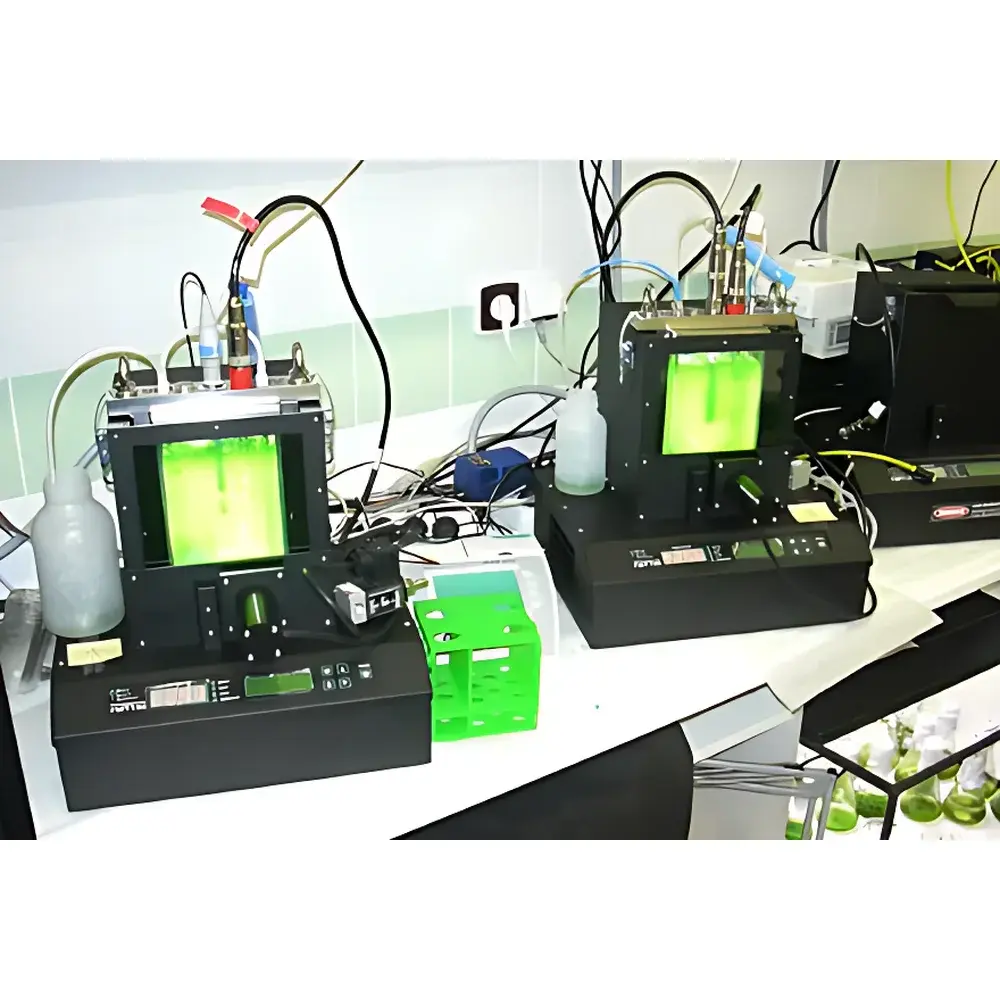
PSI FMT150 Algal Cultivation and Online Monitoring System
| Brand | PSI / Photon Systems Instruments |
|---|---|
| Origin | Czech Republic |
| Manufacturer Type | Authorized Distributor |
| Import Status | Imported |
| Model | FMT150 |
| Temperature Range | 10–60 °C |
| Temperature Uniformity | ±0.5 °C |
| Humidity Range | 20–95 % RH |
| Culture Volume | 5 L |
Overview
The PSI FMT150 Algal Cultivation and Online Monitoring System is a fully integrated, programmable photobioreactor platform engineered for high-precision cultivation and real-time physiological assessment of microalgae, cyanobacteria (blue-green algae), and other photoautotrophic organisms under controlled freshwater or marine conditions. Unlike conventional incubators or standalone bioreactors, the FMT150 embeds core analytical instrumentation—including a built-in pulse-amplitude-modulated (PAM) chlorophyll fluorometer and dual-wavelength optical density (OD) sensor—directly within the cultivation chamber. Its operational principle combines closed-loop environmental regulation with non-invasive, in situ optical phenotyping: light intensity and spectral composition (via tunable LED arrays), temperature, humidity, gas composition (O₂/CO₂/N₂), and mass flow are dynamically regulated via PID-controlled actuators, while physiological responses—including photosynthetic quantum yield (QY), dark-adapted minimal fluorescence (F₀), maximal fluorescence (Fₘ), light-adapted maximal fluorescence (Fₘ′), and steady-state fluorescence (Ft)—are acquired continuously without sampling or disruption. This architecture enables true time-resolved interrogation of photophysiology under ecologically or industrially relevant dynamic regimes.
Key Features
- Modular, software-defined cultivation protocols: Users define multi-stage programs with time-varying setpoints for light spectrum (380–750 nm), irradiance (0–2000 µmol photons·m⁻²·s⁻¹), temperature, humidity, and gas blending ratios.
- Integrated dual-channel optical monitoring: Simultaneous OD680 and OD720 measurements enable real-time biomass tracking and relative chlorophyll-a concentration estimation via differential absorbance correction.
- Onboard PAM fluorometry: Measures rapid induction kinetics, effective quantum yield of PSII (ΦPSII = (Fₘ′ − Ft)/Fₘ′), non-photochemical quenching (NPQ), and electron transport rate (ETR) without external cuvettes or dark adaptation delays.
- Expandable chemostat/turbidostat capability: Supports up to seven peristaltic pumps for automated media exchange, pH control (via acid/base titration), and turbidity-based feedback regulation.
- Multi-unit synchronization: A single control PC running PSI’s proprietary FluorCam software can coordinate up to 16 FMT150 units, ensuring inter-replicate temporal alignment for factorial or gradient experiments.
- Robust environmental control: Achieves ±0.5 °C uniformity across the 5 L working volume and maintains humidity between 20–95 % RH—critical for preventing evaporative concentration shifts during long-term cultivations.
Sample Compatibility & Compliance
The FMT150 accommodates axenic and non-axenic cultures of unicellular and colonial microalgae (e.g., Chlamydomonas reinhardtii, Dunaliella salina, Phaeodactylum tricornutum), cyanobacteria (e.g., Synechocystis sp. PCC 6803, Anabaena spp.), and mixotrophic strains. Its sealed, gas-tight design complies with OECD Test Guideline 201 (Freshwater Alga and Cyanobacteria, Growth Inhibition Test) and supports GLP-compliant experimental execution when paired with audit-trail-enabled software configurations. All optical sensors meet IEC 61000-4-3 electromagnetic compatibility standards; temperature and humidity sensors are NIST-traceable and calibrated per ISO/IEC 17025 requirements.
Software & Data Management
Control and data acquisition are managed through PSI’s FluorCam software suite (Basic and Advanced editions). The Advanced edition supports scripting in Python-compatible syntax for custom feedback loops (e.g., light ramping triggered by ΦPSII decline), automated export to HDF5 or CSV, and integration with third-party platforms (MATLAB, R, LabVIEW) via TCP/IP or OPC UA. Raw fluorescence transients, OD time series, and environmental logs are timestamped with microsecond resolution and stored with full metadata (user ID, protocol version, calibration history). Software configurations comply with FDA 21 CFR Part 11 requirements when enabled, including electronic signatures, role-based access control, and immutable audit trails for all parameter changes and data exports.
Applications
- Environmental Science: Simulation and mechanistic study of harmful algal blooms (HABs) under variable nutrient, light, and temperature regimes; assessment of algal bioremediation capacity for heavy metals (Cd, Pb, As), nitrogen/phosphorus runoff, and atmospheric CO₂ sequestration.
- Marine & Ecological Physiology: Quantification of phytoplankton acclimation responses to ocean acidification, UV-B stress, and warming scenarios; calibration of satellite-derived primary productivity models using in vivo fluorescence parameters.
- Biotechnology & Biomedicine: High-throughput screening of genetically engineered strains for nutraceutical (astaxanthin, EPA/DHA) or therapeutic protein expression; optimization of fed-batch protocols for aquaculture feedstock production.
- Algal Bioenergy Research: Dynamic phenotype mapping of lipid accumulation kinetics under nitrogen starvation or light/dark cycling; validation of metabolic models linking photosynthetic efficiency to triacylglycerol (TAG) yield.
FAQ
Can the FMT150 operate under sterile conditions for axenic cultures?
Yes—the system features autoclavable glass vessels, silicone-free fluidic pathways, and HEPA-filtered gas inlets compatible with laminar flow hood integration.
Is remote monitoring supported?
Yes—FluorCam software includes secure web-based dashboard functionality (HTTPS/TLS) for real-time visualization and alarm notifications via desktop or mobile clients.
What calibration standards are provided for fluorescence and OD measurements?
Each unit ships with traceable chlorophyll-a standard solutions (Sigma-Aldrich) and NIST-certified neutral density filters for optical path validation.
How is gas composition controlled?
Via mass flow controllers (MFCs) for CO₂, O₂, and N₂, enabling precise setpoint control of pCO₂ (0.04–5 %) and dissolved O₂ saturation (0–200 % air saturation) in the headspace.
Does the system support long-term unattended operation?
Yes—hardware watchdog timers, automatic power-fail recovery, and redundant SD-card + network storage ensure data integrity over multi-week cultivation campaigns.



