
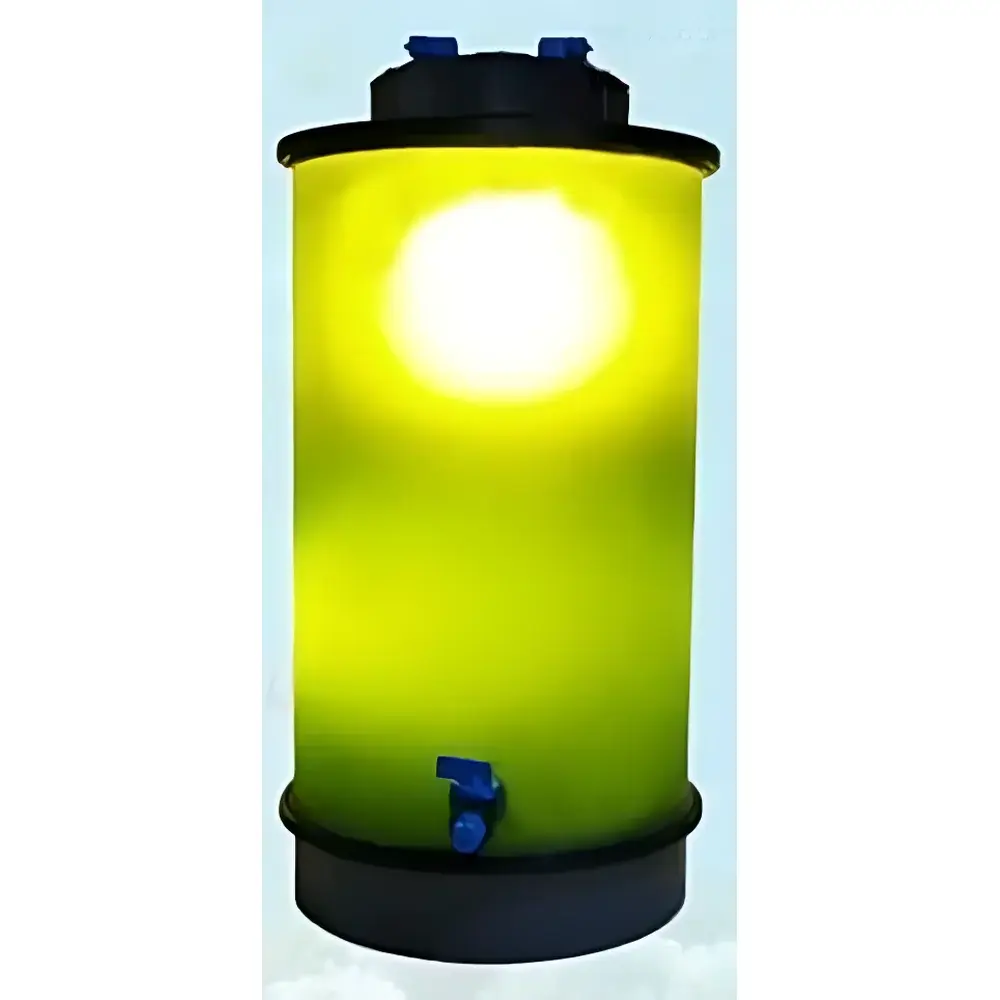
PB250 Algal Cultivation Photobioreactor
| Origin | Germany |
|---|---|
| Manufacturer Type | Authorized Distributor |
| Origin Category | Imported |
| Model | PB-250 |
| Quotation | Upon Request |
| Volume | 12 L |
| Inner Diameter | 200 mm |
| Height | 520 mm |
| Controller Dimensions | 220 mm × 80 mm × 70 mm |
| Input Voltage/Power | 85–250 VAC / 5 W |
Overview
The PB250 Algal Cultivation Photobioreactor is a purpose-engineered, benchtop-scale photobioreactor system designed for controlled, reproducible cultivation of microalgae and other photosynthetic microorganisms under laboratory conditions. Built to international standards for biological process consistency, the PB250 operates on the principle of continuous or semi-continuous batch culture, integrating precise light delivery, gas exchange, temperature-stable mixing, and programmable nutrient management. Its cylindrical, optically transparent cultivation vessel ensures uniform photon flux distribution across the culture volume—critical for mitigating self-shading effects and enabling reliable physiological response studies. The system supports both autotrophic and mixotrophic growth modes, making it suitable for strain screening, biomass production optimization, pigment yield analysis (e.g., astaxanthin, β-carotene), and carbon fixation research.
Key Features
- 12-liter working volume cylindrical bioreactor with high-transmittance borosilicate glass vessel (inner diameter: 200 mm; height: 520 mm), engineered for mechanical robustness and optical clarity across UV-A to near-infrared spectra.
- Integrated LED-based illumination unit with adjustable spectral output and intensity control, mounted circumferentially to ensure homogeneous irradiance without hotspots or shadow zones.
- Thread-sealed top lid assembly enabling rapid, leak-free access for sampling, inoculation, or maintenance—designed to maintain sterility during routine operation.
- Permanent magnet-driven stirrer providing gentle yet effective suspension of algal cells without shear-induced damage; compatible with sterile magnetic coupling configurations.
- Dedicated PB250 Control Unit (220 × 80 × 70 mm) featuring microprocessor-based timing logic, relay-controlled power sequencing, and programmable ON/OFF cycles for lighting, air sparging, and peristaltic dosing modules (optional).
- Modular gas supply interface supporting filtered ambient air, CO₂-enriched mixtures, or N₂-purged atmospheres via integrated mass flow controller ports (compatible with external gas regulation systems).
Sample Compatibility & Compliance
The PB250 accommodates a broad spectrum of freshwater and marine microalgal species—including Chlorella vulgaris, Scenedesmus obliquus, Nannochloropsis gaditana, and Dunaliella salina—as well as cyanobacteria such as Synechocystis sp. PCC 6803. Its design conforms to ISO 20589:2018 (Microbiology of water — Guidance on enumeration and characterization of phytoplankton) for standardized culturing practices. All wetted materials comply with USP Class VI biocompatibility requirements, and the controller meets IEC 61000-6-3 (EMC emission) and IEC 61000-6-2 (immunity) specifications. When operated in GLP-compliant environments, the system supports audit-ready documentation through external data logging interfaces (RS-485, analog 0–10 V outputs).
Software & Data Management
While the PB250 operates autonomously via its embedded controller, it is fully compatible with third-party SCADA platforms and laboratory information management systems (LIMS). Analog voltage outputs from illumination intensity, stirrer current draw, and optional temperature sensors (e.g., PT100 probe integration) enable real-time trending in MATLAB, LabVIEW, or Python-based acquisition frameworks. The controller’s time-based scheduling architecture supports protocol-driven experiments aligned with ASTM D7577-17 (Standard Practice for Culturing Microalgae for Biofuel Production), including automated diurnal light/dark cycles, pulsed nutrient addition, and dilution rate modulation (up to 30% daily medium exchange, as validated under standard operating conditions).
Applications
- Physiological characterization of algal strains under defined photo-biochemical stressors (e.g., high-light acclimation, nitrogen limitation, salinity gradients).
- Process development for high-value metabolite production—such as phycocyanin, EPA/DHA, or extracellular polysaccharides—in support of nutraceutical, cosmetic, and pharmaceutical applications.
- Evaluation of carbon capture efficiency using flue gas simulants under controlled pH and dissolved oxygen setpoints.
- Education and training in photobioreactor engineering principles, including light penetration modeling, mass transfer coefficient estimation (kLa), and growth kinetics fitting (Monod, Droop models).
- Pre-validation of scale-up parameters prior to pilot-scale tubular or flat-panel photobioreactor deployment.
FAQ
Is the PB250 suitable for axenic culture maintenance?
Yes—the sealed vessel design, combined with autoclavable glass components and UV-compatible gasket materials, enables rigorous sterilization protocols. Aseptic technique compliance is further supported by HEPA-filtered inlet gas lines and positive-pressure operation options.
Can the illumination spectrum be customized for specific pigments?
The base LED array emits broad-spectrum white light (400–700 nm PAR), but OEM spectral reconfiguration (e.g., red/blue ratio tuning, narrowband peaks at 450 nm or 660 nm) is available upon request for specialized photo-physiological studies.
What level of automation does the controller provide out-of-the-box?
The standard controller delivers time-based actuation of lighting and gas flow. For advanced automation—including feedback-driven pH/DO control or peristaltic nutrient dosing—external PID modules or PLC integration is recommended.
Does the system include calibration documentation traceable to national standards?
Factory calibration certificates for illumination intensity (μmol·m⁻²·s⁻¹) and electrical safety are provided. Metrological traceability to PTB (Physikalisch-Technische Bundesanstalt) standards is available as an optional service.
Are replacement parts and technical support available globally?
Yes—original spare parts (glass vessels, LED drivers, magnetic stir bars) and firmware updates are distributed through authorized regional service centers, with remote diagnostics support offered in English, German, and French.





