
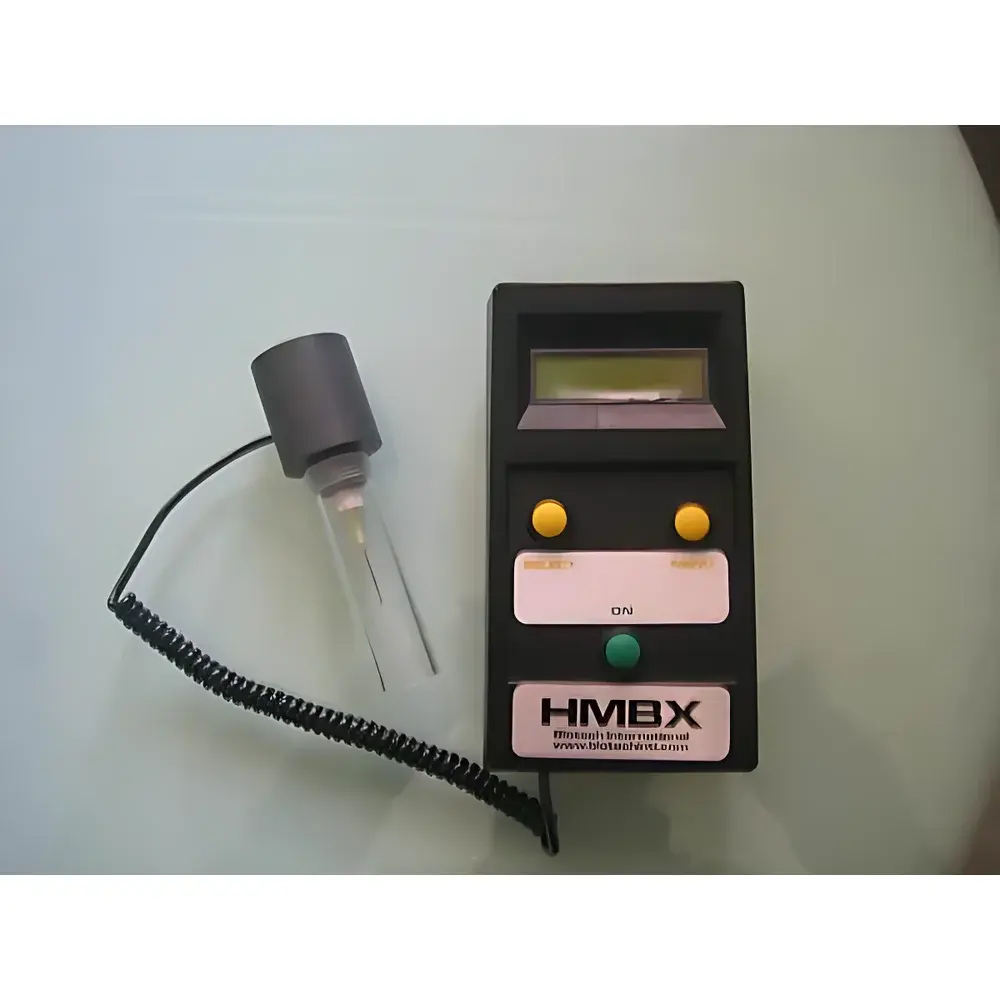
HMBX Foodborne Bacterial Rapid Detection System by BIOTECH
| Origin | USA |
|---|---|
| Manufacturer Type | Authorized Distributor |
| Origin Category | Imported Instrument |
| Model | HMB X |
| Instrument Type | Fully Automated Microbial Activity Analyzer |
| Throughput | 100 samples per hour |
| Detection Principle | Peroxidase-Based Bioluminescent Enzymatic Assay |
| Output Units | BMR (Biological Metabolic Rate) and CFU/mL (or CFU/g) |
| Measurement Range | 0–19.99 BMR |
| Power Supply | 4 × AA batteries |
| Data Storage | Onboard memory with timestamped logging |
| Sample Forms | Liquids, solids, powders, slurries, and suspensions |
| Detection Time | ≤15 minutes per sample |
Overview
The HMBX Foodborne Bacterial Rapid Detection System, developed by BIOTECH (USA), is a fully automated, portable microbial activity analyzer engineered for rapid quantification of viable aerobic microorganisms—including bacteria and yeasts—in food, environmental, and industrial process samples. Unlike conventional plate-count methods that rely on colony formation over 24–72 hours, the HMBX employs a validated enzymatic assay based on endogenous peroxidase activity. This enzyme is ubiquitously expressed during active metabolism in viable aerobic microbes and correlates directly with cellular viability and population density. Upon substrate addition, peroxidase catalyzes the decomposition of hydrogen peroxide, generating molecular oxygen that triggers a chemiluminescent or colorimetric signal—proportional to metabolic rate—converted in real time to Biological Metabolic Rate (BMR) units and calibrated CFU equivalents. The system is designed for routine use in quality control laboratories, food safety inspection units, and environmental monitoring programs where speed, reproducibility, and minimal sample preparation are critical operational requirements.
Key Features
- True rapid detection: Delivers quantitative results in ≤15 minutes per sample—no incubation, no plating, no colony isolation.
- Minimal sample preparation: Accepts raw liquids, homogenized solids, powders, and slurries without centrifugation, filtration, or enrichment steps.
- Specificity for viable aerobic microbiota: Selectively detects peroxidase-positive organisms (e.g., Enterobacteriaceae, Bacillus, Pseudomonas, Candida) while excluding dead cells, spores, and non-peroxidase-producing contaminants.
- Integrated onboard memory: Stores up to 500 timestamped test records with BMR and CFU values for audit-ready traceability.
- Portable, field-deployable architecture: Compact handheld design powered by standard AA batteries—suitable for lab, production floor, or on-site inspections.
- Dual-unit output: Simultaneous display of BMR (0–19.99) and CFU (0.0–9.9 × 10⁹), enabling cross-validation against traditional culture-based benchmarks.
- Robust optical detection module: Temperature-compensated photometric sensor with auto-zero calibration ensures consistent performance across ambient conditions (10–40 °C).
Sample Compatibility & Compliance
The HMBX system accommodates diverse matrices common in food safety and environmental testing: liquid foods (milk, juice, brines), solid foods (meat, produce, grains), powdered ingredients (spices, dairy powders), wastewater, cooling tower water, HVAC condensate, soil extracts, and industrial lubricants. It meets functional equivalency criteria outlined in ASTM E2928-21 (Standard Guide for Rapid Microbiological Methods Validation) and supports laboratory alignment with ISO 16140-2:2022 (validation of alternative methods versus reference culture techniques). While not a replacement for regulatory-grade enumeration in official compliance submissions (e.g., FDA Bacteriological Analytical Manual or ISO 4833-1), the HMBX serves as a robust screening tool for process control, lot release, and hazard analysis—reducing reliance on delayed culture data. Its workflow is compatible with GLP documentation practices and supports 21 CFR Part 11–compliant data export when integrated with validated LIMS interfaces.
Software & Data Management
Data acquisition and reporting are managed via the embedded firmware interface, which provides real-time graphing of kinetic response curves, automatic threshold detection, and user-configurable pass/fail limits. Test history is exportable in CSV format via USB port for integration into enterprise quality management systems (QMS) or statistical process control (SPC) platforms. Optional PC-based software (BIOTECH HMBX Connect v3.x) enables batch report generation, trend analysis across shifts or suppliers, and audit trail configuration—including operator ID, instrument serial number, and calibration status metadata. All stored records include ISO 8601 timestamps and are write-protected post-acquisition to ensure data integrity.
Applications
- Food manufacturing: Real-time monitoring of raw materials, in-process rinses, and finished products (e.g., ready-to-eat meats, fresh produce wash water, bakery dough).
- Environmental hygiene: Surface swab validation, HVAC system water quality, and biofilm risk assessment in processing facilities.
- Water treatment: Rapid assessment of bioburden in cooling towers, potable water distribution networks (as a prescreening tool), and effluent streams at wastewater plants.
- Pharmaceutical excipients & cosmetics: Screening of microbial load in non-sterile powders and aqueous formulations prior to further processing.
- Industrial fluids: Monitoring microbial contamination in metalworking fluids, hydraulic oils, and coolant emulsions to prevent corrosion and degradation.
FAQ
Does the HMBX detect only bacteria?
No—it detects viable aerobic microorganisms expressing peroxidase, including many Gram-negative and Gram-positive bacteria, as well as common yeasts and molds. It does not detect anaerobes, viruses, or non-viable cells.
Can it replace ISO 4833-1 or USP <61> for regulatory submissions?
No. The HMBX is intended for rapid screening and process monitoring. Regulatory enumeration requires validated culture-based methods unless formally approved via method equivalence studies per ISO 16140 or AOAC guidelines.
How is calibration verified?
Each test kit includes a certified reference standard (peroxidase-spiked buffer) for daily system verification. Annual factory recalibration is recommended, with NIST-traceable documentation available upon request.
Is training required for operation?
Basic operation requires under 30 minutes of instruction. Comprehensive training—including method validation support, troubleshooting, and data interpretation—is provided by authorized BIOTECH distributors.
What maintenance is required?
The optical path requires periodic cleaning with lint-free wipes and isopropyl alcohol. No consumable parts beyond test reagent kits; battery replacement every ~200 tests under typical usage.
Related Products



