
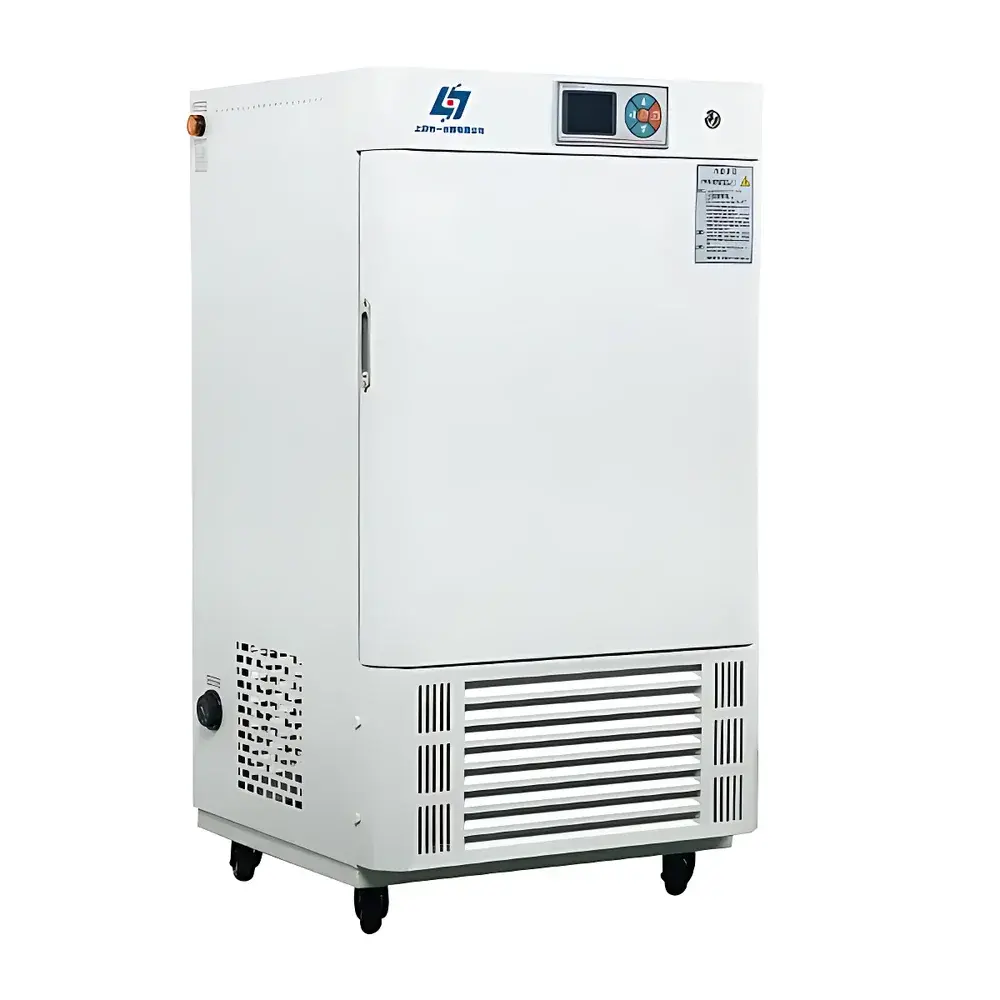
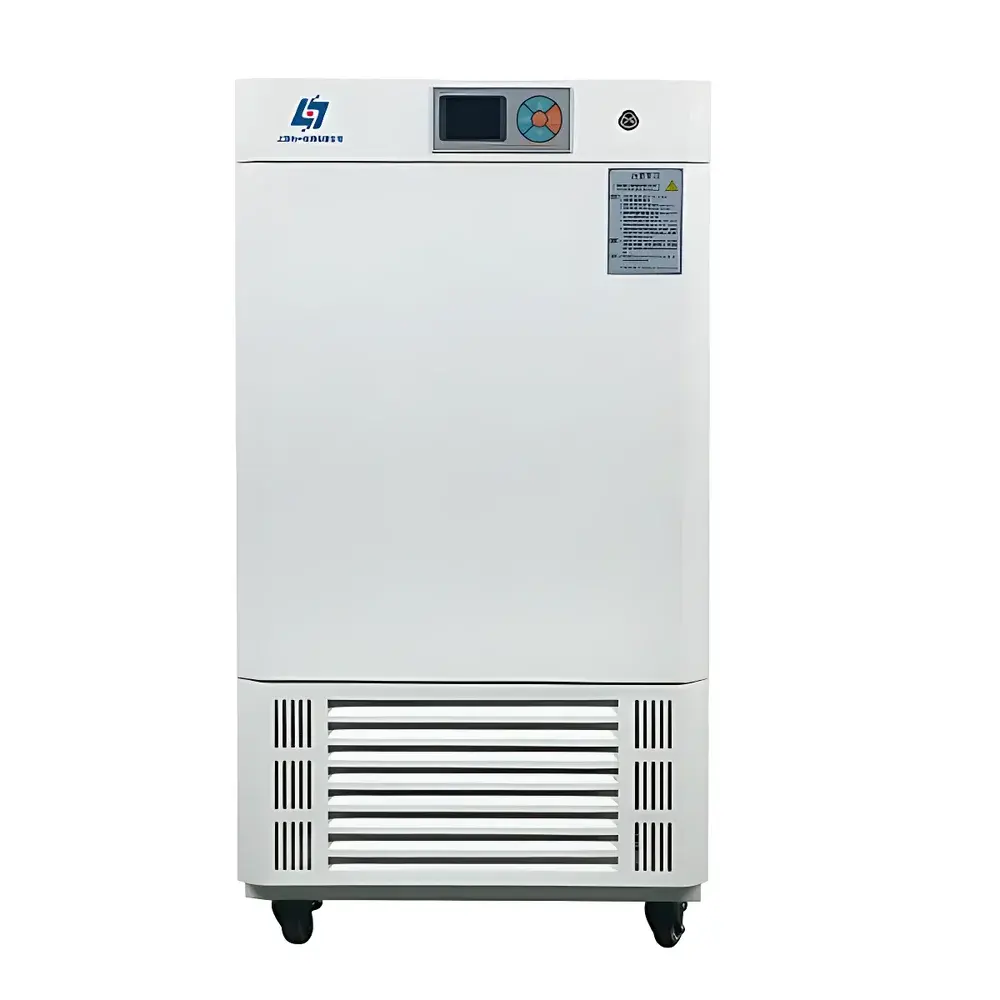
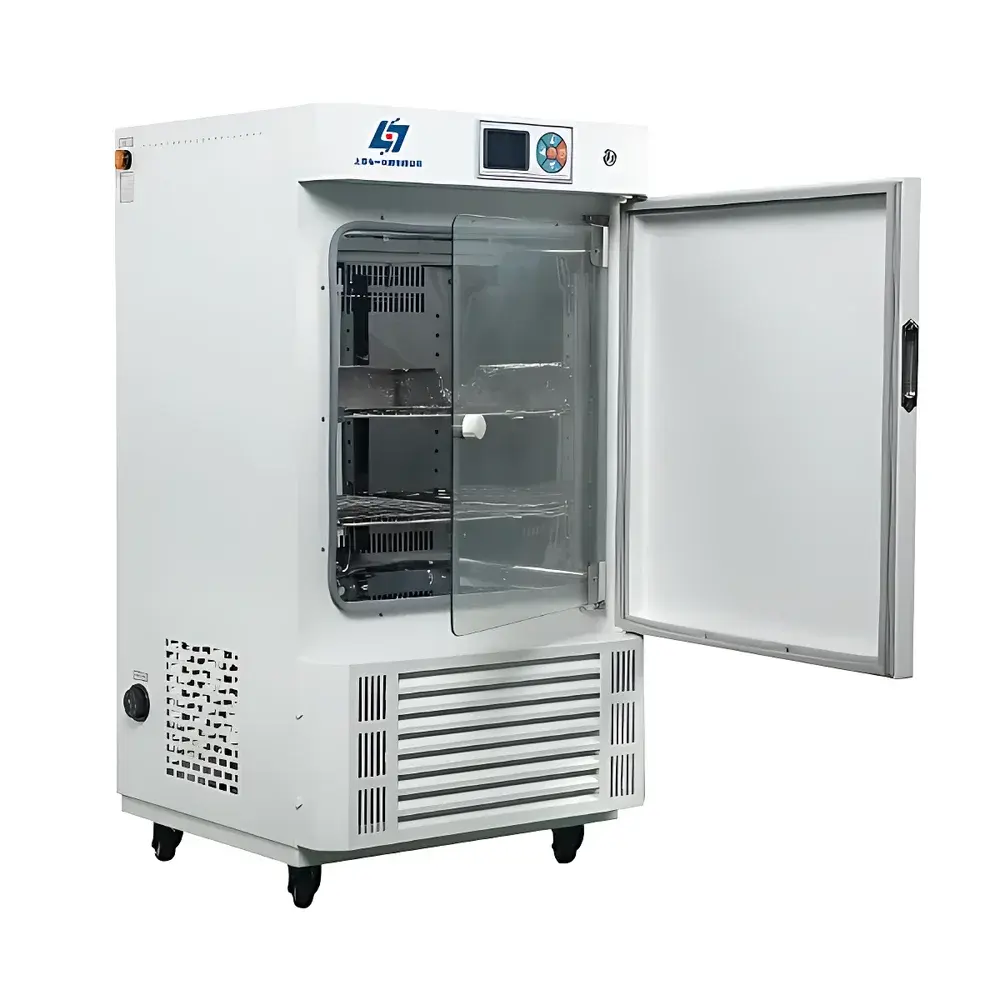
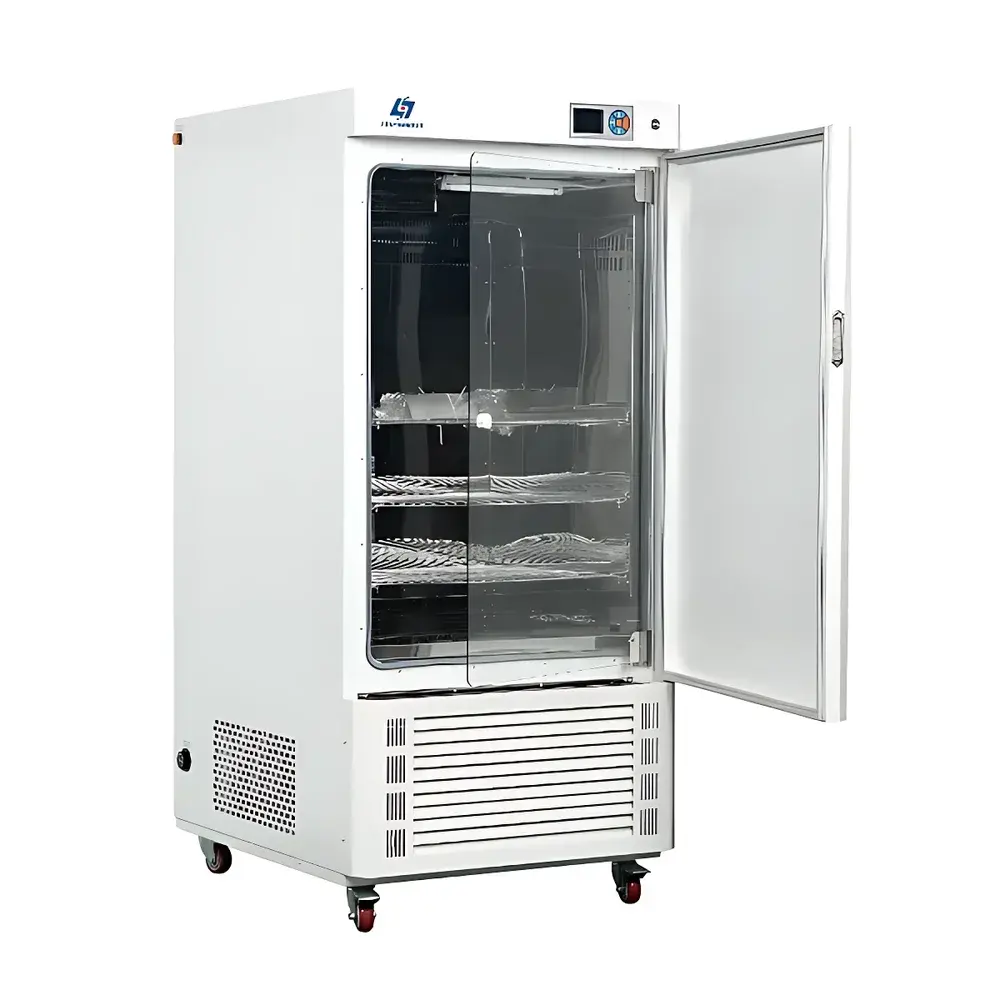
Yoyi MJ-250-II Mold Incubator with 30-Stage Programmable Humidity & Temperature Control
| Brand | Yoyi |
|---|---|
| Origin | Shanghai, China |
| Manufacturer | Yes |
| Type | Domestic |
| Model | MJ-250-II |
| Control Method | Mechanical Buttons + Microcomputer PID Controller |
| Air Circulation | Forced Convection |
| Temperature Range | 15–60 °C (with humidification), 10–60 °C (without) |
| Temperature Fluctuation | ±0.5 °C (high temp), ±1 °C (low temp) |
| Temperature Uniformity | ±1.5 °C (at 25 °C test point) |
| Humidity Range | 60–85 %RH |
| Humidity Deviation | ±5 %RH |
| Chamber Volume | 250 L |
| External Dimensions | 705 × 725 × 1525 mm (W×D×H) |
| Internal Dimensions | 580 × 500 × 850 mm (W×D×H) |
| Power Input | 1100 W |
| Display | 5.7″ LCD menu interface |
| Programmability | 99 cycles, up to 30 segments per cycle, max segment duration: 99 h 99 min |
| UV Sterilization | Integrated top-mounted UV lamp |
| Insulation | Double-door structure with high-efficiency thermal barrier |
| Construction | Cold-rolled steel exterior with electrostatic powder coating |
| Safety | Over-temperature deviation protection, power failure data retention & auto-recovery, independent temperature limiter option available |
| Environmental Compliance | CFC-free refrigerant, energy-efficient design |
Overview
The Yoyi MJ-250-II Mold Incubator is a precision-engineered environmental chamber designed specifically for controlled fungal growth, microbial culture maintenance, and long-term stability testing under regulated temperature and relative humidity conditions. It operates on the principle of forced-air convection combined with microcomputer-regulated heating and humidification—enabling stable, reproducible incubation environments essential for mycological research, pharmaceutical stability studies, and BOD/ISO 5667-17 water quality assessments. Unlike general-purpose incubators, the MJ-250-II integrates dedicated humidity control architecture—critical for simulating natural mold proliferation conditions in environmental, food safety, and materials durability testing (e.g., ASTM D3273, IEC 60068-2-78). Its dual-door thermal isolation system minimizes external thermal interference during observation, while the top-mounted UV-C (254 nm) lamp provides continuous air sterilization—reducing airborne contamination risk during extended culture periods without compromising sample integrity.
Key Features
- Microprocessor-based PID temperature control with 0.1 °C resolution and real-time display of setpoint, actual chamber temperature, and remaining hold time
- Dedicated humidity control module maintaining 60–85 %RH with ±5 %RH accuracy across the operational range, validated per ISO 17025-compliant calibration protocols
- 30-segment programmable cycle capability (up to 99 cycles), supporting complex multi-phase experiments such as temperature/humidity ramp-and-soak profiles required for ICH Q1A(R3) stability protocols
- Double-glazed, double-door construction with high-density polyurethane insulation (≥40 mm thickness) ensuring low thermal leakage and stable internal gradients
- Mirror-polished 304 stainless steel interior with radius-corner design and removable, autoclavable shelves—facilitating GLP-compliant cleaning and validation
- Integrated UV germicidal irradiation system (254 nm, 15 W) mounted at the chamber ceiling, activated automatically during idle phases or manually via control panel
- Power failure recovery function retaining all parameter settings and active program position, resuming operation upon grid restoration without manual reset
- Over-temperature cut-off with independent mechanical limiter option (available as accessory) meeting EN 61000-6-2 EMC and EN 61010-1 safety requirements
Sample Compatibility & Compliance
The MJ-250-II accommodates standard microbiological vessels including Petri dishes (up to 150 mm diameter), slant tubes, Erlenmeyer flasks (up to 2 L), and multi-well plates. Its uniform airflow distribution—validated using thermocouple mapping per ISO 14644-3—ensures ≤±1.5 °C spatial variation at 25 °C, satisfying CLSI M22-A3 and USP environmental monitoring criteria. The unit complies with GB/T 23703.2–2009 (Chinese national standard for mold incubators) and incorporates design elements aligned with FDA 21 CFR Part 11 data integrity expectations when paired with optional RS485 interface and compliant software (sold separately). Humidity performance has been verified under ISO 8573-4 clean compressed air standards for condensation-free operation during prolonged high-RH exposure.
Software & Data Management
While the base MJ-250-II operates via standalone 5.7″ LCD interface, optional RS485 communication enables integration with laboratory information management systems (LIMS) or SCADA platforms. The companion software (sold separately) supports audit-trail-enabled data logging—including timestamped temperature/humidity readings, program execution logs, alarm events, and user access records—meeting ALCOA+ principles for regulated environments. Data export is supported in CSV and PDF formats, with configurable sampling intervals (1–60 min). Optional independent temperature limiter and BOD-specific socket accessories further extend compliance readiness for ISO/IEC 17025-accredited testing laboratories.
Applications
- Fungal viability and sporulation studies under defined hygrothermal stress (e.g., Aspergillus niger, Penicillium chrysogenum)
- Pharmaceutical packaging material resistance testing per ISO 11607-1 and ASTM D4332
- BOD5 incubation per Standard Methods 5210B and ISO 5815-1
- Environmental simulation for building material mold resistance (ASTM D3273, JIS Z 2911)
- Seed germination and plant tissue culture requiring synchronized moisture regimes
- Electronics component anti-mold qualification testing per MIL-STD-810H Method 508.6
- Validation of cleaning efficacy in biopharma cleanrooms using biological indicators
FAQ
What is the maximum allowable load volume while maintaining specified temperature uniformity?
The ±1.5 °C uniformity specification applies to empty chamber conditions per GB/T 23703.2–2009. With ≤70% volumetric loading (e.g., 5–7 stacked trays), uniformity degrades by ≤0.3 °C based on internal thermal mapping reports.
Can the MJ-250-II be used for anaerobic mold cultivation?
No—it is not gas-tight and lacks nitrogen/CO₂ inlet ports. For anaerobic applications, consider supplemental glove box integration or dedicated anaerobic chambers.
Is the UV lamp intensity monitored or replaceable as a scheduled maintenance item?
UV output is not sensor-monitored; lamp lifetime is rated at 5,000 hours. Replacement is recommended annually in high-use labs or after 8,000 operating hours—documented in maintenance logs per ISO/IEC 17025 clause 6.4.8.
Does the humidity system use ultrasonic or steam-based generation?
It employs a resistive-heated water reservoir with centrifugal humidifier fan—avoiding mineral deposition issues common with ultrasonic systems and enabling stable RH control without distilled water dependency.
Are validation documents (IQ/OQ/PQ protocols) provided with the unit?
Factory-supplied OQ documentation is included. Custom IQ/PQ templates compatible with Annex 11 and GAMP5 are available upon request for qualified users.
Related Products



