
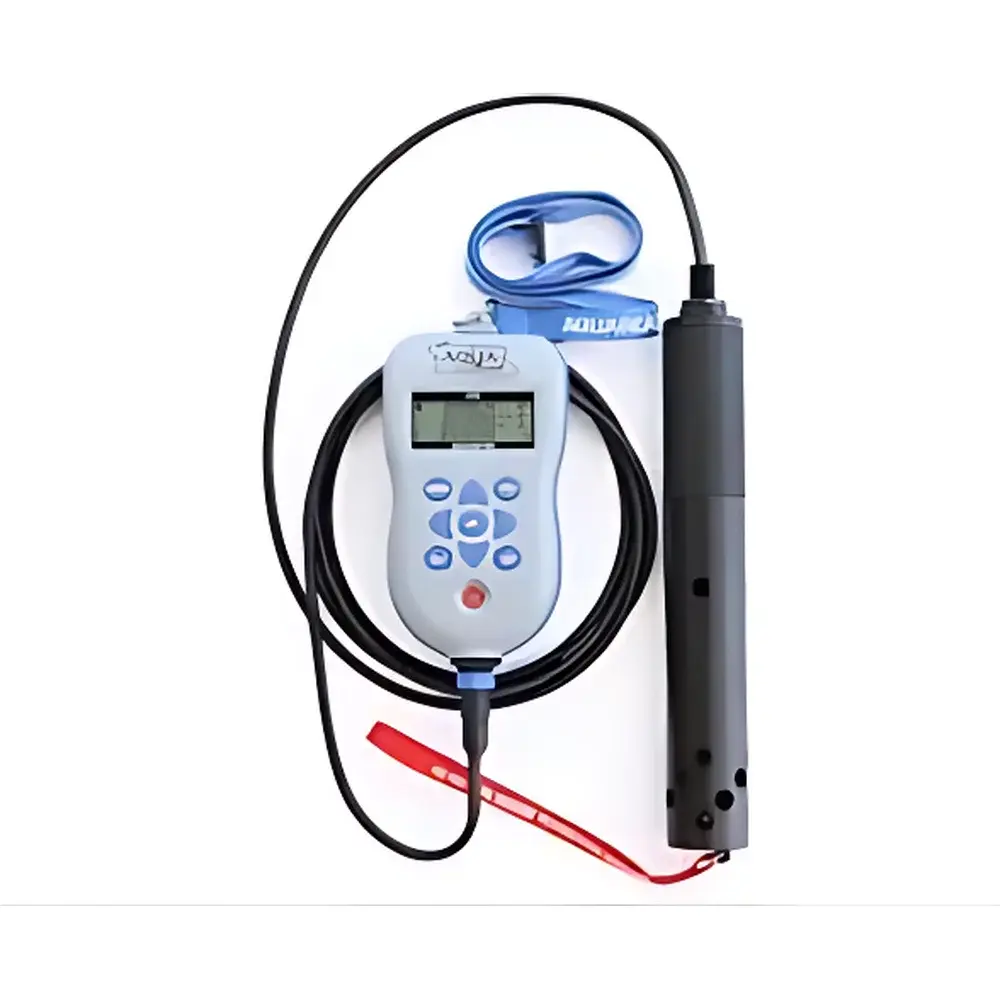
AQUAREAD AP-LITE Portable Chlorophyll a Fluorometer
| Brand | AQUAREAD |
|---|---|
| Origin | United Kingdom |
| Manufacturer Type | Authorized Distributor |
| Origin Category | Imported |
| Model | AP-LITE |
| Application | Field-deployable chlorophyll a quantification in freshwater and marine environments |
| Sensor Compatibility | Interchangeable optical modules (turbidity, phycocyanin, phycoerythrin, rhodamine WT, hydrocarbon fluorescence) |
| Readout Unit | Aquameter Data Logger |
| Chlorophyll a Range | 0–500 µg/L |
| Resolution | 0.1 µg/L |
| Repeatability | ±2% of reading |
| Sensor Housing Diameter | 24 mm |
| Sensor Housing Length | 250 mm |
| Aquameter Dimensions (W×H×D) | 90 × 180 × 39 mm |
| Aquameter Weight (with batteries) | 450 g |
| Display | Backlit 80-character LCD |
| Memory Capacity | 1900 data points |
| GPS | Integrated 12-channel receiver, positional accuracy ±10 m |
| Barometric Pressure Range | 150–1150 mbar, accuracy ±1 mbar |
| Power Supply | 5 × AA alkaline or Ni-MH rechargeable batteries |
| Operating Temperature | −20 to +70 °C |
| Ingress Protection | IP67 |
Overview
The AQUAREAD AP-LITE Portable Chlorophyll a Fluorometer is an integrated, field-ready optical instrument engineered for rapid, in-situ quantification of chlorophyll a concentration in natural and engineered aquatic systems. It operates on the principle of in vivo chlorophyll fluorescence excitation and emission detection, utilizing a calibrated blue LED (typically ~470 nm) to excite photosynthetic pigments in live phytoplankton cells, followed by measurement of emitted red fluorescence (~685 nm). This method enables real-time, non-destructive estimation of algal biomass without sample preservation or extraction—critical for time-sensitive ecological monitoring, bloom early-warning systems, and regulatory compliance assessments. The system comprises three modular components: the Aquameter handheld data logger, the AP-LITE sensor housing, and the LITE-CPHYLL optical sensor head. Its compact form factor, IP67-rated enclosure, and battery-powered operation make it suitable for deployment from shorelines, small vessels, buoys, or autonomous platforms.
Key Features
- Modular sensor architecture: The AP-LITE sensor housing accepts interchangeable optical sensor cartridges—including turbidity (nephelometric), freshwater cyanobacteria (phycocyanin), marine cyanobacteria (phycoerythrin), rhodamine WT tracer, and hydrocarbon fluorescence—enabling multi-parameter water quality profiling with a single platform.
- High-fidelity fluorometric detection: Optimized optical path geometry and temperature-compensated photodiode electronics ensure stable signal-to-noise ratio across variable ambient light and thermal conditions.
- Integrated GPS logging: Each chlorophyll a measurement is geotagged with 12-channel GNSS positioning (±10 m horizontal accuracy), supporting spatial mapping of phytoplankton distribution in GIS workflows.
- Ruggedized field design: Aquameter unit features IP67 ingress protection, −20 to +70 °C operational range, and shock-resistant casing—validated for use in estuarine, lacustrine, and coastal environments.
- On-device data management: Stores up to 1900 timestamped, location-stamped readings internally; export via USB-C or Bluetooth to compatible desktop software (AQUAlogger v5.x).
Sample Compatibility & Compliance
The AP-LITE is validated for direct immersion measurements in freshwater, brackish, and marine matrices with salinity up to 35 PSU. It complies with ASTM D7777–22 (“Standard Practice for Determination of Chlorophyll a in Water by In Vivo Fluorometry”) and supports alignment with ISO 10260:2021 (Water quality — Guidance on fluorometric determination of chlorophyll a). While not a primary reference method per USP General Chapter <1058>, its performance characteristics meet field-screening requirements under EPA Method 445.0 (Fluorometric Determination of Chlorophyll a) when used within specified calibration traceability protocols. All firmware and data handling routines are structured to support GLP-aligned audit trails, including user ID tagging, calibration history logging, and tamper-evident timestamping.
Software & Data Management
Data collected by the Aquameter is transferred via AQUAlogger desktop software (Windows/macOS), which provides calibration curve management (linear, quadratic, or user-defined), batch export to CSV/Excel, GIS-compatible KML generation, and QA/QC flagging (e.g., saturation alerts, low-signal warnings). The software enforces 21 CFR Part 11-compliant electronic signature options for regulated reporting. Firmware updates are delivered through signed binary packages with SHA-256 verification. No cloud dependency is required—data remains under full user control at all stages.
Applications
- Real-time assessment of phytoplankton dynamics during harmful algal bloom (HAB) events
- Long-term trophic status monitoring in lakes, reservoirs, and wetlands
- Validation of satellite-derived chlorophyll a products (e.g., Sentinel-3 OLCI, Landsat 9 OLI-2)
- Effluent discharge compliance screening at wastewater treatment plant outfalls
- Ecological baseline studies in protected marine areas and UNESCO biosphere reserves
- Integration into autonomous surface vehicles (ASVs) and fixed-platform observatories
FAQ
Is the AP-LITE suitable for measuring chlorophyll a in highly turbid or colored waters?
Yes—its dual-wavelength compensation algorithm mitigates interference from suspended solids and CDOM absorption, though validation against acetone-extraction HPLC is recommended for waters exceeding 100 NTU turbidity.
Can the LITE-CPHYLL sensor be recalibrated in the field?
No—calibration is performed at the factory using NIST-traceable chlorophyll a standards; users perform zero-point verification with deionized water prior to each deployment.
Does the system support external power or continuous logging?
The Aquameter operates exclusively on internal AA batteries (up to 100 hours typical use); continuous logging requires external power via optional USB-C adapter with regulated 5 V DC input.
How is sensor fouling addressed during extended deployments?
The AP-LITE housing incorporates a smooth, chemically inert PEEK polymer surface and optional wiper accessory (LITE-WIPE) for manual cleaning; anti-fouling coatings are not integrated but may be applied post-purchase per manufacturer guidelines.
Is raw fluorescence intensity data accessible for custom algorithm development?
Yes—AQUAlogger exports unprocessed analog counts alongside calculated chlorophyll a values, enabling advanced spectral modeling and machine learning integration.
Related Products







