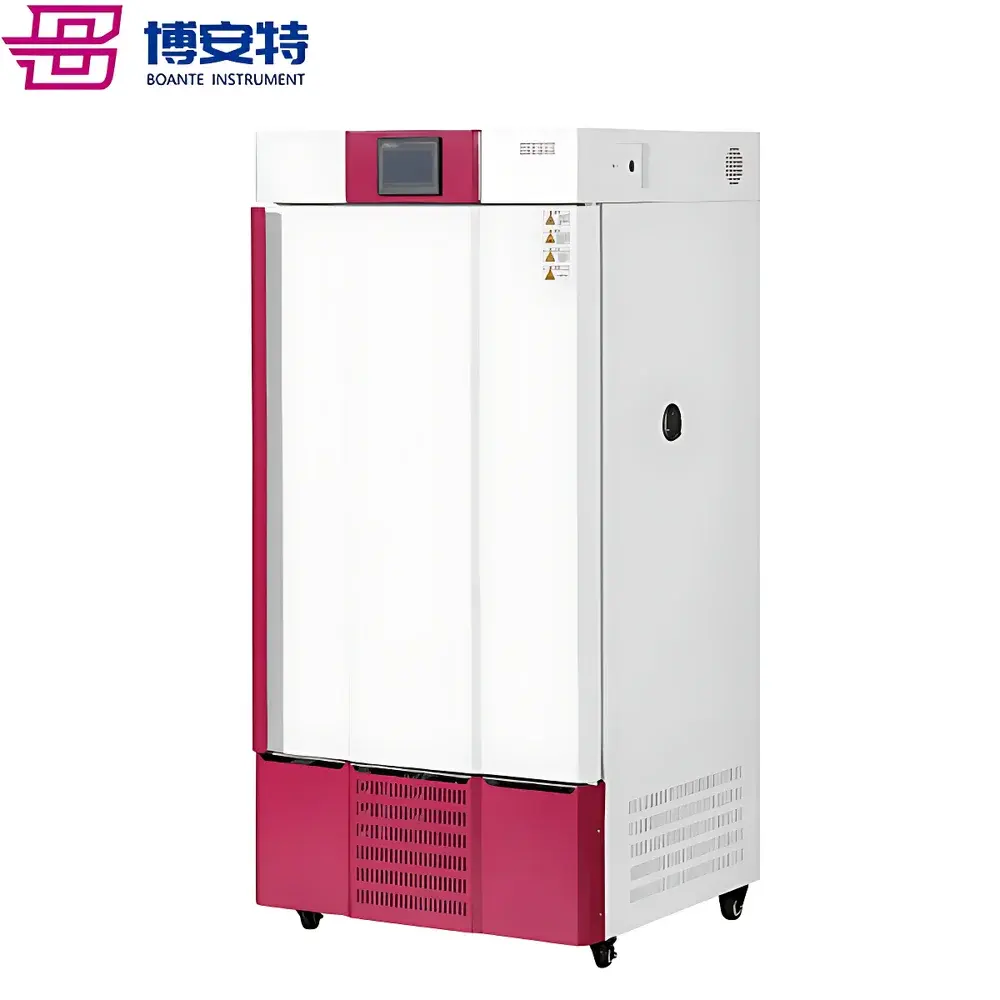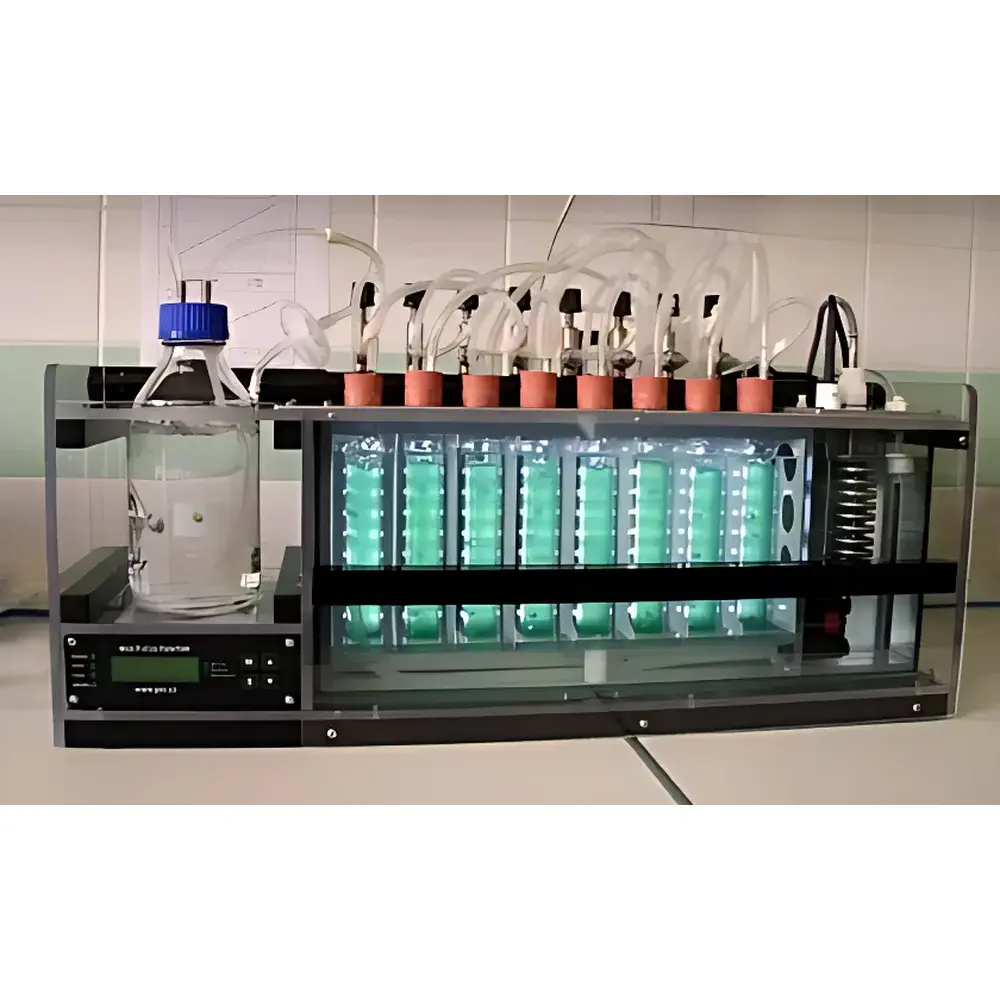
PSI MC1000 8-Channel Algal Cultivation and Online Monitoring System
| Brand | PSI / Photon Systems Instruments |
|---|---|
| Origin | Czech Republic |
| Model | MC1000 |
| Temperature Range | 10–60 °C |
| Temperature Uniformity | ±0.5 °C |
| Humidity Range | 20–95% RH |
| Total Culture Volume Capacity | 5 L |
| Channel Count | 8 |
| Vessel Volume per Channel | 100 mL (85 mL working volume) |
| Optical Monitoring | OD₆₈₀ & OD₇₂₀ (standard), Dissolved Oxygen (optional), Chlorophyll Fluorescence (optional module), O₂/CO₂ Gas Exchange (optional) |
Overview
The PSI MC1000 is an engineered platform for high-precision, multi-parameter algal physiology studies under controlled environmental conditions. Built upon a modular architecture, it integrates eight independent cultivation channels—each housing a 100 mL borosilicate tube with 85 mL working volume—within a thermally stabilized water-bath incubation chamber. The system operates on the principle of real-time, non-invasive optical densitometry (OD₆₈₀ and OD₇₂₀) to quantify biomass accumulation, while optional dissolved oxygen (DO) and chlorophyll fluorescence modules enable concurrent assessment of photosynthetic efficiency, respiratory activity, and electron transport kinetics. Its design conforms to standard laboratory practices for reproducible microalgal culture, supporting both static and dynamic light–temperature–gas regimes aligned with OECD 201, ASTM D5664, and ISO 8692 protocols for aquatic toxicity and ecophysiological testing.
Key Features
- Eight parallel cultivation channels with individual LED illumination control—enabling programmable spectral composition, intensity (0–100% dimming), photoperiod (e.g., 12:12 LD cycles), and ramping profiles.
- Integrated water-jacketed temperature regulation (10–60 °C) with ±0.5 °C uniformity across all channels, verified by internal PT100 sensors and logged at 1-min intervals.
- Humidity-controlled environment (20–95% RH) maintained via integrated humidification/dehumidification subsystem, critical for long-term cultures prone to evaporation-induced salinity drift.
- Optical density monitoring at two wavelengths (OD₆₈₀ for chlorophyll-a absorption; OD₇₂₀ for baseline scattering correction), sampled every 1–60 minutes and stored with timestamped metadata.
- Manual gas-flow mixing via calibrated needle valves—providing consistent suspension without shear stress or foam generation typical of magnetic stirrers.
- Expandable sensor architecture: Optional DO probes (Clark-type or optical), CO₂/O₂ dual-gas analyzers, and the MC-FM fluorometer module for Pulse-Amplitude Modulated (PAM) fluorescence measurements (Fv/Fm, ΦPSII, NPQ).
Sample Compatibility & Compliance
The MC1000 accommodates standard 100 mL culture tubes (e.g., Schott Duran, Pyrex) and supports freshwater, marine, and hypersaline strains—including Chlamydomonas reinhardtii, Dunaliella tertiolecta, Phaeodactylum tricornutum, and cyanobacteria such as Synechocystis sp. PCC 6803. All optical and electronic components comply with IEC 61000-6-3 (EMC emission standards) and IEC 61010-1 (safety requirements for lab equipment). Data acquisition meets ALCOA+ principles (Attributable, Legible, Contemporaneous, Original, Accurate, Complete, Consistent, Enduring, Available) and supports audit trails required under GLP-compliant workflows. When configured with secure user authentication and electronic signatures, the system aligns with FDA 21 CFR Part 11 expectations for regulated environments.
Software & Data Management
The MC1000 is operated via PSI’s proprietary AlgaWatch software (Windows-based, v5.2+), which provides synchronized control of temperature, lighting, gas flow, and data acquisition. Experimental protocols are defined using a graphical timeline editor, allowing nested loops, conditional triggers (e.g., “initiate DO measurement when OD₆₈₀ > 0.8”), and inter-channel parameter coupling. All raw sensor outputs—including OD, temperature, humidity, and optional gas/fluorescence signals—are saved in HDF5 format with embedded calibration coefficients and unit metadata. Export options include CSV (for Excel/Python analysis), MATLAB .mat, and direct integration with LabArchives ELN or Benchling via REST API. Software logs include operator ID, session start/stop timestamps, configuration snapshots, and hardware error codes—ensuring full traceability for peer-reviewed publication or regulatory submission.
Applications
- Multi-channel comparative studies: Simultaneous exposure of identical algal cultures to gradient light spectra (e.g., PAR distribution across 405–730 nm), temperature ramps, or nutrient limitation regimes.
- Photosynthetic phenotyping: Quantification of light-use efficiency, photoinhibition thresholds, and recovery kinetics under fluctuating irradiance—supporting functional genomics and mutant screening.
- Aquatic ecotoxicology: Standardized OECD 201 acute toxicity assays with real-time growth inhibition endpoints derived from OD kinetics rather than endpoint cell counts.
- Cultivation optimization: Empirical determination of optimal light quality/intensity combinations for lipid accumulation (Nannochloropsis) or astaxanthin production (Haematococcus).
- Carbon-concentrating mechanism (CCM) research: Paired O₂ evolution and CO₂ uptake measurements to resolve stoichiometric imbalances during CCM induction under low-CO₂ conditions.
FAQ
What light spectra configurations are available for the MC1000?
The system offers four optical variants: MC1000-OD (cool white LEDs), MC1000-OD-WW (warm white LEDs), MC1000-OD-MULTI (eight discrete monochromatic channels: 405, 450, 470, 3000K warm white, 540, 590, 640, and 730 nm), and MC1000-OD-MIX (user-customizable per-channel LED arrays selecting from the same eight wavelengths).
Can the system operate unattended for extended periods?
Yes—continuous operation up to 30 days is supported with stable power, uninterrupted network connectivity, and adequate media volume. Internal battery-backed real-time clock ensures time-synchronized logging even during brief outages.
Is remote monitoring possible?
AlgaWatch supports VNC-based remote desktop access and provides a lightweight web dashboard (HTTP/HTTPS) showing live OD curves, temperature/humidity trends, and alarm status—accessible via institutional VPN or authenticated cloud relay.
How is calibration performed for OD and DO sensors?
OD channels are factory-calibrated against NIST-traceable neutral density filters; users may perform verification using standardized suspensions (e.g., polystyrene microspheres). DO probes require two-point calibration (0% and 100% air saturation) prior to each experimental series, with automatic temperature and salinity compensation applied in software.
Does the system support third-party data analysis tools?
Yes—HDF5 output files contain structured metadata compliant with the HDF Group’s H5PY conventions and can be directly loaded into Python (via h5py/pandas), R (rhdf5), MATLAB, or Igor Pro without proprietary converters.
Related Products