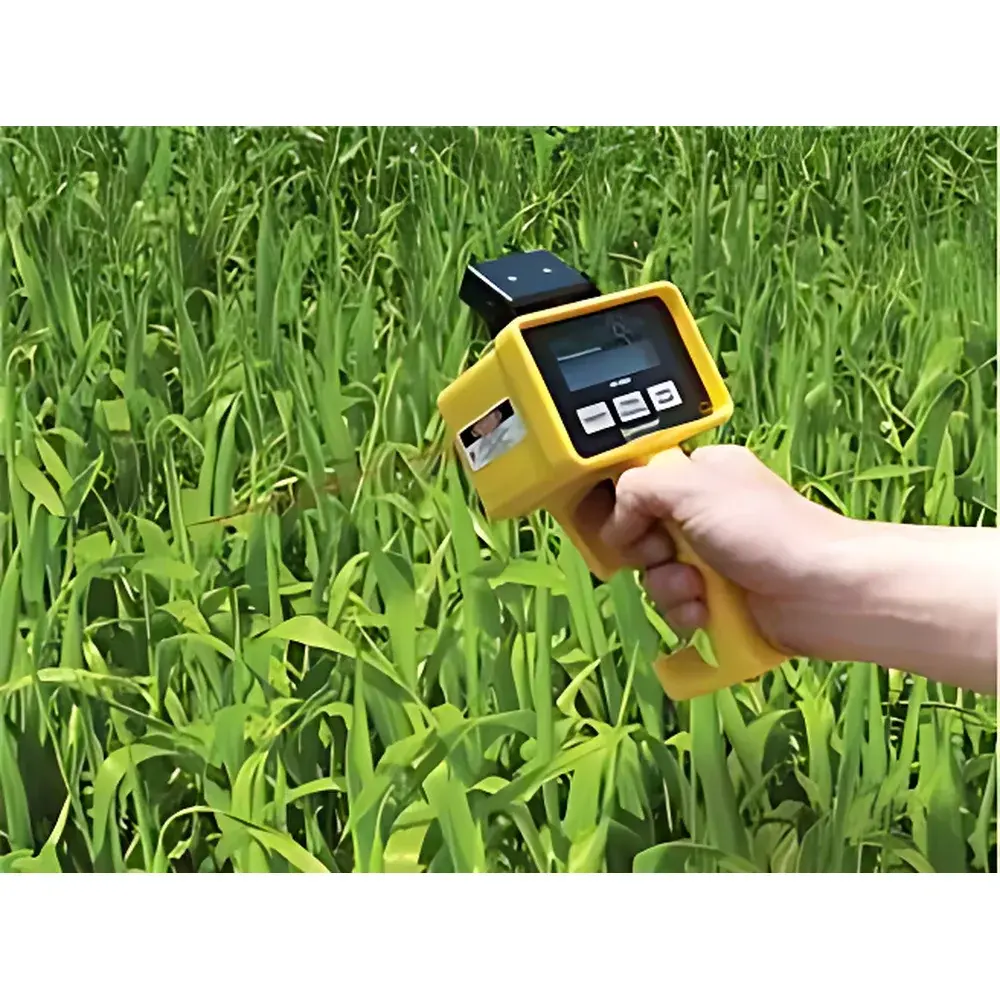
NDVI Vegetation Index Meter – CM1000 Model
| Origin | USA |
|---|---|
| Manufacturer Type | Authorized Distributor |
| Origin Category | Imported |
| Model | CM1000 |
| Price | USD 7,200 (approx.) |
| Measurement Principle | Dual-Wavelength Reflectance (660 nm & 840 nm) |
| Field of View | Conical, 12–72 in diameter |
| Minimum Working Distance | 30.5 cm |
| Maximum Working Distance | >72 in |
| Sensor | Four Photodiode Array |
| Output Unit | NDVI (0.00–1.00, dimensionless) |
| Measurement Interval | 2 s |
| Accuracy | ±0.05 NDVI units |
| Power Supply | Two AAA alkaline batteries (~3,000 measurements per set) |
Overview
The CM1000 NDVI Vegetation Index Meter is a handheld, field-deployable optical sensor engineered for rapid, non-destructive assessment of plant canopy vigor and nitrogen status through the normalized difference vegetation index (NDVI). Based on the fundamental biophysical principle that healthy green vegetation strongly absorbs red light (~660 nm) while highly reflecting near-infrared radiation (~840 nm), the CM1000 quantifies spectral reflectance contrast between these two bands to compute NDVI = (NIR − Red) / (NIR + Red). This dimensionless index—ranging from −1.0 to +1.0, though practically constrained to 0.00–1.00 for terrestrial vegetation—serves as a robust proxy for leaf chlorophyll concentration, photosynthetic capacity, canopy density, and nitrogen assimilation efficiency. Unlike destructive tissue analysis or laboratory-based spectrophotometry, the CM1000 delivers real-time, in situ NDVI values with minimal operator training, enabling high-frequency monitoring across heterogeneous agricultural plots, greenhouse trials, or ecological transects.
Key Features
- Optimized dual-band optical architecture with narrowband interference filters centered at 660 nm (red) and 840 nm (near-infrared), ensuring spectral fidelity compliant with standard NDVI calculation protocols.
- Conical field-of-view design (12–72 inch diameter at working distance) allows flexible sampling of individual leaves, small canopies, or aggregated crop stands without requiring precise positioning.
- Four photodiode sensing elements provide balanced signal acquisition and inherent noise reduction via differential readout, supporting stable performance under variable ambient lighting conditions.
- Calibration-traceable optical path with factory-set gain and offset parameters; no user recalibration required during routine operation.
- Low-power embedded electronics powered by two standard AAA alkaline cells, delivering approximately 3,000 discrete measurements per battery set—ideal for multi-day field campaigns without charging infrastructure.
- Ruggedized polycarbonate housing rated IP54 for dust resistance and limited water splashing, suitable for outdoor use in humid, dusty, or temperature-variable environments (operating range: 0–45 °C).
Sample Compatibility & Compliance
The CM1000 is validated for direct measurement on intact, unshaded plant tissues including broadleaf and grass species, young seedlings, mature cereal canopies, turfgrass stands, and horticultural crops. It is not intended for submerged, senesced, or heavily soiled foliage where spectral signatures deviate significantly from healthy green biomass assumptions. While the device itself does not carry formal regulatory certification (e.g., FDA, CE), its optical methodology aligns with established remote sensing standards referenced in ISO 11727:2019 (optical methods for plant health assessment) and supports data collection workflows compatible with USDA-NRCS crop monitoring guidelines and FAO’s CropWatch framework. Raw NDVI outputs are traceable to NIST-traceable spectral irradiance references used during manufacturing calibration.
Software & Data Management
The CM1000 operates as a standalone instrument with onboard numeric display and immediate NDVI readout. No proprietary software, Bluetooth, or USB interface is integrated; all data logging is manual via field notebook or external spreadsheet entry. However, exported NDVI values are fully interoperable with common agronomic platforms—including AgLeader SMS, FarmWorks, and open-source tools like R (‘raster’ and ‘spatstat’ packages) or Python (‘scikit-image’, ‘xarray’)—for spatial interpolation, time-series trend analysis, or integration with variable-rate application (VRA) prescription maps. For GLP/GMP-aligned research applications, users may implement standardized operating procedures (SOPs) documenting measurement height, solar zenith angle, and target geometry to ensure data reproducibility and audit readiness.
Applications
- Nitrogen status monitoring in cereal crops (wheat, maize, rice) to inform side-dress fertilizer timing and dosage optimization.
- Early detection of abiotic stress (drought, heat, salinity) prior to visible symptom onset, supporting irrigation scheduling decisions.
- Phenotyping trials in breeding programs assessing genetic variation in canopy development and photosynthetic efficiency.
- Validation of satellite- or drone-derived NDVI products at ground truth level for calibration and uncertainty quantification.
- Ecological studies evaluating seasonal dynamics of grassland productivity, forest understory light capture, or invasive species spread.
- Educational use in plant physiology, agronomy, and environmental science curricula for hands-on spectral ecology instruction.
FAQ
What does NDVI measure, and why is it relevant to nitrogen management?
NDVI quantifies the relative difference in reflectance between red and near-infrared wavelengths—a proxy strongly correlated with chlorophyll content and leaf area index. Since nitrogen is a primary constituent of chlorophyll and Rubisco, NDVI trends reliably indicate nitrogen sufficiency or deficiency in actively growing vegetation.
Can the CM1000 be used under cloudy conditions?
Yes. Its active optical design minimizes dependence on direct solar illumination; however, rapidly changing diffuse light (e.g., passing clouds) may introduce minor short-term variability. Consistent measurement timing (e.g., local solar noon ± 2 hours) is recommended for longitudinal studies.
Is calibration required before each use?
No. The CM1000 is factory-calibrated using reference panels with known spectral reflectance properties. Users should verify baseline stability annually using a neutral gray reference tile (provided optionally) if operating in extreme thermal or mechanical environments.
Does the device store measurements internally?
No. The CM1000 provides real-time display only. Users must record values manually or integrate with external data loggers via custom mounting solutions.
How does measurement distance affect accuracy?
Within the specified 30.5 cm to >72 inch range, the conical FOV ensures consistent spatial averaging. At distances beyond 72 inches, signal-to-noise ratio decreases; for quantitative comparisons, maintain consistent height (e.g., 60 cm above canopy) across all measurements.