
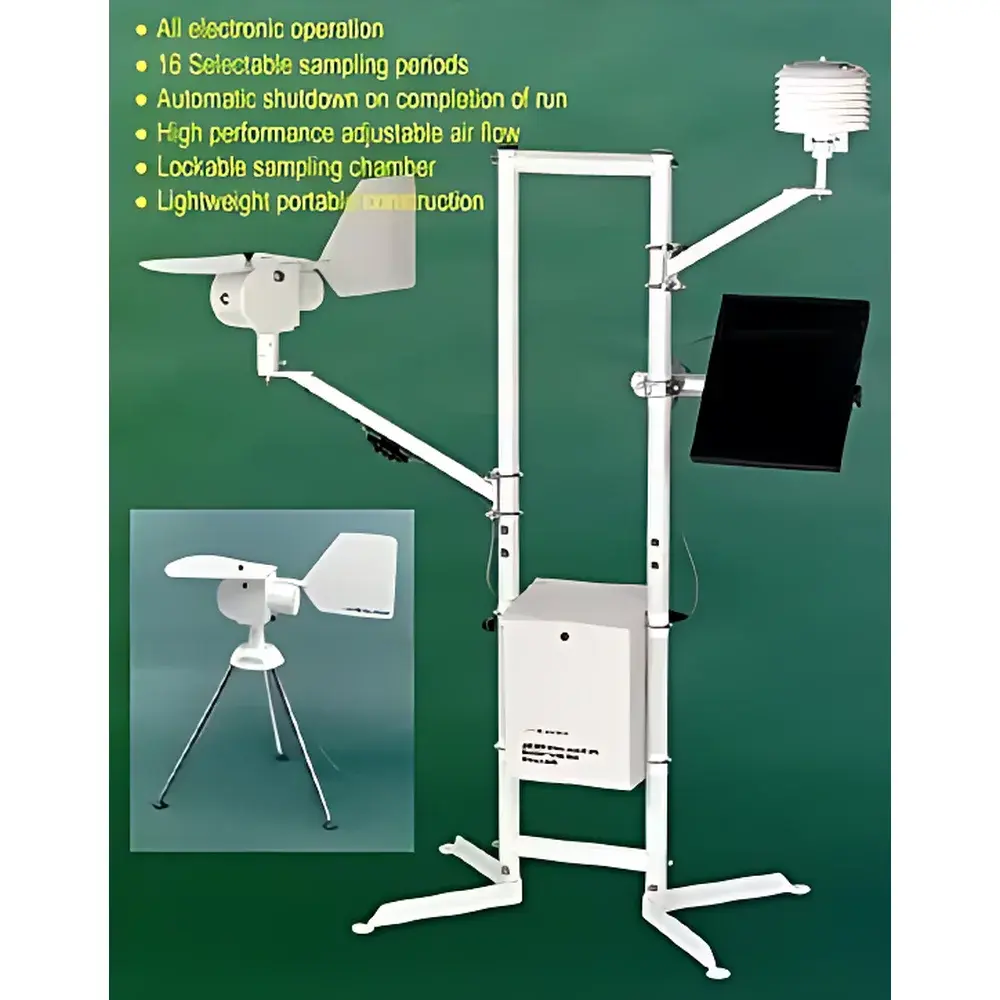
Burkard SPOREWATCH Electronic Spore and Pollen Sampler
| Brand | Burkard |
|---|---|
| Origin | United Kingdom |
| Model | SPOREWATCH |
| Sampling Duration Options | 1, 3, 6, 9, 12, 15, 18, 21, 24 hours |
| Drum Translation Rate | 2 mm/h (over 7-day cycle) |
| Airflow Rate | 10 L/min (nominal) |
| Orifice Dimensions | 2 mm × 14 mm |
| Sampling Tape Width | 200 mm (standard) |
| Effective Sampling Area | 0.882 m² (radius: 53 cm) |
| Power Supply | 12 V DC (AC adapter, rechargeable battery, or solar panel compatible) |
| Net Weight | 3.5 kg |
| Dimensions (L×W×H) | 240 × 100 × 550 mm |
| Enclosure | Lockable control housing and sample chamber |
| Mounting Options | Tripod, wall bracket, or mast-mounted configurations |
| Environmental Monitoring Integration | Optional temperature and relative humidity logging module |
Overview
The Burkard SPOREWATCH Electronic Spore and Pollen Sampler is a precision-engineered, field-deployable volumetric air sampler designed for continuous, quantitative monitoring of airborne biological particulates—including pollen grains, fungal spores, and microbial propagules—in atmospheric biology, environmental health, and aerobiological surveillance applications. Based on the internationally standardized Hirst-type sampling principle—where ambient air is drawn through a calibrated rectangular orifice onto a continuously moving adhesive tape—the SPOREWATCH maintains strict fidelity to ISO 21501-4 and EN 16882 guidance for bioaerosol collection geometry and flow dynamics. Unlike mechanical clock-driven predecessors, its fully electronic architecture enables precise temporal resolution, programmable multi-cycle operation, and long-term unattended deployment under variable climatic conditions. The instrument operates at a nominal volumetric flow rate of 10 L/min, ensuring compatibility with established Hirst-based quantification protocols and enabling direct comparison with decades of historical aerobiological datasets.
Key Features
- Fully electronic control system with 16 user-selectable sampling durations—from 1 hour to 7 days—eliminating mechanical timing drift and enabling granular experimental design.
- Microprocessor-regulated brushless DC motor driving the sampling drum at a stable 2 mm/h translation rate, delivering consistent tape advancement across full 7-day cycles without manual intervention.
- Adjustable airflow calibration capability via integrated flow sensor feedback loop, supporting validation against traceable flow standards per ISO/IEC 17025-accredited procedures.
- Triple-power architecture: supports 12 V DC input from AC mains adapters, sealed-lead-acid or LiFePO₄ batteries, and photovoltaic panels—ideal for remote or off-grid monitoring stations.
- Lockable, weather-resistant enclosure for both control electronics and the 200-mm-wide sampling tape cassette, ensuring sample integrity and operator safety in public or sensitive locations.
- Modular mounting interface compatible with standard photographic tripods (¼″-20 thread), stainless-steel wall brackets, and mast-mounting kits—facilitating rapid repositioning or permanent installation.
- Optional integrated environmental logger records ambient temperature and relative humidity synchronously with sampling events, supporting correlation analysis per EPA OAQPS and WHO air quality guidelines.
Sample Compatibility & Compliance
The SPOREWATCH collects intact, morphologically preserved bioaerosols on standard glycerin-coated or silicone-adhesive tapes—compatible with light microscopy, scanning electron microscopy (SEM), and PCR-based molecular identification workflows. Its orifice geometry (2 mm × 14 mm), effective sampling area (0.882 m²), and laminar flow profile comply with the physical specifications defined in the original Hirst methodology (Hirst, 1952) and are referenced in EU Directive 2008/50/EC Annex XII for allergenic pollen monitoring networks. The device meets IP54 ingress protection rating for outdoor use and is routinely deployed in GLP-compliant national aerobiological networks across Europe, North America, and Oceania. All firmware and data handling modules are designed to support audit-ready metadata tagging, including UTC timestamps, operator ID, location coordinates (via optional GPS integration), and calibration history logs.
Software & Data Management
Data export is supported via USB-C interface to Windows/macOS platforms using Burkard’s validated Aerobiology Data Manager (ADM) software v3.2+, which complies with FDA 21 CFR Part 11 requirements for electronic records and signatures when configured with role-based access controls and audit trail activation. ADM enables batch annotation, tape image stitching, particle classification templates (e.g., Poaceae, Alternaria, Cladosporium), and automated reporting aligned with EAN (European Aeroallergen Network) and NAB (National Allergy Bureau) submission formats. Raw timestamped event logs—including power source status, motor duty cycle, and environmental sensor readings—are stored in CSV and SQLite formats for third-party statistical analysis (R, Python, SAS).
Applications
- Public health early-warning systems for seasonal allergen forecasting (e.g., grass, birch, ragweed pollen peaks).
- Phytosanitary surveillance of plant-pathogenic fungi (e.g., Puccinia, Venturia, Botrytis) in agricultural zones and protected horticulture.
- Indoor air quality assessment in hospitals, pharmaceutical cleanrooms, and biotechnology facilities per ISO 14644-1 Class 5–8 classifications.
- Climate change impact studies correlating spore/pollen phenology shifts with long-term meteorological datasets.
- Validation of numerical dispersion models (e.g., HYSPLIT, SILAM) through ground-truth bioaerosol concentration time series.
- Regulatory compliance monitoring for occupational exposure limits (OELs) to fungal bioaerosols in composting, wastewater, and grain-handling facilities.
FAQ
Is the SPOREWATCH compatible with existing Hirst tape analysis protocols?
Yes—its orifice dimensions, airflow rate, and tape speed are identical to legacy Hirst samplers, ensuring full backward compatibility with published identification keys, counting grids, and reporting conventions.
Can the device operate autonomously for extended periods without maintenance?
Yes—configured with a 12 Ah deep-cycle battery and 20 W solar panel, it sustains uninterrupted 7-day sampling cycles in temperate climates with >3 h daily insolation.
Does the unit meet regulatory requirements for clinical or pharmaceutical environmental monitoring?
When deployed with validated tape substrates and calibrated flow verification, it satisfies ISO 14698-1:2003 and EU GMP Annex 1 (2022) recommendations for viable particle sampling in controlled environments.
How is calibration traceability maintained?
Each unit ships with a NIST-traceable flow calibration certificate; annual recalibration is recommended using a primary-standard dry calibrator (e.g., Bioscience DCM-100) per ISO/IEC 17025 laboratory practice.
Is GPS positioning integrated into the standard configuration?
GPS is available as an optional add-on module with automatic geotagging of all sampling events in ADM software export files.



