
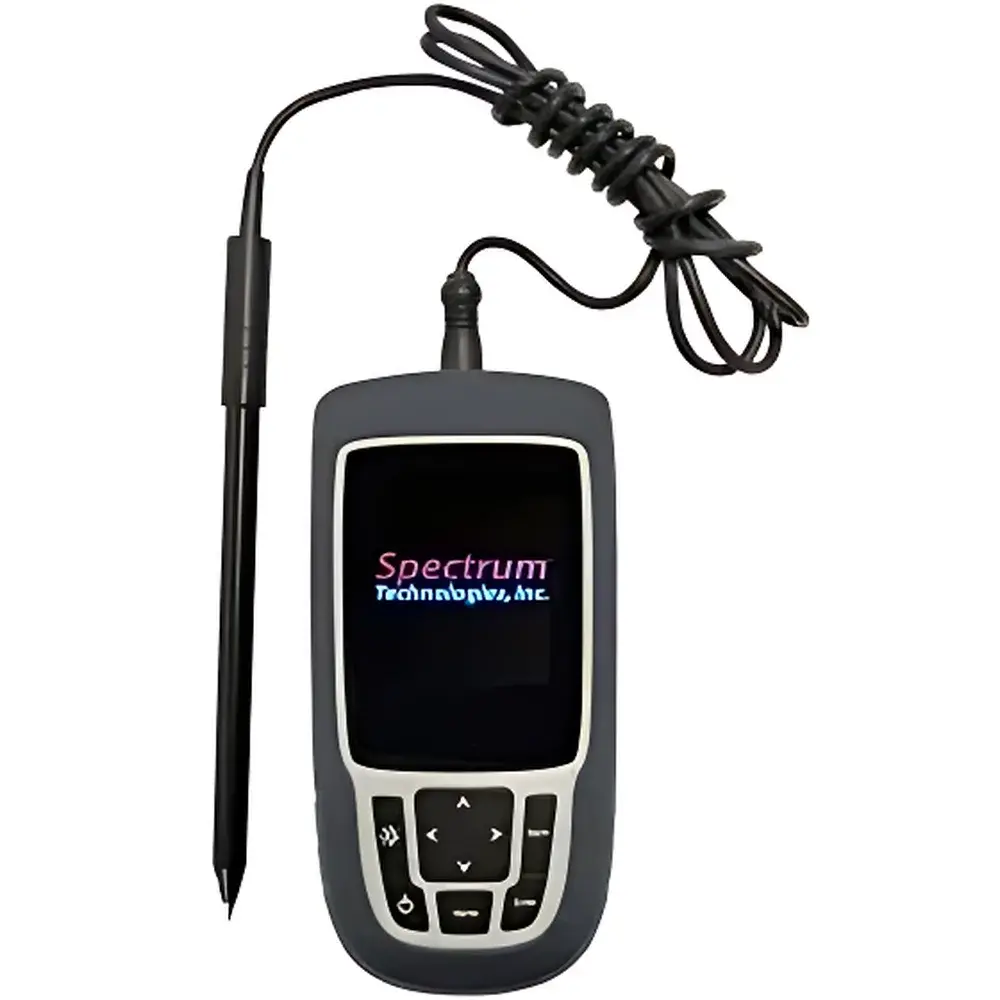
Spectrum Technologies FieldScout pH-400 Soil Acidity Meter
| Brand | Spectrum Technologies |
|---|---|
| Model | pH-400 |
| Origin | USA |
| IP Rating | IP65 |
| Display | 3.2" color backlit LCD |
| Calibration | 1-point and 2-point auto-guided calibration |
| Power | 3 × rechargeable AA batteries (AC adapter included) |
| Warranty | 1 year |
| Enclosure | rubber-gasketed battery compartment and sealed USB port |
| Compliance | Designed for field-deployable environmental monitoring per ASTM D2796 and ISO 10390 guidelines |
Overview
The Spectrum Technologies FieldScout pH-400 Soil Acidity Meter is a portable, field-ready instrument engineered for rapid, reliable measurement of soil pH in situ. Unlike conventional glass-electrode pH meters, the pH-400 employs patented ISFET (Ion-Sensitive Field-Effect Transistor) sensor technology — a solid-state, non-glass sensing platform offering superior mechanical robustness, faster response time, and immunity to breakage or electrolyte leakage. This architecture eliminates the need for liquid-filled reference junctions and reduces drift during extended field use. The device operates on the principle of potentiometric ion detection, where hydrogen ion activity at the ISFET gate surface modulates channel conductivity, enabling direct voltage-to-pH conversion with temperature compensation integrated via an onboard NTC thermistor. Designed specifically for environmental soil assessment, the pH-400 delivers consistent accuracy across variable moisture content, texture, and organic matter composition — critical for agronomic decision-making, ecological site evaluation, and regulatory soil health reporting.
Key Features
- ISFET-based solid-state pH sensor: No fragile glass bulb, no refilling, no clogging — optimized for repeated insertion into heterogeneous soil matrices
- IP65-rated enclosure: Dust-tight and protected against low-pressure water jets; rubber-gasketed battery compartment and hermetically sealed USB port ensure operational integrity in humid, muddy, or dusty field conditions
- Intuitive user interface: Modern menu navigation with real-time dual-display of pH and temperature values — no interruption of live measurement during parameter adjustment
- Smart calibration wizard: Step-by-step on-screen prompts guide users through 1-point or 2-point calibration using standard pH 4.01 and 7.00 buffers; calibration status and slope diagnostics are logged automatically
- High-visibility display: 3.2-inch color backlit LCD with adjustable contrast supports legible readings under full sunlight or twilight conditions
- Field-optimized ergonomics: Compact, lightweight chassis (≤320 g) with textured grip enables one-handed operation during prolonged sampling campaigns
- Power flexibility: Operates on three rechargeable AA batteries (included); AC adapter provided for benchtop charging and continuous lab use
Sample Compatibility & Compliance
The pH-400 is validated for direct insertion into moist, well-aerated soils with minimal pre-treatment — eliminating the need for slurry preparation in most routine applications. It performs reliably across USDA textural classes (sand to clay loam), organic soils (up to 20% OM), and moderately saline substrates (EC ≤4 dS/m). While not intended for saturated paste extracts per ASTM D4373, it conforms to ASTM D2796 (Standard Test Method for pH of Soils) for field screening and ISO 10390:2022 (Soil quality — Determination of pH) for preliminary assessment. The instrument meets CE marking requirements for electromagnetic compatibility (EMC Directive 2014/30/EU) and RoHS compliance. Data logging and calibration records support GLP-aligned documentation when used within institutional QA/QC protocols.
Software & Data Management
Data export is facilitated via micro-USB interface to Windows/macOS systems using Spectrum’s free FieldScout Connect desktop application. The software enables batch download of timestamped pH/temperature readings, calibration history, and instrument configuration logs. All entries include metadata such as operator ID, GPS coordinates (when paired with optional Bluetooth GNSS receiver), and ambient conditions. Audit trails are retained locally on-device memory (non-volatile EEPROM) and support traceability per FDA 21 CFR Part 11 requirements when deployed in regulated agricultural research or environmental remediation projects. Firmware updates are delivered through the same interface, ensuring long-term interoperability and security maintenance.
Applications
- Agricultural extension services: Rapid pH mapping of crop fields to inform lime amendment strategies and nutrient management planning
- Horticultural nurseries and greenhouse operations: Monitoring substrate acidity in containerized production systems
- Educational laboratories: Teaching soil chemistry principles with hands-on, real-world instrumentation
- Ecological restoration projects: Pre- and post-intervention soil pH tracking across reclamation sites
- Municipal turf management: Routine testing of sports fields, golf courses, and public green spaces
- Environmental consulting: Preliminary site characterization for Phase I ESA or brownfield assessments
FAQ
Does the pH-400 require soil slurry preparation before measurement?
No — the ISFET probe is designed for direct insertion into field-moist soil. For optimal contact, ensure the soil is neither dry nor saturated; ideal moisture corresponds to the “ribbon test” consistency.
Can the pH-400 be used in highly saline or sodic soils?
It provides usable readings up to EC ≈4 dS/m. For soils exceeding this threshold, laboratory analysis using saturated paste extract remains recommended per standard methods.
Is calibration traceable to NIST standards?
Yes — calibration buffers certified to NIST-traceable pH standards (e.g., Traceable® pH 4.01 and 7.00) are compatible and recommended for routine verification.
How often should the sensor be cleaned?
Rinse the ISFET tip with deionized water after each sampling session; avoid abrasive cleaning agents. A soft brush may be used to remove adherent organic debris.
Does the device store calibration data between sessions?
Yes — all calibration parameters, date/time stamps, and electrode slope values are retained in non-volatile memory until manually reset or overwritten.







