
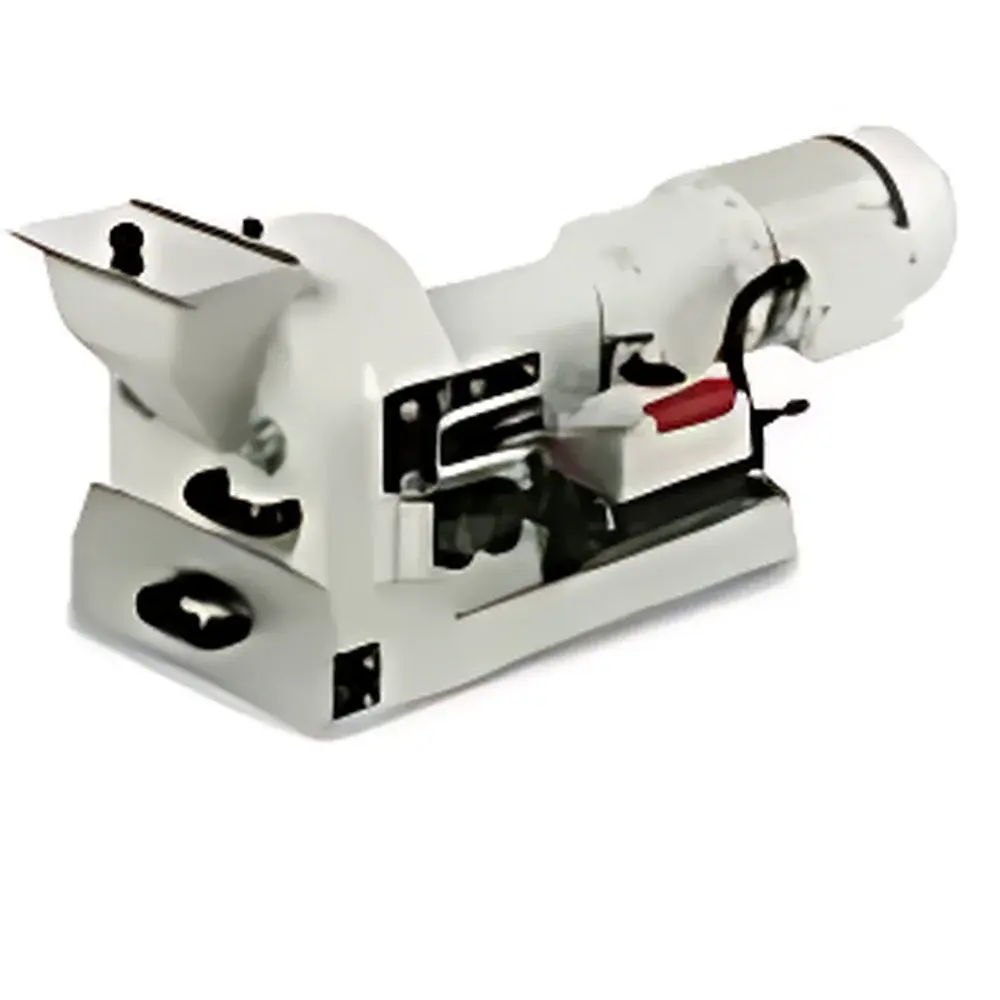
Fritsch PULVERISETTE 13 Disc Mill
| Brand | Fritsch |
|---|---|
| Origin | Germany |
| Model | PULVERISETTE 13 |
| Max. Feed Size | < 20 mm |
| Throughput | up to 150 kg/h |
| Final Particle Size Range | 0.1 – 12 mm (adjustable) |
| Disc Speed | 440 rpm |
| Power Supply | 400 V / 3~ / 50–60 Hz |
| Rated Power | 1830 W |
| Net Weight | 140 kg |
| Dimensions (W × H × D) | 44 × 87 × 40 cm |
| Grinding Disc Materials | Stainless Steel, Manganese Steel, Tungsten Carbide, Zirconia Oxide |
Overview
The Fritsch PULVERISETTE 13 Disc Mill is a high-capacity, precision-engineered laboratory disc mill designed for the controlled size reduction of brittle and extremely hard materials. Operating on the principle of compressive and shear forces generated between two parallel, counter-rotating (or one rotating/one fixed) grinding discs, it delivers consistent particle size distribution through adjustable disc clearance and precisely regulated rotational speed. Unlike impact or planetary mills, the PULVERISETTE 13 employs a deterministic mechanical action—ideal for applications requiring minimal thermal degradation, low contamination risk, and high batch-to-batch reproducibility. Its robust cast-iron housing, precision-machined disc alignment system, and modular drive architecture make it suitable for both routine sample preparation in geochemical laboratories and continuous fine grinding in quality control environments across mining, metallurgy, ceramics, and environmental research.
Key Features
- Adjustable grinding gap mechanism enabling precise, repeatable final particle size control from 0.1 mm to 12 mm—calibrated via micrometer-scale vernier scale with lockable positioning.
- Reversible motor rotation direction to distribute wear evenly across both grinding surfaces, extending disc service life by up to 2× compared to unidirectional operation.
- Four interchangeable grinding disc material options—stainless steel (AISI 304), manganese steel (for abrasive ores), tungsten carbide (for ultra-hard minerals), and zirconia oxide (for contamination-sensitive applications such as trace-element analysis).
- Integrated dust extraction port compliant with ISO 13849-1 safety standards; compatible with standard laboratory vacuum systems or central fume hoods to maintain operator safety and sample integrity during dry grinding.
- Tool-free access to grinding chamber and rapid disc replacement design—cleaning time reduced to under 10 minutes without specialized tools or calibration recalibration.
- Modular coupling interface for direct mechanical integration with the Fritsch PULVERISETTE 1 Jaw Crusher, enabling seamless two-stage comminution workflows—from >20 mm feed down to ≤0.1 mm final product in a single automated process line.
Sample Compatibility & Compliance
The PULVERISETTE 13 is validated for use with inorganic, non-fibrous, and thermally stable samples including coal, quartzite, basalt, limestone, slag, ceramic powders, and metal alloys. It is not intended for soft, elastic, fibrous, or moisture-sensitive materials (e.g., polymers, biological tissues, or hygroscopic salts). The instrument complies with CE marking requirements under EU Machinery Directive 2006/42/EC and Electromagnetic Compatibility Directive 2014/30/EU. Its mechanical design adheres to ISO 12100:2010 (risk assessment principles) and supports GLP-compliant documentation when paired with Fritsch’s optional digital logging module (sold separately), which records timestamped operational parameters—including disc gap setting, runtime, and motor current—for audit-ready traceability.
Software & Data Management
While the base PULVERISETTE 13 operates via manual mechanical controls, Fritsch offers the optional *ComminutionControl™* digital interface kit—a DIN-rail mounted I/O module with RS485 and Ethernet connectivity. This enables remote parameter monitoring (disc speed, load current, temperature at bearing housings), event-triggered data logging, and integration into LIMS or MES platforms via Modbus TCP or OPC UA protocols. All configuration changes are recorded with user ID, timestamp, and checksum-verified metadata—supporting compliance with FDA 21 CFR Part 11 requirements when deployed with validated electronic signature workflows.
Applications
- Geochemical sample preparation for XRF, ICP-OES, and fusion bead analysis—ensuring homogeneity and minimizing mineralogical bias in heterogeneous rock matrices.
- Coal pulverization for ASTM D3174 (ash content), D3175 (volatile matter), and ISO 1171 (determination of ash) testing protocols.
- Pre-grinding of metallurgical slags and ferroalloys prior to leaching or XRD phase identification.
- Production of standardized reference materials (SRMs) in certified reference material laboratories requiring NIST-traceable particle size consistency.
- Raw material homogenization in ceramic and glass R&D labs—particularly for silica sand, feldspar, and kaolin blends prior to sintering trials.
FAQ
What types of materials are unsuitable for processing in the PULVERISETTE 13?
Materials with high elasticity (e.g., rubber, plastics), fibrous structure (e.g., wood chips, plant stems), or elevated moisture content (>5% w/w) may cause clogging, uneven wear, or thermal deformation of discs. These require alternative comminution methods such as cryogenic milling or cutting mills.
Can the PULVERISETTE 13 be used in GMP-regulated pharmaceutical environments?
It is not classified as GMP-compliant out-of-the-box due to lack of built-in cleaning validation features or stainless-steel sanitary construction. However, units configured with zirconia oxide discs and electropolished stainless-steel housings—combined with the ComminutionControl™ module—can be qualified for specific non-sterile API intermediate grinding tasks under client-defined validation protocols.
Is calibration required after changing grinding disc material?
No recalibration is needed for disc replacement alone. The gap adjustment system is independent of disc composition; however, users must verify zero-point alignment using the supplied feeler gauge set before first use of a new disc pair.
How does the PULVERISETTE 13 compare to jaw crushers in terms of size reduction efficiency?
Jaw crushers excel at primary coarse reduction (<20 mm → 1–5 mm); the PULVERISETTE 13 achieves secondary/tertiary fine grinding (1 mm → 0.1 mm) with superior particle shape control and narrower size distribution—making it complementary rather than competitive in multi-stage comminution workflows.



